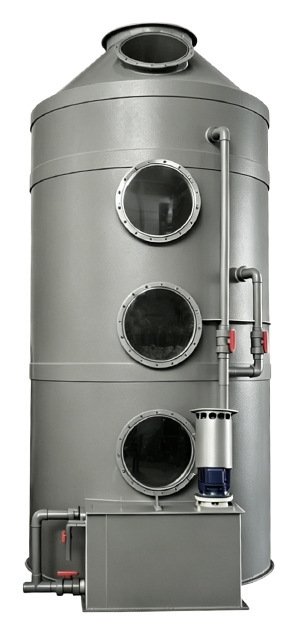
Acid Fume Scrubber
Acid fume scrubbers from MUSI Technology, Changzhou, China, for electroplating, anodizing and pickling lines. Tank hoods, ductwork, packed tower, recirculation, mist eliminator, fan and stack are engineered as one system and matched to the bath chemistry of the line they serve. Merkezi Çin'in Changzhou kentinde bulunan MUSI Technology, bu ekipmanı kendi bünyesinde tasarlayıp üretir ve 36 ülkeye, yerinde kurulum ve operatör eğitimi dahil olmak üzere 800+ boyama hattı teslim etmiştir.
Rim and lip extraction hoods sized to the tank surface and the bath hazard.
Counter-current packed towers in polypropylene, PVC or fibreglass-reinforced plastic.
Water or caustic soda scrubbing with automatic pH dosing and level control.
Mist eliminators for chromic acid and sulphuric acid mist.
Scrubber blowdown routed to the wastewater treatment plant of the line.
Hızlı yanıt: An acid fume scrubber captures acid gas and mist from plating, anodizing and pickling tanks and washes it out of the exhaust air. Rim hoods draw the fumes into plastic ductwork; a fan pulls the air up through a packed tower against a downward flow of water or dilute caustic soda; a mist eliminator removes the remaining droplets. US EPA fact sheets give 95 to 99 percent as the removal efficiency vendors estimate for inorganic gases in packed-bed scrubbers. The spent liquor is bled to the wastewater treatment plant.
What is an acid fume scrubber and which tanks need one?
An acid fume scrubber is a wet scrubber, usually a vertical packed tower, that absorbs soluble acid gases and collects acid mist from process tank exhaust. Tanks that give off acid gas, acid mist or toxic vapour are extracted to one; in China, GB 21900-2008 requires local collection and central treatment of such fumes. Per US EPA AP-42, gassing at the electrodes carries fine mist off the bath, rising with bath strength, temperature and current density.
| Tank or process | What it emits | Typical treatment |
|---|---|---|
| Hydrochloric acid pickling and activation | Hydrogen chloride gas and mist | Packed-bed scrubber with water or dilute caustic soda |
| Sulphuric acid pickling, sulphuric acid anodizing, acid copper | Sulphuric acid mist from gassing and air agitation | Mist eliminator and packed-bed scrubber |
| Nitric acid pickling, bright dipping, stripping | Nitrogen oxides (NOx): NO2 and NO | Packed-bed scrubber; alkaline or reducing stage where NO must also be removed |
| Hydrofluoric acid and fluoride pickles (stainless steel, titanium, aluminium) | Hydrogen fluoride | Alkaline packed-bed scrubber |
| Hexavalent chromium plating and chromic acid anodizing | Chromic acid mist, caused by the low cathode efficiency of the bath | Mist eliminator and packed-bed scrubber, often with a fume suppressant in the bath |
| Cyanide plating and hot alkaline cleaning | Alkaline mist; hydrogen cyanide from cyanide baths | Separate duct and alkaline scrubber; kept away from acid exhaust |
How does a packed-bed acid fume scrubber work?
It works by counter-current absorption: the exhaust gas rises through a bed of plastic packing while the scrubbing liquid trickles down over it as a thin film. The packing provides a large wetted surface, so the soluble acid passes from the gas into the liquid. In caustic scrubbing, the acid reacts with sodium hydroxide to form a neutral salt. Chromic acid droplets are humidified, grow in mass and impinge on the wet packing (US EPA AP-42).
A chevron-blade or mesh-pad mist eliminator above the sprays catches entrained droplets. A sump below the packing holds the liquor, which a pump returns to the nozzles; fresh water or reagent replaces the liquor bled off.
What components does an acid fume scrubber include?
It includes extraction hoods, ductwork, the packed tower with its packing and distributor, a recirculation pump, a mist eliminator, the fan, the stack, and pH dosing and level control, running from the tank rim to the stack. Sizes and materials are fixed in the written specification for each project.
| Bileşen | İstasyon işlevi | Typical material |
|---|---|---|
| Rim / lip extraction hoods | Slot hoods along one or both long sides of the tank draw fumes sideways off the bath surface | Polypropylene or PVC |
| Ductwork and dampers | Carry the exhaust to the scrubber; balancing dampers set the flow at each hood | Polypropylene, PVC or fibreglass-reinforced plastic (FRP) |
| Packed tower | Vertical shell with gas inlet, packing support, packed bed and liquid distributor | Polypropylene, PVC or FRP |
| Packing | Random plastic packing (rings, saddles, polyhedral spheres) or structured packing for a large wetted surface | Polypropylene or PVC |
| Spray nozzles or distributor | Wet the packing evenly from above | Polypropylene or PVC |
| Recirculation pump | Returns liquor from the sump to the distributor | Plastic-lined or solid plastic centrifugal pump |
| Sis tutucu | Chevron blades or mesh pad above the spray zone | Polypropylene or PVC |
| Egzoz fanı | Overcomes the pressure drop of hoods, ducts, packing and stack | FRP or plastic-lined centrifugal fan |
| Baca | Discharges the cleaned air at the permitted height, with a sampling port | FRP or polypropylene |
| pH / ORP dosing | Meters caustic soda or a reducing agent to hold the set point of the liquor | Dosing pump, probe and controller |
| Level control and make-up | Keeps the sump level; adds fresh water as liquor is bled off | Level switch or transmitter, solenoid valve |
Plastics are used because gas and liquor are both corrosive. US EPA AP-42 states that chromic acid control devices are typically made of PVC or fibreglass, and the EPA cost manual notes that metal packings cannot be used for acid gas. The limit of plastics is temperature: EPA lists FRP as temperature-sensitive, so hot tank exhaust is checked against the material rating.
How much air must be extracted from each tank?
The extraction rate is set per square metre of tank surface, from the hazard class of the bath and the hood layout. The California open-surface tank regulation (Title 8, Section 5154) classifies each tank by the exposure limit or flashpoint of what it emits (A to D) and its rate of evolution (1 to 4, from liquid temperature, distance below the boiling point and evaporation rate), then gives a minimum control velocity and airflow per unit of tank surface.
| Lateral (rim) exhaust | Minimum control velocity | Hood on one side or two sides, tank against a wall or baffle | Hood on one side or two sides, free-standing tank |
|---|---|---|---|
| Class A-1 and A-2 (highest hazard) | 150 fpm (0.76 m/s) | 150 to 300 cfm/ft² (about 2,740 to 5,490 m³/h per m²) | 225 to 375 cfm/ft² (about 4,110 to 6,860 m³/h per m²) |
| Class A-3, B-1, B-2 and C-1 | 100 fpm (0,51 m/s) | 100 to 200 cfm/ft² (about 1,830 to 3,660 m³/h per m²) | 150 to 250 cfm/ft² (about 2,740 to 4,570 m³/h per m²) |
| Class B-3, C-2 and D-1 | 75 fpm (0.38 m/s) | 75 to 150 cfm/ft² (about 1,370 to 2,740 m³/h per m²) | 110 to 190 cfm/ft² (about 2,010 to 3,470 m³/h per m²) |
| Class A-4, C-3 and D-2 | 50 fpm (0.25 m/s) | 50 to 100 cfm/ft² (about 910 to 1,830 m³/h per m²) | 75 to 125 cfm/ft² (about 1,370 to 2,290 m³/h per m²) |
Within each range, the shape of the tank decides which figure applies.
| Tank shape | Width-to-length ratio | Figure within the range |
|---|---|---|
| Long, narrow tank | Below 0.1 | Lower figure |
| Square tank, or wider than long | 1.0 to 2.0 | Higher figure |
The arithmetic example below uses assumed inputs.
| İşlem adımı | Input / calculation | Sonuç |
|---|---|---|
| 1 | Tank (assumed): 2.0 m × 0.8 m | 1.6 m², ratio 0.4 |
| 2 | Against a wall at 100 fpm | 150 cfm/ft² |
| 3 | 150 cfm/ft² expressed per m² of tank surface | About 2,740 m³/h per m² |
| 4 | Airflow for the tank: 1.6 m² × about 2,740 m³/h per m² | About 4,390 m³/h |
Lids reduce the volume further: the EU reference document for surface treatment reports the cuts below, which shrink the scrubber and fan.
| Lid type | Cut in extracted volume |
|---|---|
| Lids moving with the flight bar | 60 to 75 percent |
| Automatic hinged lids | Up to 90 percent |
How is the scrubber tower sized?
The tower diameter follows from the total airflow and the allowable gas velocity; the packed height follows from the removal efficiency the permit requires. The values below are typical published design rules, confirmed per project from the gas composition, the packing data and the required outlet concentration.
| Design parameter | Typical published value | Referans kaynağı |
|---|---|---|
| Extraction rate | Sum of hood airflows from the tank table above | California Title 8, Section 5154 |
| Gas velocity in the tower | 60 to 70 percent of the flooding velocity of the chosen packing | US EPA Air Pollution Control Cost Manual; Texas TCEQ guidance (no more than 70 percent) |
| Liquid-to-gas ratio | 1.2 to 1.5 times the minimum ratio from the equilibrium line; a minimum liquid rate is also needed to wet the packing | US EPA Air Pollution Control Cost Manual |
| Contact time / packed height | Calculated from the transfer units needed for the required efficiency; liquid redistributors every 8 to 20 ft (2.4 to 6.1 m) of random packing in tall beds | US EPA Air Pollution Control Cost Manual |
| Pressure drop across the packing | 0.5 to 1.0 in. water column per foot of packing (about 410 to 820 Pa per metre) | US EPA Air Pollution Control Cost Manual |
| Inlet gas temperature for absorption | 4 to 38 °C; lower temperature favours absorption | US EPA fact sheet EPA-452/F-03-015 |
| Dust loading at the inlet | Below 0.45 g/m³ to avoid clogging the bed | US EPA fact sheet EPA-452/F-03-015 |
Which scrubbing liquor suits each contaminant?
Water absorbs the very soluble acids; caustic soda is used where a lower outlet value or a less soluble gas has to be reached. US EPA names caustic soda (NaOH) as the most common scrubbing liquid for acid gas, with sodium carbonate and slaked lime also in use.
| Kirletici | Scrubbing liquor | What the published data show |
|---|---|---|
| Hydrogen chloride | Water, or dilute NaOH for low outlet values | EU reference document: 30 to 10 mg/m³ generally reached with a water scrubber; below 10 mg/m³ only with much higher water use |
| Sulphuric acid mist | Water or dilute NaOH, with an efficient mist eliminator | US EPA AP-42: mist eliminators remove droplets mainly by inertial impaction on blades or a mesh pad |
| Hydrogen fluoride | Dilute NaOH | EU reference document: an alkaline scrubber is usually necessary to reach 3 mg/m³ HF (German limit) |
| Nitrogen oxides | Water or alkali first stage; a reduction stage where NO must also be removed | EU reference document: most NO2 is absorbed, leaving mainly NO, which is harder to remove; one aluminium brightening plant reports 60 to 70 mg/m³ NOx after scrubbing |
| Chromic acid mist | Water, recirculated | US EPA AP-42: chromic acid is highly soluble in water; chevron-blade and mesh-pad mist eliminators are washed down periodically |
| Cyanide and alkaline mist | Alkaline liquor in a separate scrubber | EU reference document: the lower end of the hydrogen cyanide range is achievable with alkali scrubbers |
The liquor from a chromium scrubber or mist eliminator is kept with the other chromium effluents, where hexavalent chromium is reduced before precipitation; the EU reference document describes treating this wash liquor with the other chromium effluents. Acid and caustic liquor is bled to the neutralisation stage. The electroplating wastewater treatment system takes these streams, so scrubber and treatment plant are designed together with the electroplating line they serve.
What emission limits does the scrubber have to meet?
The local air permit sets the design outlet values. Three published references are shown as examples.
| Pollutant | China GB 21900-2008, Table 5 (mg/m³) | EU reference document, Table 3.28: ranges reported by installations (mg/Nm³) |
|---|---|---|
| Hydrogen chloride | 30 | <0.3 to 30 |
| Chromic acid mist / chromium | 0.05 | Cr(VI) <0.01 to 0.2; total Cr <0.1 to 0.2 |
| Sulphuric acid mist | 30 | Not listed |
| Nitrogen oxides | 200 | <5 to 500 |
| Hydrogen cyanide | 0.5 | 0.1 to 3.0 |
| Fluoride / hydrogen fluoride | 7 | <0.1 to 2 |
GB 21900-2008 sets the dates from which the Table 5 limits apply, requires local collection and central treatment of process fumes and sets a minimum stack height.
| GB 21900-2008 requirement | Değer |
|---|---|
| Table 5 limits, new plants | From 1 August 2008 |
| Table 5 limits, existing plants | From 1 July 2010 |
| Stack height | At least 15 m |
| Stack height where the exhaust contains hydrogen cyanide | 25 m |
| Height above buildings within 200 m | At least 5 m |
In the United States, the chromium electroplating standard 40 CFR Part 63, Subpart N limits total chromium in the exhaust.
| Tank (40 CFR 63.342) | Total chromium limit, mg/dscm |
|---|---|
| Hard chromium plating, existing tank at a large facility | 0.011 |
| Hard chromium plating, existing tank at a small facility | 0.015 |
| Hard chromium plating, new or reconstructed tank | 0.006 |
| Decorative chromium (chromic acid bath) and chromium anodizing, existing tank | 0.007 |
| Decorative chromium (chromic acid bath) and chromium anodizing, new or reconstructed tank | 0.006 |
As an alternative, a tank using a fume suppressant with a wetting agent may comply by keeping the bath surface tension at or below the limits below.
| Çalışma koşulu | Sınır |
|---|---|
| Surface tension, measured by stalagmometer | At or below 40 dynes/cm |
| Surface tension, measured by tensiometer | At or below 33 dynes/cm |
| PFOS-based fume suppressants | May not be added after 21 September 2015 |
How is a scrubber operated and monitored?
It is run at the airflow, pressure drop and liquor strength set in the performance test, with daily readings and quarterly inspections.
| Neyi kontrol etmeli | Neden önemli | Published reference |
|---|---|---|
| Pressure drop across the packed bed | A rise points to flooding, plugging or damaged packing | 40 CFR 63.343: packed-bed systems kept within ±1 inch water column of the tested value, recorded daily |
| Velocity pressure at the scrubber inlet | Shows that hoods still draw the design airflow | 40 CFR 63.343: within ±10 percent of the tested value |
| Liquor pH or titration | A small fall in pH means a large loss of caustic strength | Texas TCEQ absorber guidance |
| Liquor circulation rate | Removal efficiency falls as the circulation rate drops | Texas TCEQ absorber guidance; a stand-by pump can be specified |
| Visual inspection of drainage, packing and mist eliminator | Finds chromic acid build-up, chemical attack and mist breakthrough | 40 CFR 63, Subpart N work practice table: quarterly |
What does an acid fume scrubber cost?
Acid fume scrubbers are quoted per project. The figure follows from the total airflow, the number of hoods and duct length, the contaminants and outlet limits, the material and the stack. Lids or enclosures that cut the airflow also cut the size of tower and fan. MUSI Technology supplies acid fume scrubbers matched to plating, anodizing and pickling lines, supplied with the line.
Teklif için neler göndermelisiniz?
Send the tank list, bath chemistry, temperatures, layout, air permit limits and site conditions listed below. MUSI engineers reply within 24 hours; the configuration and quotation follow once the inputs are complete.
| Girdi | Neyi belirler |
|---|---|
| Tank list: process, length, width, liquid level and position against walls | Hood type and extraction rate per tank |
| Bath chemistry and concentration (for example HCl, H2SO4, HNO3, HF, chromic acid, cyanide) | Number of scrubbers, liquor and stages |
| Bath temperatures, agitation method, and any lids or enclosures | Hazard class, airflow and material temperature check |
| Layout drawing with tank row, scrubber location and duct route | Duct sizes, fan pressure, footprint |
| Local air permit limits and required stack height | Outlet design values and stack |
| Site limits: power supply, water, outdoor temperature range, available height | Fan motor, make-up water, freeze protection, tower height |
| Wastewater plant on site, or to be supplied | Blowdown routing and treatment |
For a full plating plant, see equipment for electroplating plants. Other air and water treatment equipment is listed under environmental equipment; for paint overspray, which is a different duty, see the paint-booth wet scrubber. Send the tank list through the iletişim sayfası.
Sıkça Sorulan Sorular
Can one scrubber serve every tank on a plating line?
Not always. Acid exhaust can share one scrubber, but cyanide and alkaline exhaust is kept on its own duct and scrubber so that acid never meets cyanide. Chromium tanks often have their own mist eliminator or scrubber so that the chromium-bearing liquor can be treated with the other chromium effluents.
Should the scrubber use water or caustic soda?
Water is enough for very soluble acids such as hydrogen chloride and chromic acid when the outlet limit allows it. Dilute caustic soda is used for lower outlet values and for hydrogen fluoride.
Does a fume suppressant replace the scrubber?
Sometimes, for chromium tanks only. Subpart N lets a chromium tank comply through the bath surface tension limit, and US EPA AP-42 notes that fume suppressants alone are effective, but many plants use them together with an add-on control device. Acid gases from pickling still need a scrubber.
Where does the scrubber liquor go?
It is bled to the wastewater treatment plant. Acid and caustic liquor goes to neutralisation; liquor from chromium scrubbers joins the chromium stream for reduction before precipitation; cyanide-bearing liquor goes to the cyanide treatment stage.
How much does an acid fume scrubber cost?
It is quoted per project, from the airflow, hoods, contaminants, outlet limits, materials and stack. MUSI engineers reply within 24 hours; the quotation follows once the tank list and permit limits are complete.
Daha Fazla Bilgi
- Electroplating line: rack, barrel and anodizing
- Electroplating wastewater treatment system
- Equipment for electroplating plants
- Environmental equipment
About the figures on this page. All figures are typical published values, not guarantees or design data for a MUSI scrubber. Emission mechanisms, control devices and materials for chromic acid mist are from US EPA AP-42 Section 12.20. Removal efficiency, temperature and dust-loading ranges are from US EPA fact sheet EPA-452/F-03-015; flooding fraction, liquid-to-gas factor, pressure drop and redistribution from the US EPA Air Pollution Control Cost Manual, Section 5, Chapter 1 (7th edition), with the 70 percent flooding rule also in Texas TCEQ absorber guidance (1995). Extraction velocities and airflows are from California Code of Regulations Title 8, Section 5154, converted to SI units (1 cfm/ft² is about 18.3 m³/h per m²). Scrubbing performance, emission ranges and lid savings are from the EU reference document on best available techniques for the surface treatment of metals and plastics (2006). Emission limits are from China GB 21900-2008 and US 40 CFR Part 63 Subpart N. Final values are set per project from the tank list, the bath chemistry and the local air permit.