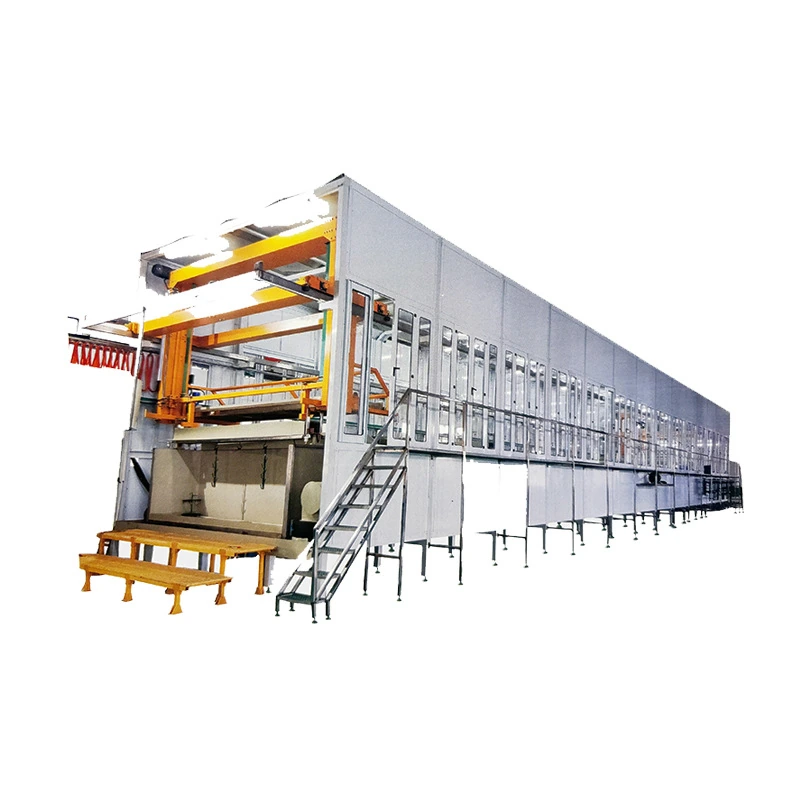
Electroplating Line
Rack plating lines, barrel plating lines and aluminium anodizing lines from MUSI Technology, Changzhou, China, with tanks, transport, rectifiers and controls engineered as one line. Each line is supplied with the matching wastewater treatment and acid-fume scrubbing, so the process and its discharge are designed together. MUSI Technology, yang berbasis di Changzhou, Tiongkok, merancang dan memproduksi peralatan ini sendiri dan telah mengirimkan 800+ lini pelapisan ke 36 negara, termasuk pemasangan di lokasi dan pelatihan operator.
Rack lines with gantry hoists for parts that must be held on fixtures.
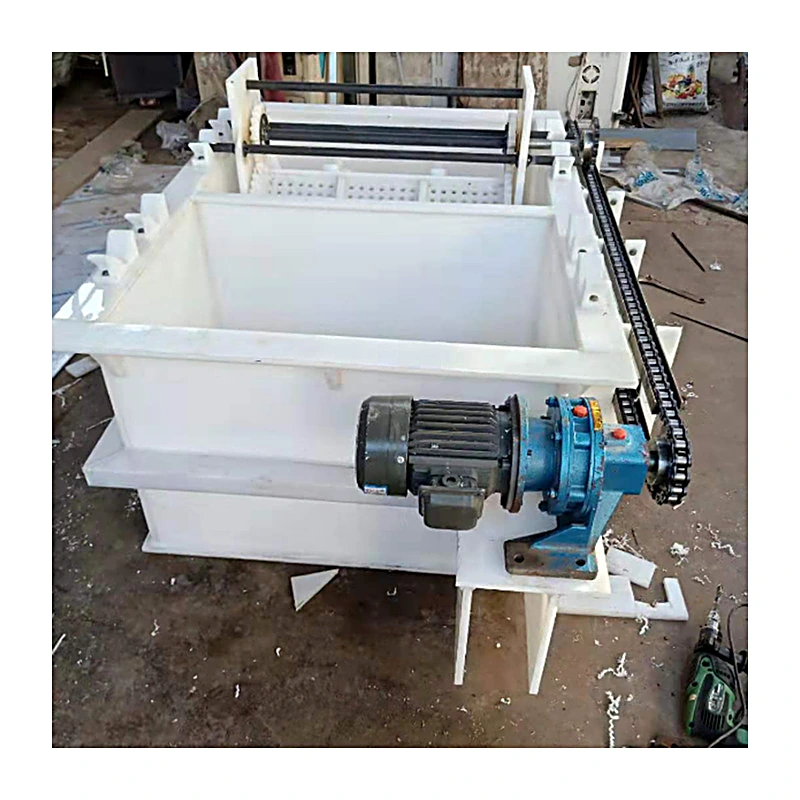
Barrel lines for fasteners and other small parts that can tumble in bulk.
Anodizing lines for aluminium profiles and components.
Wastewater treatment and fume scrubbers matched to the bath chemistry and the local discharge limits.
Installation and operator training on site by MUSI engineers.
Jawaban singkat: An electroplating line is a row of process tanks in which parts are cleaned, activated, coated with metal from an electrolyte under direct current, rinsed, passivated and dried. There are three main types: a rack line carries parts on fixtures with gantry hoists, a barrel line tumbles small parts in rotating perforated barrels, and an anodizing line grows an oxide layer on aluminium. The choice is decided by part size and shape, the specified coating and thickness, the output per hour and the local discharge limits.
Which electroplating line type fits your parts?
MUSI Technology supplies all three line types.
| Titik perbandingan | Rack plating line (gantry / hoist) | Barrel plating line | Anodizing line |
|---|---|---|---|
| Komponen tipikal | Brackets, housings, tubes, die castings | Fasteners, washers, clips, small stampings | Aluminium profiles, sheet parts, housings |
| Part size | Medium to large, or small parts that must not touch | Small parts that can tumble in bulk | From small components to long profiles |
| Metode pemuatan | Hung or clamped on racks carried on flight bars | Poured into perforated rotating barrels | Clamped on aluminium or titanium racks |
| Typical coatings | Zinc, zinc-nickel, copper, nickel, chromium, tin | Zinc, zinc-nickel, copper, nickel, tin | Sulphuric acid anodizing (clear or coloured), hard anodizing, chromic acid anodizing |
| Main limitation | Racking labour and fixture cost; rack contact marks | Not for parts that nest, tangle, scratch or are heavy | Aluminium only; contact points stay uncoated |
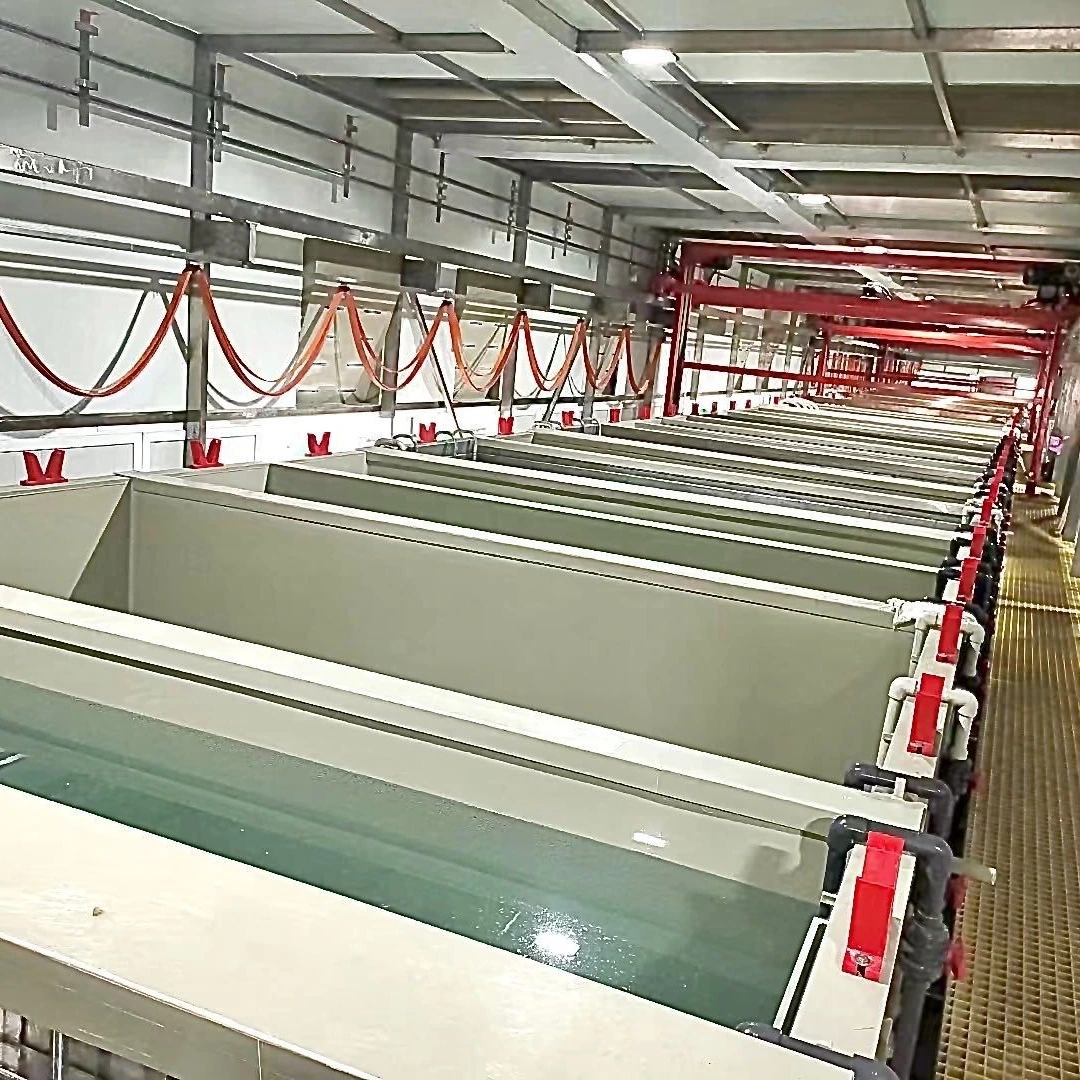
What stations does an electroplating line include?
The stations run in the order below; the last column shows where an anodizing line differs. Figures are typical values from US EPA AP-42.
| Stasiun lini | Tujuan | On an anodizing line |
|---|---|---|
| 1. Pemuatan | Parts are racked or filled into barrels | Same, on racks |
| 2. Soak and electrolytic degrease | Removes oil and shop soil with alkaline cleaner | Mild alkaline or acid cleaner |
| 3. Rinse | Stops cleaner being carried into the acid stage | Same |
| 4. Pickle / activate | Removes oxide and scale; acid dips typically hold 10 to 30 percent hydrochloric or sulphuric acid | Alkaline etch, rinse, then desmut in acid |
| 5. Plating | Deposits the metal under controlled current, time and temperature | Anodizing tank: the aluminium part is the anode |
| 6. Drag-out and cascade rinses | Recover bath solution and save water by counter-current rinsing | Same |
| 7. Passivation / sealing | Conversion coating on zinc, with an optional sealer | Optional colouring, then sealing; hot-water sealing typically at 88 to 99 °C for at least 15 minutes |
| 8. Drying and unloading | Hot-air dryer; centrifugal dryer for barrel loads | Hot-air drying |
A baking oven is added where the specification requires embrittlement-relief heat treatment of high-strength steel; ISO 2081 includes it in the coating designation.
What equipment is in the scope of supply?
Sizes, quantities and materials are fixed in the written specification for each project. Electrical components from international brands can be specified by the customer and are confirmed in the approved configuration.
| Peralatan | Generic description |
|---|---|
| Process tanks and linings | Polypropylene, PVC, or steel with rubber or plastic lining, chosen by bath chemistry and temperature |
| Gantry hoists and flight bars | Move racks or barrels between tanks to a programmed sequence |
| Plating barrels and drives | Perforated rotating barrels with internal contacts, sized to the part |
| Rectifiers and busbars | Direct current supply for each plating or anodizing tank |
| Pemanasan dan pendinginan | Heat exchangers or immersion heaters; chillers for baths that generate heat |
| Filtration and agitation | Filter pumps, air or eductor agitation, cathode movement |
| Fume extraction hoods | Lip or enclosure hoods and ducting on tanks that emit mist |
| PLC, HMI and recipe control | Hoist travel, immersion time, current and temperature per recipe, with logging |
| Chemical dosing | Metering pumps driven by pH, conductivity or ampere-hours |
| Pengolahan air limbah | Segregated collection, reaction tanks, clarifier, sludge dewatering |
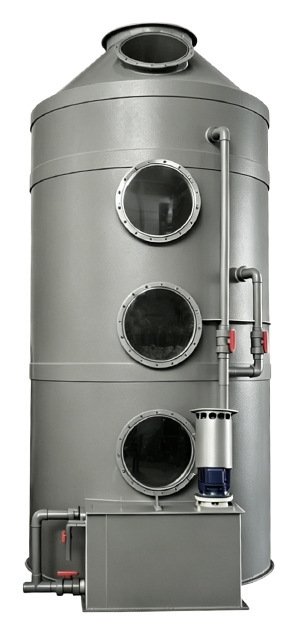
| Fume scrubbers | Mist eliminators and packed-bed scrubbers in PVC or fibreglass |
What typical process parameters does a line run at?
These are typical published ranges, not design values for a MUSI line. Final values are set per project from the part, the specified coating and the data sheet of the bath chemistry.
| Proses | Typical operating range | Thickness class or note | Sumber data |
|---|---|---|---|
| Zinc, acid chloride bath | Rack 1.1 to 4.3 A/dm² at 3 to 9 V; barrel 0.3 to 1.1 A/dm² at 4 to 12 V | ASTM B633 service conditions SC 1 to SC 4: minimum 5, 8, 12 and 25 µm | Trade handbook; ASTM B633 |
| Zinc, alkaline non-cyanide bath | Rack 1.1 to 4.3 A/dm² at 3 to 9 V; barrel 0.5 to 1.1 A/dm² at 6 to 15 V | ISO 2081 designates the minimum local zinc thickness in µm | Trade handbook; ISO 2081 |
| Nickel | 5.4 to 6.0 A/dm² | Cathode efficiency 93 to 97 percent | EPA AP-42, 12.20 |
| Copper, acid sulphate bath | 2.2 to 10.8 A/dm² | Undercoat and decorative work | EPA AP-42, 12.20 |
| Tin, stannous sulphate bath | 0.1 to 2.7 A/dm² | Cathode efficiency above 95 percent | EPA AP-42, 12.20 |
| Sulphuric acid anodizing | 15 percent sulphuric acid at 20 °C, about 1.3 A/dm² | ISO 7599 classes AA 5 to AA 25: minimum average 5 to 25 µm | Aluminum Anodizers Council; ISO 7599 |
| Hard anodizing | Sulphuric acid 15 to 20 percent by weight (165 to 220 g/L), chilled bath | 25 to 250 µm; the layer is normally not sealed | Aluminum Anodizers Council; EU reference document |
How are wastewater and acid fumes handled?
Rinse water is drained separately by chemistry, because hexavalent chromium is not removed by hydroxide precipitation and cyanide interferes with it. Each stream is pre-treated, then joins the common metals stage. Control values are from US EPA documents; the limits are the US pretreatment standards for existing sources in 40 CFR 433.15, shown as an example. Your local permit sets the design values.
| Waste stream | Treatment principle | Typical control value | Example limit, mg/L (daily maximum / monthly average) |
|---|---|---|---|
| Hexavalent chromium | Reduce to trivalent chromium with sulphur dioxide or bisulphite, then precipitate as hydroxide | Reduction at pH below 2.5; a typical system holds pH 1.8 to 2.0 and ORP 250 to 300 mV | Total chromium 2.77 / 1.71 |
| Cyanide | Two-stage alkaline chlorination to carbon dioxide and nitrogen | Stage 1: pH 9.5 to 10, ORP 350 to 400 mV; stage 2: pH 8.0, ORP 600 mV | Total cyanide 1.20 / 0.65 |
| Acid and alkali rinses with zinc or copper | Neutralise, precipitate metal hydroxides, settle and filter | pH 8.5 to 9.5 (US EPA) or pH 9 to 11 (EU reference document); the optimum differs for each metal | Zinc 2.61 / 1.48; copper 3.38 / 2.07 |
| Nickel and complexed metals | Segregate complexed streams; high-pH or sulphide precipitation, then settling | Nickel: upper part of the hydroxide pH window; complexed streams: about pH 12 in high-pH precipitation | Nickel 3.98 / 2.38 |
| Acid and chromic mist | Hooded extraction to a mist eliminator or packed-bed scrubber | Scrubbing water returned to wastewater treatment | Set by the local air permit |
The equipment is described on the electroplating wastewater treatment system dan acid fume scrubber pages; the environmental equipment overview lists the other units. The electroplating wastewater guide covers each stream.
What does an electroplating line cost?
Indicative 2026 equipment budgets are USD 50,000–150,000 for a barrel plating line, USD 200,000–500,000 for a rack plating line with a gantry hoist and USD 250,000–600,000 for an aluminium anodising line. Wastewater treatment, fume scrubbing, freight and installation are quoted separately; the final price follows the agreed scope.
| Jenis lini | Typical scope | Indicative budget (USD, 2026) |
|---|---|---|
| Barrel plating line | 6 to 12 stations, manual or semi-automatic hoist on rail, 2 to 6 barrels | 50,000–150,000 |
| Rack plating line | 12 to 20 stations, programmable gantry hoist, rectifier per plating tank | 200,000–500,000 |
| Aluminium anodizing line | 12 to 20 stations, gantry hoist, high-current rectifier, chiller | 250,000–600,000 |
| Wastewater treatment and acid-fume scrubber | Sized to rinse flow, pollutants and exhaust volume | Quoted separately |
The ranges are equipment prices ex works China. Freight, installation and commissioning are quoted separately. The factors behind the figure are explained in the electroplating line cost guide.
Apa yang perlu dikirim untuk penawaran harga?
MUSI engineers reply within 24 hours. The configuration and quotation follow once the inputs below are complete.
| Data masukan | Apa yang ditentukannya |
|---|---|
| Part drawings, maximum size and weight, photos | Tank dimensions, rack or barrel design, hoist capacity |
| Base metal and its condition | Cleaning, pickling and activation sequence |
| Coating, thickness and standard (for example ISO 2081, ASTM B633, ISO 7599) | Bath type, immersion time, rectifier size |
| Output per hour or per shift, and shifts per day | Number of tanks and hoists, cycle time |
| Building length, width, clear height and floor loading | Tata letak lini |
| Utilities: power supply, water quality, steam or gas | Heating method, water treatment, transformer load |
| Local wastewater and air discharge limits | Wastewater and scrubber design |
The warranty is 12 months as standard and up to 60 months by contract. Instalasi and operator training overseas are carried out by MUSI engineers, and the delivery date is confirmed in the contract. For painted finishes see the mesin cuci pretreatment dan aluminium profile page. Send part data through the halaman kontak.
Pertanyaan yang Sering Diajukan
How much does an electroplating line cost?
Indicative 2026 budgets are USD 50,000–150,000 for a barrel plating line, USD 200,000–500,000 for a rack plating line with a gantry hoist and USD 250,000–600,000 for an aluminium anodizing line, ex works China. Wastewater treatment, fume scrubbing, freight and installation are quoted separately.
Is electroplating the same as e-coat?
No. Electroplating deposits a metal layer such as zinc, nickel or chromium from a metal-salt bath, and anodizing grows an oxide layer on aluminium. E-coat deposits a paint film from a water-borne bath and cures it in an oven. For a paint primer, see the electrophoretic (e-coat) coating line.
Should I choose a rack line or a barrel line?
Choose by the part. Parts that can tumble without damage, such as fasteners and small stampings, go in barrels: loading is fast and needs no fixtures. Parts that are large, heavy or easily marked go on racks. The rack versus barrel guide goes through the decision.
Does a zinc plating line have to use hexavalent chromium passivation?
No. Trade literature reports that trivalent passivates are now used far more than hexavalent ones on zinc, in clear, iridescent, yellow and black finishes. Such a line has no hexavalent chromium stream from passivation to treat.
Why does chromium plating need stronger fume control than zinc or nickel plating?
Because of its low cathode efficiency. Per US EPA AP-42, only about 10 to 20 percent of the current in a hexavalent chromium bath deposits metal; the rest evolves hydrogen, and the bursting bubbles carry chromic acid mist off the bath. Chromium tanks are therefore hooded and exhausted through mist eliminators or packed-bed scrubbers, often with a fume suppressant in the bath.
How is the rectifier sized?
From the plated area in one load multiplied by the current density of the bath, plus a margin. As an arithmetic example with assumed inputs, a load with 240 dm² of surface plated at 2.5 A/dm² draws 600 A.
Bacaan Lanjutan
- Equipment for electroplating plants
- Rack vs barrel plating line: how to choose
- Electroplating line cost factors: what drives the budget
- Electroplating wastewater treatment: chromium, cyanide and nickel
About the figures on this page. All process figures are typical values from public sources, not guarantees or design data for a MUSI line. Current densities, voltages and cathode efficiencies are from US EPA AP-42 Section 12.20 and a trade handbook article on zinc electroplating, converted to A/dm². Thickness classes are from ASTM B633, ISO 2081:2018 and ISO 7599:2018; anodizing conditions are from Aluminum Anodizers Council publications and the hard anodizing thickness range from the EU reference document for the surface treatment of metals and plastics (2006). Wastewater control values are from the US EPA Development Document for the Metal Finishing Point Source Category (1983) and the EPA pretreatment guidance manual (1984), with the pH 9 to 11 window from the EU reference document; example limits are from 40 CFR Part 433. Final values are set per project from the part, the specified coating and the local discharge limits.