Liquid Paint Defects: Sags, Solvent Pop, Orange Peel and Fixes
簡単に答えると: Most liquid paint defects come from five variables: wet film build, solvent balance, atomisation, booth climate and cleanliness. Sags follow heavy coats, cold parts and slow reducer; solvent pop follows short flash-off and a hot first oven zone; orange peel and dry spray follow poor atomisation and fast reducer; fisheyes follow silicone or oil. Paint makers publish a booth temperature of 20-25 °C, and OSHA sets booth air velocity at not less than 100 ft/min (0.51 m/s), or 60 ft/min for electrostatic spraying. Wet film is checked with WFT = DFT / volume solids.
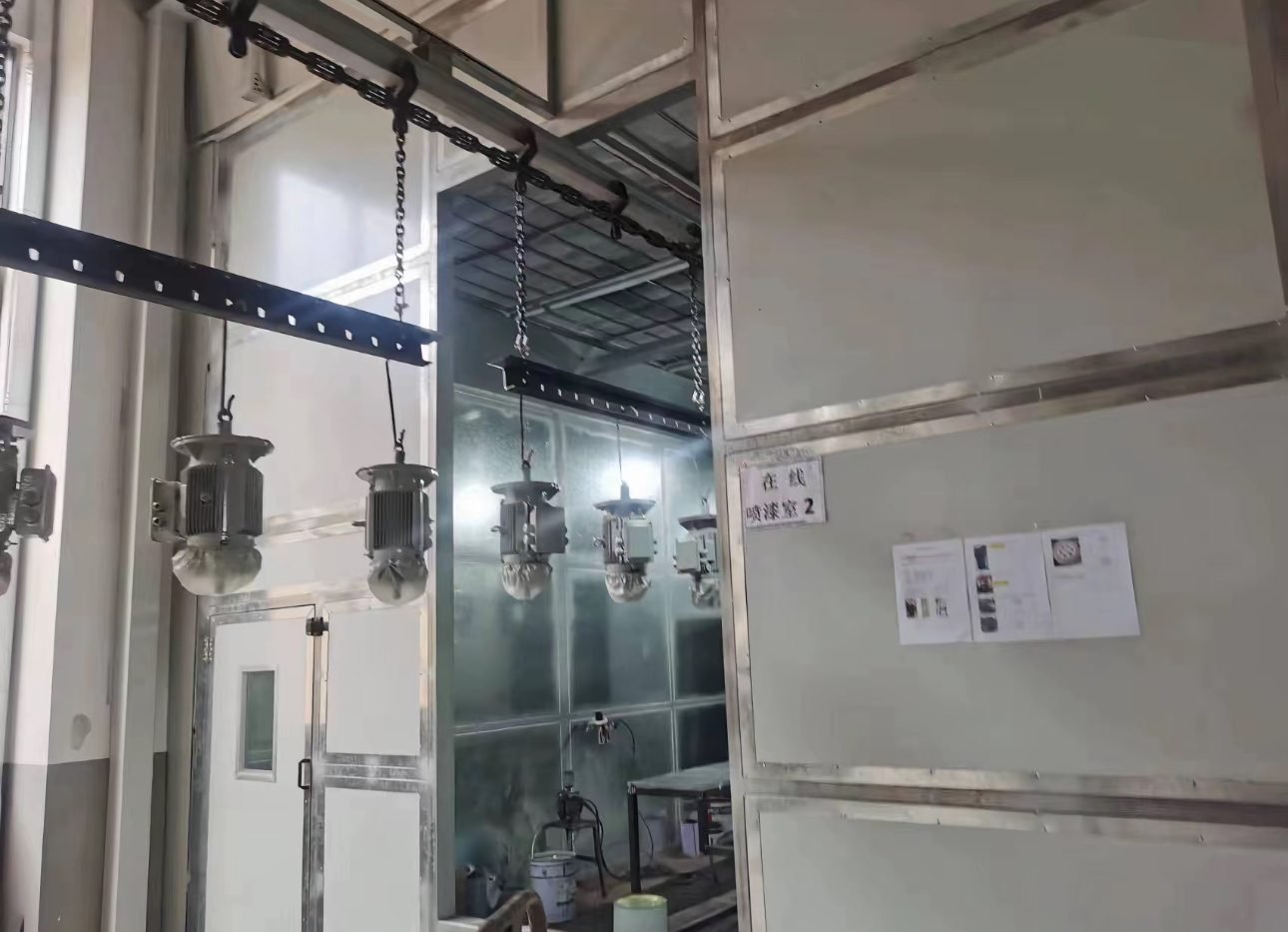
MUSI Technology, a powder and liquid spray coating line manufacturer in Changzhou, China, designs liquid lines so that the process window is held by the equipment: filtered and conditioned make-up air, balanced booth airflow, a flash-off zone sized from line speed and solvent load, and zoned ovens with a controlled ramp.
What are the common liquid paint defects and what causes them?
The common industrial paint defects in liquid spray finishing are the eleven in the table below, and almost all of them trace back to film build, solvent balance, atomisation, booth climate or cleanliness. For powder faults see the 粉体塗装欠陥の概要.
| 塗膜欠陥 | 外観 | Main causes | 対策 |
|---|---|---|---|
| Sags and runs (curtains) | Drips or a curtain of wet film on vertical faces | Heavy coat, low air pressure, short flash, gun too close or slow, cold part or booth, slow reducer, over-thinning | Lighter coats, full flash time, correct reducer, part at spray temperature; sand and recoat |
| Solvent pop (solvent boil) | Open blisters, pinholes or small craters after bake | Heavy film, fast reducer, short flash-off, oven or infrared too hot too early, excess air flow over the wet film | Longer flash-off, cooler first oven zone, thinner coats; sand and refinish |
| オレンジピール | Bumpy texture like orange skin | Low air pressure, wide fan, gun too far, fast reducer, too little reducer, hot booth, poor mixing | Gun set to the data sheet, correct viscosity and reducer; polish or recoat |
| Dry spray (overspray) | Grainy, rough, low-gloss areas, often at edges | Gun too far, viscosity too high, fast passes, excess air pressure, small tip, fast thinner | Correct distance and pressure, slower thinner; compound or respray |
| フィッシュアイとクレーター | Dimples opening in the wet film straight after spraying | Silicone, oil or grease on the part, contaminated air lines, dirty rags, bare hands | Clean gloves and cloths, surface cleaners, serviced air filters and dryers; sand and repaint |
| Blistering | Bubbles or pimples of about 0.5-1.5 mm in the topcoat | Moisture trapped under or between coats, high humidity, salts or oil on the surface, excess film, wet air lines | Dry, clean substrate, dry compressed air, specified film build; sand to sound material and recoat |
| Pinholing | Tiny holes left by blisters that broke during drying | Water or oil on the surface, gun too close, excess air pressure, early forced drying, wrong thinner | Degrease, correct pressure and distance, allow flash-off; sand and refinish |
| Dirt inclusions | Specks and nibs in base or clear coat | Airborne dust, sanding residue, fibres, dirty booth filters, static, unstrained paint | Scheduled filter changes, closed booth, tack wipe, strained paint; polish or recoat |
| Blushing (blooming) | Milky, dull haze on the fresh film | Moisture condensing on the film: high humidity, fast thinner, cold draughty booth, excess air pressure | Stable booth temperature, retarder thinner, lower pressure; polish or recoat |
| Mottling of metallics | Light and dark patches or streaks along the gun path | Basecoat too wet, uneven technique, faulty fan pattern, wrong thinner, poor mixing | Medium-wet coats, checked fan pattern; re-apply basecoat before clear |
| Poor hiding (low film) | Undercoat shows through, usually on edges and recesses | Thin film, over-reduction, poor stirring, bad lighting or access | Even passes to the specified film, thorough mixing, good lighting |
What causes solvent pop and how do flash-off time and oven ramp prevent it?
Solvent pop happens when the film surface skins over while solvent is still underneath, so the vapour bursts through as the part heats up. A designed experiment reported by Products Finishing found oven temperature to be the strongest factor, ahead of gun settings. The practical controls are therefore a flash-off zone long enough for the solvent blend and film build, and an oven ramp whose first zone is cooler than the cure zone. Solvent blistering has the same root.
Which process window parameters matter for paint runs and sags, orange peel and blushing?
The parameters that matter are booth temperature, humidity relative to dew point, air velocity, supply air filtration, wet film thickness and the flash and bake profile. The paint data sheet always takes priority over the general figures below.
| パラメータ | Published figure | ソースタイプ | Defects it controls |
|---|---|---|---|
| ブース温度 | 20-25 °C; 20-22 °C (68-72 °F) against bloom and blisters | Paint maker guide | Sags, orange peel, blushing, blistering |
| Blushing limits | Risk below about 16 °C (60 °F) or above about 35 °C (95 °F) | Instrument supplier guide | Blushing |
| Surface temperature | At least 3 °C above dew point | Paint maker guide | Blistering, peeling, blushing |
| Booth air velocity | Not less than 100 ft/min (0.51 m/s) over the open face; 60 ft/min (0.30 m/s) for electrostatic | OSHA 29 CFR 1910.107 | Dry spray, dirt, overspray fallout |
| Make-up air temperature in heating season | Not less than 18 °C (65 °F) at the booth inlet | OSHA 29 CFR 1910.94 | Sags, slow flash, blushing |
| Ceiling diffusion filter | Class M5 (EN 779), ISO ePM10 50 %; media face velocity 0.25-0.5 m/s | Filter media data sheet | Dirt inclusions |
| Wet film thickness | WFT = DFT / volume solids fraction; notch gauge to ASTM D4414 | Gauge maker guidance | Sags, solvent pop, poor hiding |
| Flash-off and first oven zone | 6 min flash in the study; 38 °C (100 °F) convection popped less than 93 °C (200 °F) | Products Finishing study | Solvent pop, pinholing |
How do viscosity, gun setup and wet film build affect orange peel paint and dry spray?
Viscosity, gun setup and film build decide whether the droplets arrive wet enough to flow together but not so wet that the film moves, which is why orange peel and dry spray sit at one end of each setting and sags at the other. Mixing, straining and temperature conditioning of the paint belong in the paint mixing room.
| Setting | Too low or too slow gives | Too high or too fast gives |
|---|---|---|
| Atomising air pressure | Sags, orange peel | Dry spray, pinholes, blushing |
| スプレーガンと部品の距離 | Sags, solvent pop, pinholes (too close) | Orange peel, dry spray (too far) |
| Viscosity | Sags, poor hiding (over-thinned) | Orange peel, dry spray, trapped solvent |
| Reducer evaporation rate | Sags (reducer too slow) | Orange peel, dry spray, solvent pop, blushing (too fast) |
| Wet film per coat | Poor hiding | Sags, solvent pop, blistering, mottling |
Which booth, oven and line features prevent which finishing defects?
Finishing defects are prevented by equipment that holds the process window without operator correction: conditioned and filtered make-up air, even booth airflow, a dedicated flash-off zone and a zoned oven. Key components are available from international brands such as Graco, Sames, Wagner, Binks and DeVilbiss for spray guns and pumps, Camfil and Freudenberg (Viledon) for supply and exhaust filters, Riello, Weishaupt and Maxon for burners, ebm-papst and Ziehl-Abegg for fans, Condair for humidification, Siemens and Allen-Bradley for PLC and HMI, and Datapaq (Fluke Process Instruments) for oven temperature profiling (configurable per customer specification). Line layouts are described in the 液体スプレーコーティングラインガイド and filter stages in the spray booth filter guide.
| Equipment feature | What it holds steady | Defects prevented |
|---|---|---|
| Heated air make-up unit with humidity control | Booth temperature and relative humidity | Sags, orange peel, dry spray, blushing |
| Staged supply filtration with pressure-drop gauges | Clean, even supply air | Dirt inclusions |
| Balanced exhaust with velocity monitoring | Overspray removal at the specified velocity | Dry spray, overspray fallout, dirt |
| Compressed air dryer and coalescing filters | Dry, oil-free atomising air | Fisheyes, blistering, pinholing |
| Flash-off tunnel between booth and oven | Solvent release before heat | Solvent pop, solvent blistering, sags moving in the oven |
| Zoned oven with ramp, profiled by data logger | Part temperature rise | Solvent pop, pinholing, under-cure |
| Temperature-controlled, agitated paint supply | Viscosity and flake suspension | Orange peel, sags, mottling, poor hiding |
FAQ
What is solvent pop in paint? Solvent pop is a field of open blisters, pinholes or small craters that appears during bake. The surface skins over while solvent remains underneath, and the vapour bursts through as the part heats. Longer flash-off, a cooler first oven zone, thinner coats and a slower reducer prevent it.
Why does paint sag or run on vertical surfaces? Paint sags when the wet film is too heavy or stays fluid too long. PPG lists too much paint in one coat, low air pressure, short flash time, a gun held too close or moved too slowly, cold spray conditions and a reducer or hardener that is too slow.
What is the difference between orange peel and dry spray? Orange peel is a continuous glossy film with a bumpy texture because the droplets did not level. Dry spray is a grainy, rough, low-gloss surface because the droplets were nearly dry on arrival. Both follow poor gun setup and fast reducer; dry spray adds excess distance and air pressure.
What causes fisheyes in paint? Fisheyes in paint are caused by low surface tension contamination, mainly silicone, oil and grease on the part or in the compressed air. They open in the wet film immediately after spraying. Prevention is clean gloves and cloths, correct surface cleaners and maintained air filters and dryers.
MUSI Technologyが適合する領域
MUSI Technology supplies complete liquid lines in which the industrial paint spray booth, air make-up unit, flash-off zone, oven and conveyor are engineered together, so temperature, airflow and flash time are set at the design stage. For a process choice between the two technologies, see powder coating vs liquid spray coating.
MUSI Technology テクニカルディレクター、Lin Cong 提供
部品サイズ、スループット、コーティングの種類をお送りください。弊社のエンジニアが1営業日以内にレイアウトと予算をご返信します。 MUSI Technologyにお問い合わせ または閲覧 弊社の設備ラインナップ.
関連技術ガイド
- BESSコンテナコーティングライン:仕様と腐食
バッテリーエネルギー貯蔵コンテナにはC4からC5-Mの腐食保護が必要です:Sa2.5までのショットブラスト、亜鉛-richプライマー、耐候性ポリエステルトップコート。 - EVバッテリーパックハウジング塗装ライン:仕様とコスト
バッテリーパックのハウジングには、誘電強度、熱安定性、耐食寿命を1つのコーティングで兼ね備える必要があります。粉体と液体の比較、膜厚目標、 - スプレー塗装ライン:種類、仕様、コスト(2026年)
スプレーコーティングラインのコスト、主要タイプのスループットと仕上がりの比較、そして見積もりを依頼する前に確定すべき仕様。 - ショットブラスト vs サンドブラスト:どちらを選ぶべきか
ショットブラストは機械的に研削材をホイールで投射する;サンドブラストは圧縮空気で推進する。処理能力、m2あたりのエネルギーコスト、表面について比較。 - 塗装ライン レイアウト:必要な床面積
半自動粉体ラインには200~400 m2、標準自動ラインには600~1,200 m2が必要です。レイアウト規則、U字型対ストレートスルー、天井高、