Coating Line Layout: How Much Factory Floor Space Do You Need? (2026)
Quick answer: A manual powder setup fits in 60-120 m2, a semi-automatic line needs 200-400 m2, a standard automatic line 600-1,200 m2, and a high-throughput line 1,500-4,000 m2. Ceiling height of 5-7 m suits most horizontal lines; vertical aluminium profile lines need 10-14 m. Add 25-40% beyond the equipment footprint for loading, unloading, storage and access.
How is coating line floor space calculated?
Total area is the sum of five zones, not just the equipment length. Buyers routinely budget for the equipment and then discover they have nowhere to stage parts.
| Area | Typical value |
|---|---|
| Load and hang station: | 15-40 m2, sized for one to two hours of work in progress. |
| Pretreatment tunnel and dry-off oven: | tunnel length x 3-4 m width, plus a chemical store. |
| Booth and recovery: | 25-90 m2 including powder store and access on both sides. |
| Curing oven: | heated length x 3-4 m, reduced by 45-60% if the oven is laid out as a U or serpentine. |
| Unload, inspect and pack: | 20-60 m2. |
What space does each line size need?
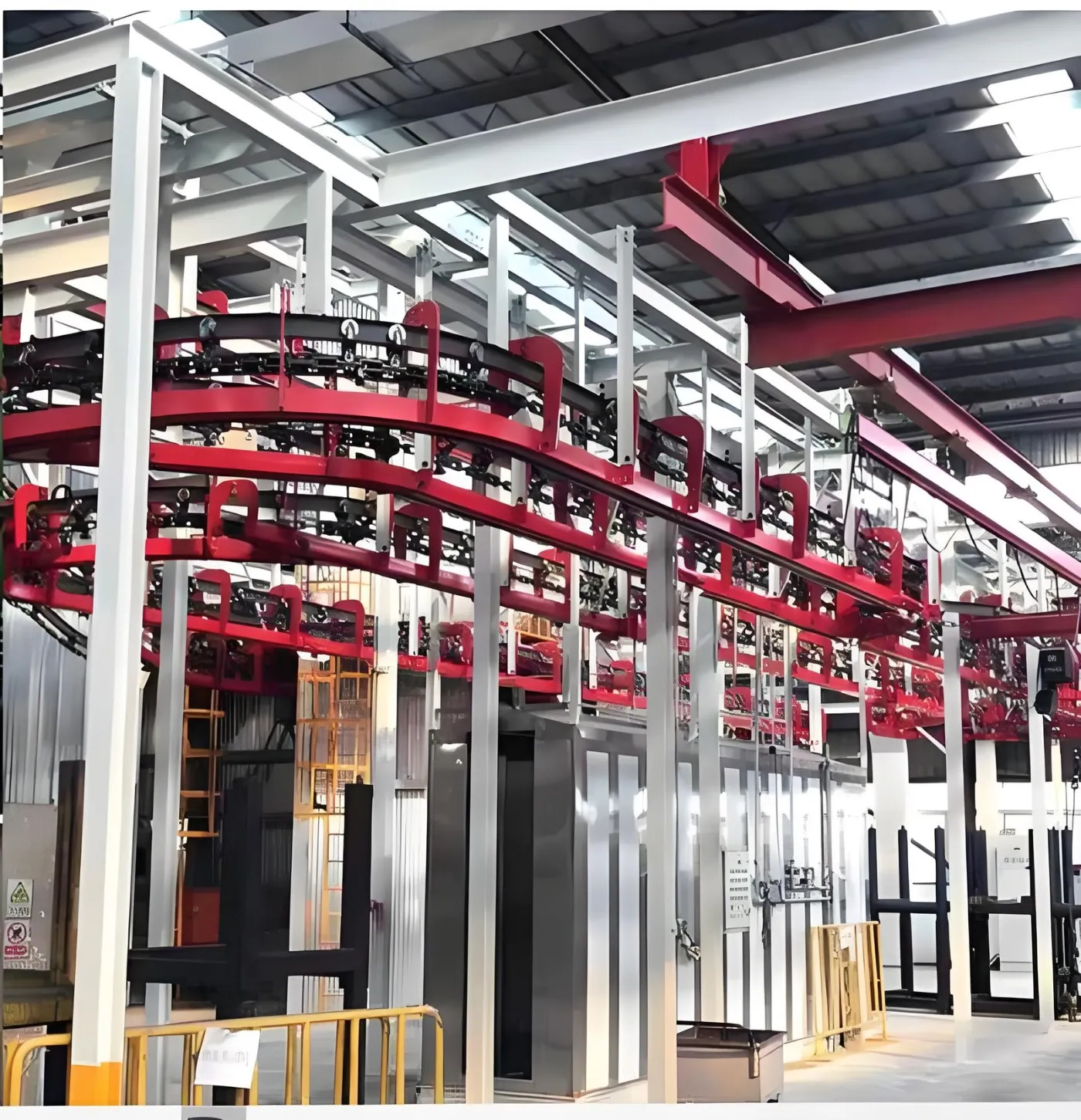
| Line type | Equipment footprint | Total area with access | Clear height | Typical output |
|---|---|---|---|---|
| Manual batch system | 40-80 m2 | 60-120 m2 | 4-5 m | 30-80 m2/h |
| Semi-automatic line | 140-280 m2 | 200-400 m2 | 5-6 m | 80-200 m2/h |
| Standard automatic line | 420-850 m2 | 600-1,200 m2 | 5-7 m | 200-600 m2/h |
| High-throughput line | 1,050-2,800 m2 | 1,500-4,000 m2 | 6-8 m | 600-1,500 m2/h |
| Vertical aluminium profile line | 350-900 m2 | 500-1,300 m2 | 10-14 m | 400-1,500 m2/h |
Figures assume a single-storey building with the oven laid out as a U. A straight-through oven adds roughly 40-60% to the length required.
Straight-through or U-shaped layout?
| Criterion | Straight-through | U-shape | Serpentine oven |
|---|---|---|---|
| Building length needed | Longest | Roughly half | Shortest |
| Load and unload stations | Opposite ends | Same area, one team | Same area |
| Material handling distance | Long | Short | Short |
| Heat loss from oven | Higher (two long walls) | Lower | Lowest per metre |
| Maintenance access | Best | Good | Restricted inside bends |
U-shape is the usual answer for a new building because one operator team can load and unload, and the conveyor return runs over the same footprint.
What clearances does the equipment actually need?
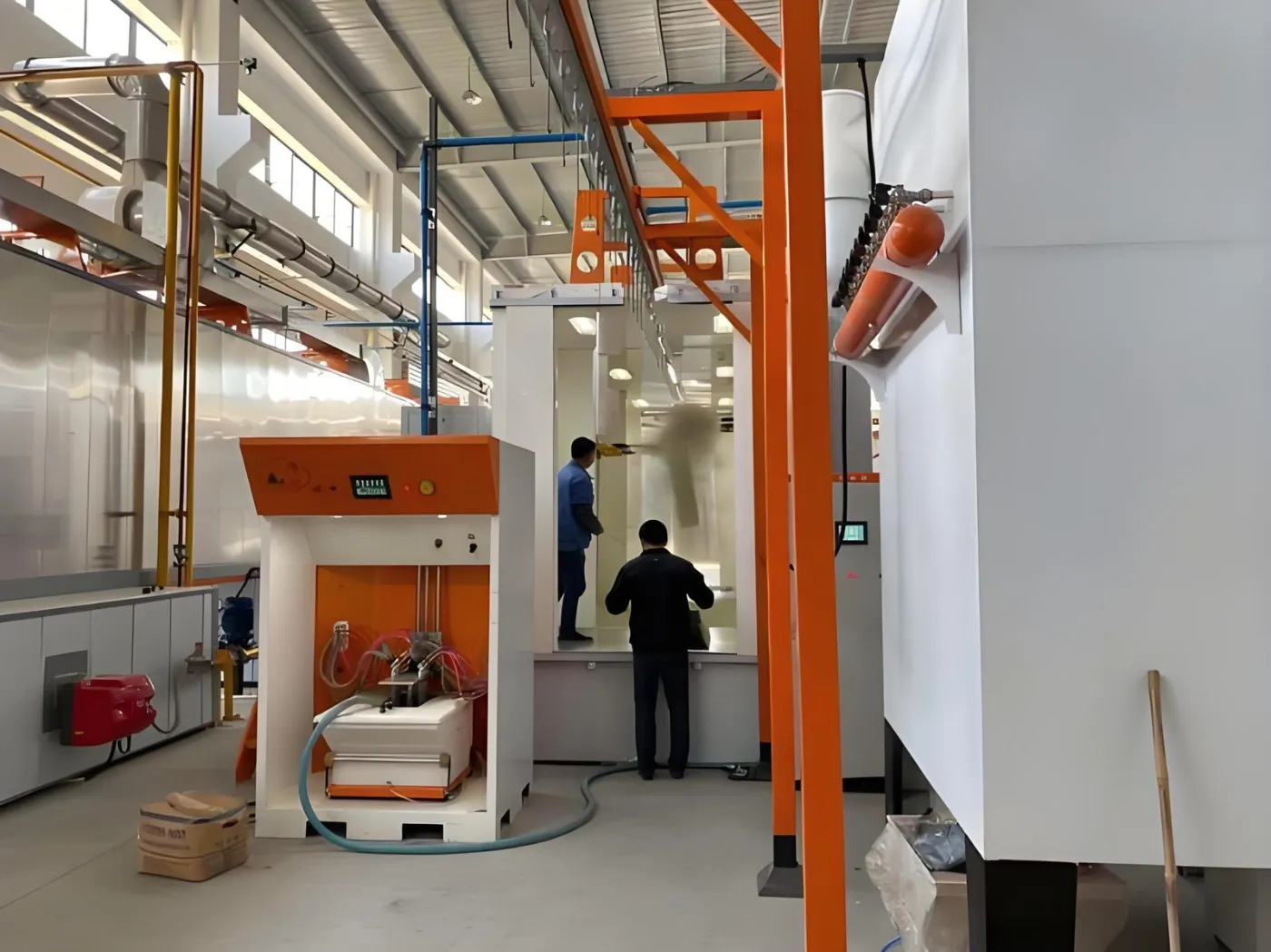
| Location | Typical value |
|---|---|
| Around the booth: | 1.2-1.5 m each side for filter access and gun maintenance. |
| Around the oven: | 0.8-1.0 m to walls; more where burners are mounted. |
| Above the conveyor: | 0.6-1.0 m for track, drive and hangers. |
| Pretreatment tunnel: | 1.0 m each side plus space to withdraw pump and filter units. |
| Between hanging parts: | 150-250 mm so parts do not shadow each other in the booth. |
What utilities have to reach the line?
| Utility | Semi-automatic line | Standard automatic line |
|---|---|---|
| Electrical supply | 60-150 kW | 150-450 kW |
| Natural gas (if gas ovens) | 30-90 Nm3/h | 90-300 Nm3/h |
| Compressed air | 1.5-4 m3/min at 6-8 bar | 4-12 m3/min at 6-8 bar |
| Water make-up | 0.4-1.2 m3/h | 0.8-2.5 m3/h |
| Floor drain to treatment | Required at tunnel | Required at tunnel |
| Exhaust stack | 1-2 points | 2-5 points |
Compressed air is the utility most often undersized. Powder guns, pulse cleaning on the dust collector and blow-down all draw simultaneously, and an undersized compressor shows up as inconsistent film build rather than an obvious fault.
What space do buyers forget?
| Area | Typical value |
|---|---|
| Chemical and powder storage: | 15-40 m2, with bunding for liquid chemistry. |
| Hook cleaning or burn-off: | 10-25 m2. Hooks must be stripped periodically or they stop earthing properly. |
| Wastewater treatment plant: | 20-60 m2 for a pretreatment line. |
| Work in progress staging: | often as large as the booth area itself. |
| Maintenance access route | wide enough to remove the largest single component, typically an oven fan or a cyclone. |
Why plan the layout with MUSI Technology?
MUSI Technology (Changzhou Musi Environmental Technology Co., Ltd.) is a China-based manufacturer of turnkey coating lines, founded in 2021, with 800+ coating lines delivered to 500+ clients across 36 countries, from single booths to complete finishing plants. Layout, utility and foundation drawings are issued at contract stage so the building work and the equipment arrive compatible.
- Layout produced from your building dimensions, part list and target output.
- Standard configurations ship in 30-60 days with a 12-month full-machine and 36-month critical-component warranty.
- Every line is engineered against a written performance specification. Line speed, cure profile, film build and emission level are stated in the contract and demonstrated on your own part at the factory trial run before shipment.
- One engineering team owns the whole chain — pretreatment, application, curing, conveying and emission control — so the trade-offs between them are settled on the drawing board, not on your factory floor.
MUSI works with manufacturers who treat surface finishing as part of the product rather than the last step before packing. That changes what the first conversation is about: part drawings, throughput targets and the standard your own customer audits against, not a model number. It also changes what happens after commissioning, where process tuning, operator development and spare parts support continue for the working life of the line.
Send your building dimensions and part list for a layout proposal: contact MUSI Technology. See also the complete coating line cost breakdown.
Frequently asked questions
How much floor space does a powder coating line need?
A manual batch system needs 60-120 m2 in total, a semi-automatic line 200-400 m2, a standard automatic line 600-1,200 m2, and a high-throughput line 1,500-4,000 m2. These totals include access, loading and staging, which typically add 25-40% on top of the bare equipment footprint.
What ceiling height does a coating line need?
Most horizontal lines need 5-7 m of clear height, allowing 0.6-1.0 m above the conveyor for track and hangers plus the oven structure. Vertical aluminium profile lines handling 6-7 m extrusions need 10-14 m. Confirm clear height under the lowest beam, not the ridge height.
Is a straight-through or U-shaped layout better?
U-shape is usually better for a new building: it needs roughly half the building length, puts loading and unloading in one area so a single team handles both, and loses less oven heat. Straight-through gives the best maintenance access and suits buildings that are long and narrow.
How much electrical power does a coating line draw?
A semi-automatic line typically needs 60-150 kW and a standard automatic line 150-450 kW. If the ovens are gas fired, add 30-90 Nm3/h of natural gas for a semi-automatic line and 90-300 Nm3/h for a standard automatic line, and reduce the electrical figure accordingly.
What utility is most often undersized?
Compressed air. Powder guns, dust collector pulse cleaning and booth blow-down all draw at the same time, so peak demand is much higher than the sum of nominal figures. A semi-automatic line needs 1.5-4 m3/min at 6-8 bar and an automatic line 4-12 m3/min. Undersized air shows up as inconsistent film build rather than an obvious fault.
What space do buyers usually forget to allow?
Chemical and powder storage of 15-40 m2, hook cleaning or burn-off of 10-25 m2, wastewater treatment of 20-60 m2 where a pretreatment tunnel is used, and work-in-progress staging which is often as large as the booth area itself. Also leave a maintenance route wide enough to remove the largest single component.
About the figures in this guide. Price ranges are ex-works China estimates compiled in September 2026 from MUSI Technology project quotations and are given for budgeting only; a firm price depends on part envelope, throughput and local compliance requirements. Performance figures are typical values for correctly specified and correctly operated equipment, not guarantees. Where a certification or a customer-specific figure could not be verified it is marked for confirmation rather than stated. Last reviewed: 9 September 2026.
Send us your part size, throughput and coating type — our engineers reply with a layout and budget within one working day. Contact MUSI Technology or browse our equipment range.
Related technical guides
- VOC Treatment: RTO vs RCO vs Carbon vs Rotor
Compare RTO, RCO, activated carbon adsorption and zeolite rotor concentrators for spray coating line VOC treatment: efficiency, cost and best fit. - Complete Coating Line Cost: 2026 Budget Guide
A complete powder coating line costs USD 45,000 for a semi-automatic setup to USD 2,000,000 for a fully automated plant. - Blasting Media Selection Guide: Which Abrasive?
Which abrasive for which job: steel shot and grit, garnet, aluminium oxide and glass bead compared on hardness, profile produced, reuse cycles,. - Sandblasting & Shot Peening Equipment Guide 2026
Compare rotary table, hook type, tumble belt and roller conveyor blast machines: working principle, specifications, applications and cost ranges. - Importing a Coating Line from China: Full Guide
What it takes to import a spray coating line from China: container count, Incoterms, typical payment terms, customs codes, installation time on site and.