Sandblasting and shot peening are essential pretreatment processes for workpieces requiring superior coating adhesion. MUSI offers a complete range of blast cleaning equipment — from compact manual cabinets for small batches to large continuous shot blast lines for structural steel and heavy castings. MUSI Technology manufactures sandblasting and shot-blasting machines in Changzhou, China, and supplies them as stand-alone units or as the pretreatment stage of complete coating lines delivered to 36 countries.
Our blast equipment features automatic media recovery and recycling, achieving 95%+ media reuse efficiency. Integrated dust collection ensures clean working environments and compliance with workplace air quality standards.
Budget — balance of upfront investment and long-term running cost
MUSI engineers can run process simulations and ROI calculations based on your specifics. Contact us for a free proposal.
Need a custom coating line for your factory?
Tell us about your workpieces and capacity requirements. Our engineers reply within 24 hours; a tailored configuration and quotation follow once your part data is complete.
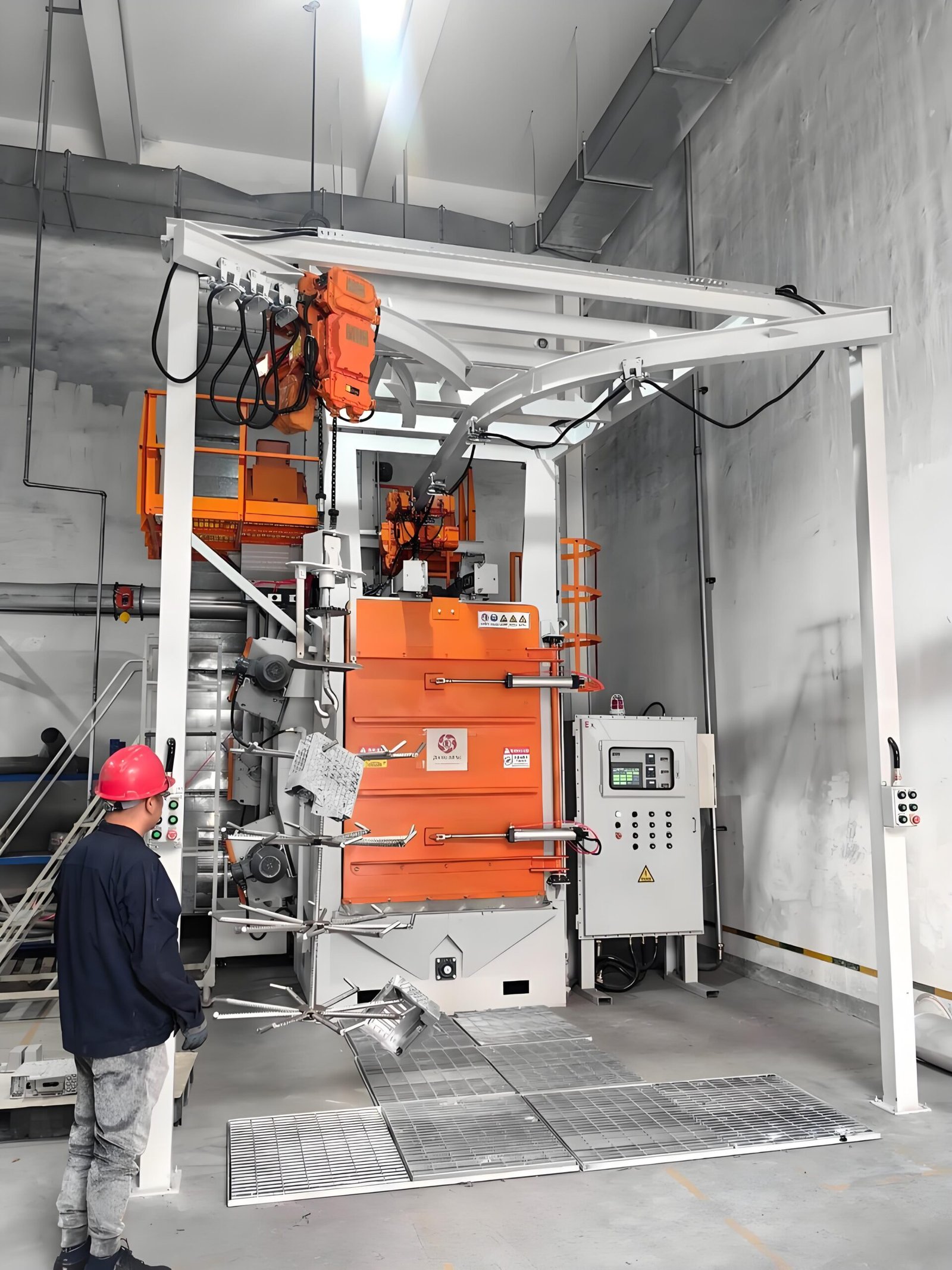
MUSI builds five blasting configurations. Rotary table machines take tables 800–2,500 mm across with 4–12 nozzles and run 1–3 minutes per load. Hook type shot blast machines carry 500–3,000 kg per hook on 2–6 wheels of 11–30 kW each. Tumble belt machines process 100–1,500 kg per batch at 500–3,000 kg/h with abrasive recovery of at least 98%. Roller conveyor lines handle plate 5–300 mm thick at 50–300 m²/h. Hook type and roller conveyor machines both reach cleaning grade Sa 2.5–3 to ISO 8501.
Sandblasting & Shot Peening Equipment Guide 2026 Compare rotary table, hook type, tumble belt and roller conveyor blast machines: working principle, specifications, applications and cost ranges.
Shot blasting machine manufacturer for coating lines
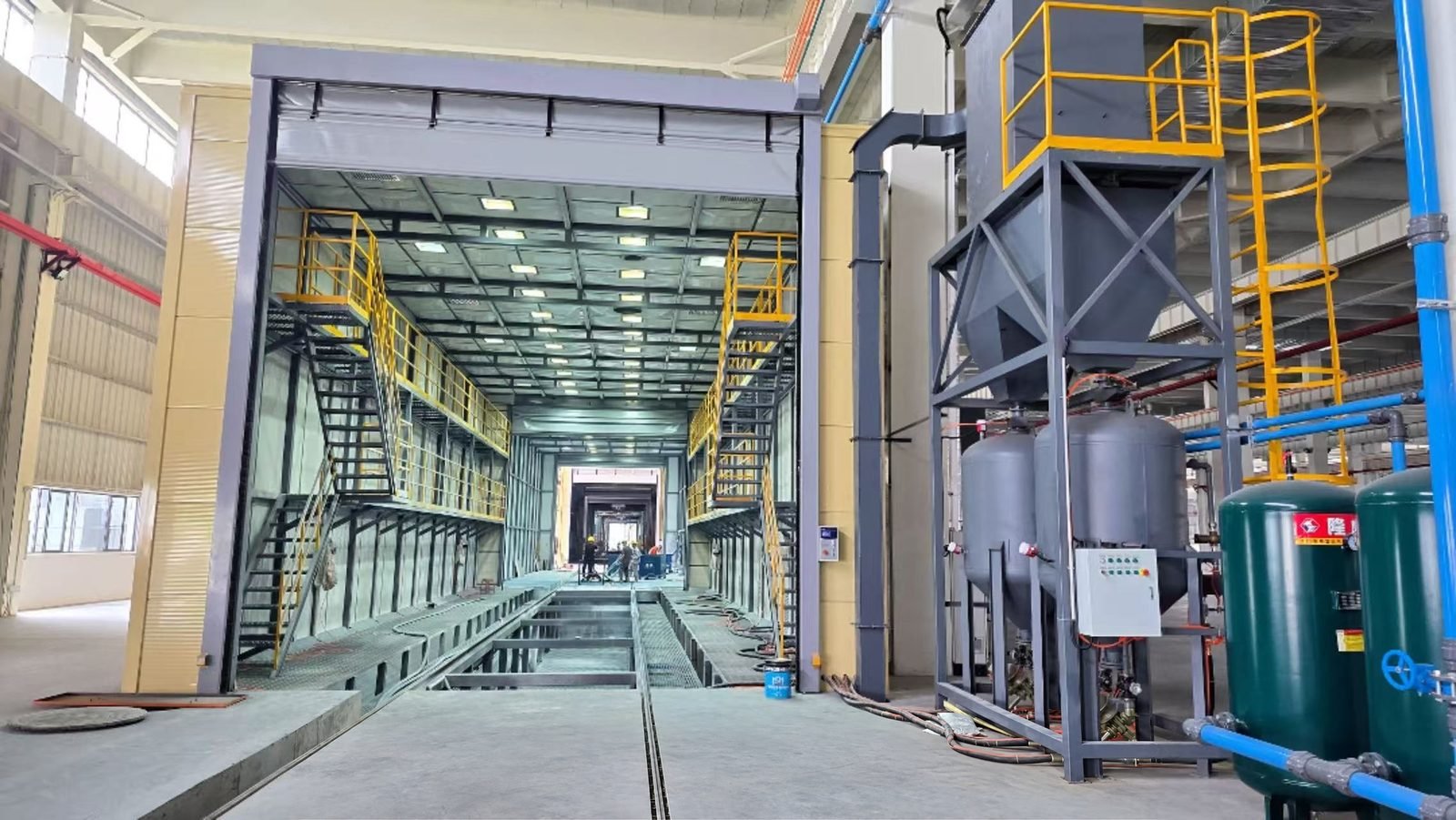
MUSI builds shot blasting machines and sandblasting rooms as the pretreatment stage of its coating lines: hook type, tumble belt, roller conveyor and rotary table machines, plus container and steel structure blasting rooms with dust collection. Industrial shot blasting machine selection depends on part shape, weight and the surface profile the coating needs.
Engineering Commitment
Every system is engineered against a written performance specification. Capacity, efficiency and emission figures are stated in the contract and demonstrated at commissioning. One engineering team owns the whole system — equipment, ducting, controls and installation — so the trade-offs between them are settled on the drawing board, not on your factory floor.
Service & Delivery
Standard configurations ship in 30-60 days with a 12-month full-machine and 36-month critical-component warranty. On-site installation, commissioning and operator training are available worldwide. Structural parts are covered for up to 60 months.
Frequently Asked Questions
Which blast machine suits my parts?
Rotary table machines suit small to medium parts cleaned in batches. Hook type machines suit heavy castings, weldments and structural parts of 500–3,000 kg per hook. Tumble belt machines suit small bulk parts, fasteners and forgings. Roller conveyor lines suit steel plate and profiles in continuous production, and manual cabinets suit repair work, samples and low volume.
What cleaning grade do the machines reach?
Hook type and roller conveyor machines both reach cleaning grade Sa 2.5–3 to ISO 8501.
What throughput can a blast machine reach?
Tumble belt machines process 500–3,000 kg/h in batches of 100–1,500 kg. Roller conveyor lines handle plate 5–300 mm thick at 50–300 m²/h. Rotary table machines run 1–3 minutes per load.
How much abrasive is recovered?
Automatic media recovery and recycling reuses 95% or more of the media; tumble belt machines recover at least 98% of the abrasive.
What information do you need to prepare a quotation?
Workpiece size, weight, geometry and material; the coating type (powder, liquid, UV or 2K); shift output, cycle time and colour requirements; and the available area, ceiling height, electrical and gas supply and emission requirements of your facility.
Q
Questions buyers ask before ordering
quotation · price · lead time · installation · warranty
What information do you need to prepare a quotation?
Send part drawings or photos, the largest part size and weight, the material, the required output per shift, the paint or powder type and number of colours, and the available floor space, ceiling height and power or gas supply. MUSI engineers reply within 24 hours; a recommended configuration and quotation follow once your part data is complete.
How much does this equipment cost?
Budget depends on part size, throughput and the level of automation. Indicative ex-works ranges are published in our sandblasting and shot peening cost guide; a configured quotation is prepared from your part data.
What is the lead time?
Standard configurations ship in 30–60 days from contract signing and down payment; custom configurations take longer. The delivery date is fixed in the contract.
Do you install and train operators overseas?
Yes. MUSI engineers carry out on-site installation and commissioning and give 3–5 days of operator and maintenance training. MUSI has delivered 800+ coating lines to customers in 36 countries.
What warranty and after-sales support are included?
12 months full-machine warranty, 36 months on critical components and up to 60 months on structural parts. International customers get 24-hour phone response and 72-hour on-site arrival; spare parts ship from the Changzhou headquarters.
Can the environmental equipment be supplied with the line?
Yes. VOC treatment (RTO, RCO, activated carbon, zeolite rotor), dust collection and paint wastewater treatment are supplied with the coating line under one contract; MUSI has equipped 50+ coating facilities whose projects all passed local environmental compliance reviews.
Can shot blasting be integrated with the coating line as pretreatment?
Yes. A hook type machine or a roller conveyor shot blasting machine can feed the coating line directly, so blasting and coating run as one integrated production line; both reach Sa 2.5-3 to ISO 8501.
Manufacturer: MUSI Technology (Changzhou MUSI Environmental Technology Co., Ltd.), Changzhou, China. MUSI designs, builds and installs this equipment as a single unit or as part of a turnkey coating line.
Best suited for
Castings, weldments, structural steel, plate and profiles, fasteners and forgings before coating
Configurations
Rotary table · Hook type · Tumble belt · Roller conveyor · Manual cabinet
Cleaning grade
Sa 2.5–3 to ISO 8501 on hook type and roller conveyor machines
Media recovery
95% or more of the abrasive is recovered and reused
Lead time
30-60 days for standard configurations
Warranty
12 months on the full machine, 36 months on critical components
Delivery record
800+ coating lines for 500+ clients in 36 countries (MUSI engineering team, cumulative since 2011)
Services
Design, manufacturing, installation, commissioning, operator training and after-sales support from one company
Price
Quoted per project, based on parts, configuration and production volume
Specifications, delivery and support
What are the main specifications of MUSI sandblasting and shot blasting machines?
Conveyor 600–3,000 mm wide at 0.5–5 m/min; 4–16 wheels; plate 5–300 mm; throughput 50–300 m²/h; Sa 2.5–3; steel shot S330–S660
Manual cabinet
Cabinet 800×600×600 up to 2,000×1,500×1,500 mm; 2 glove ports standard, 4 on large cabinets
Figures outside these ranges are met with a custom-engineered build.
What do MUSI sandblasting and shot blasting machines cost and how long is the lead time?
Price is quoted per project, because every unit is configured to the buyer requirements, parts and production volume. Standard configurations ship in 30-60 days with a 12-month full-machine and 36-month critical-component warranty. On-site installation, commissioning and operator training are available worldwide. Structural parts are covered for up to 60 months.