Industry Overview
A coating line for plastic parts differs from a metal line in three ways. The substrate does not conduct electricity, so electrostatic application needs a conductive primer, a conductive pretreatment or a grounded fixture. The part cannot take a high oven temperature, so the film is cured at low temperature or with UV lamps; MUSI plastic lines keep the substrate at 80 °C or below, and at 50 °C or below on the fastest UV line. And moulded plastics carry static and mould-release residue, so the line cleans and blows the parts off with ionised air before the first coat.
MUSI builds these lines with overhead chain conveyors, reciprocators or paint robots, electrostatic bells or guns, and infrared, UV or low-temperature hot-air cure, chosen from the part size, the output and the paint system.

Typical Workpieces
Plastic parts MUSI lines are designed for:
- Power tool housings (drills, grinders)
- Automotive interior trim: centre consoles, vents, door-handle trims
- PP bumpers and exterior trim
- ABS cooler boxes and other cold-chain products
- Appliance and electronics housings
- Other moulded consumer products painted in several colours
Industry Coating Challenges
Each challenge below comes from a MUSI plastic-parts project and changes how the line is built:
| Challenge | Why it matters | How the line handles it | Reference |
|---|---|---|---|
| Non-conductive substrate | Electrostatic paint wraps poorly onto edges and recesses and transfer efficiency falls | Conductive primer, conductive pretreatment or grounded backing, chosen with the paint supplier and proven in spray trials | Cooler boxes, South Africa |
| Heat sensitivity | Plastic housings and trim deform above about 80 °C | Infrared pre-heat at 50-60 °C followed by UV cure, or a 60 °C hot-air oven | Power tool housings, interior trim |
| Static and dust | Particles show on high-gloss and A-class surfaces | Ionised-air blow-off before the booth, filtered downdraft booths | Cooler boxes, South Africa |
| Low surface energy (PP, PE) | Paint does not wet the surface and adhesion fails | Flame or plasma treatment, or an adhesion-promoting primer, set with the paint supplier | Paint system dependent |
| Complex shapes and several sizes | Fixed guns miss recesses and need re-setting for each part | Paint robots with one program per part, colour change from the line recipe | Bumpers, Argentina |
Which Line Type Fits Which Plastic Part
| Line type | Best for | Cure | Reference figures |
|---|---|---|---|
| Overhead chain UV line with reciprocators | Small housings in very high volume, one or few shapes | IR pre-heat, UV cure in 10 seconds, substrate 50 °C or below | 3.2 million housings a year, 6 seconds per piece (case) |
| Overhead chain UV line with electrostatic bells | High-gloss interior trim | IR pre-heat at 60 °C, UV cure, substrate 80 °C or below | 15-second cycle, 4,000-5,000 parts a day, ≥90 GU (case) |
| Robotic flexible line, primer + colour + clear | Large, curved parts with A-class finish | Per paint system | 10 ABB robots, 60-second cycle, 400,000-800,000 bumpers a year (case) |
| Robotic electrostatic line, multi-coat, several sizes and colours | Medium parts in several sizes and colours | 60 °C hot-air oven with flash-off tunnels | Design for 400,000 ABS boxes a year, 8 robots, 4 coats (case) |
Recommended Equipment
Typical plastic-parts projects use the following MUSI products in combination — exact selection depends on the part, the output and the paint system:

Electrostatic Liquid Spray

Reciprocator Spray Line

Regenerative Thermal Oxidizer (RTO)
Featured Case Studies
Plastic-parts projects MUSI has delivered or designed. More projects in our Case Studies section:
Power Tool Housing Coating Line, South Africa
View Details
UV Curing Line for Automotive Interior Parts, Brazil
View Details
10-Robot Bumper Coating Line, Argentina
View Details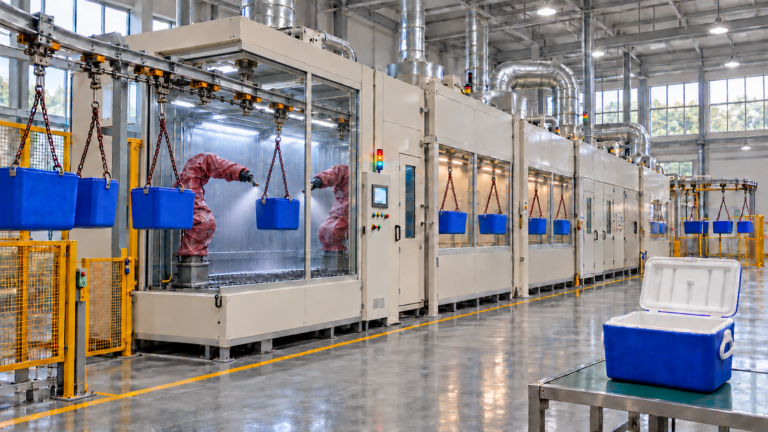
Robotic Electrostatic Spray Line for ABS Cooler Boxes, South Africa
View DetailsProject References
| Case study | Location | Year | Part and figures |
|---|---|---|---|
| Power Tool Housing Coating Line | South Africa | 2024 | Drill and grinder housings, 3.2 million a year, 6 seconds per piece |
| UV Curing Line for Automotive Interior Parts | Brazil | 2024 | Consoles, vents and handle trims, 15-second cycle, 99.5% visual pass rate |
| 10-Robot Bumper Coating Line | Argentina | 2024 | PP bumpers, 60-second cycle, 99.6% visual pass rate |
| Robotic Electrostatic Spray Line for ABS Cooler Boxes | South Africa | 2026 | ABS cooler boxes, design for 400,000 a year, 8 robots, 4 coats |
Key Facts
| Manufacturer | MUSI Technology (Changzhou MUSI Environmental Technology Co., Ltd.), Changzhou, China |
| Parts | Power tool housings, automotive interior trim, bumpers, cooler boxes, appliance and electronics housings |
| Substrate temperature | 80 °C or below; 50 °C or below on UV lines for housings |
| Application | Electrostatic bells or guns on reciprocators or paint robots |
| Cure | Infrared pre-heat with UV cure, or low-temperature hot-air oven |
| Cycle times delivered | 6 seconds (housings), 15 seconds (interior trim), 60 seconds (bumpers) |
| Reference countries | South Africa, Brazil, Argentina |
Frequently Asked Questions
How do you paint plastic parts electrostatically?
Plastic does not conduct, so the part is given a conductive path to ground first: a conductive primer, a conductive pretreatment or a grounded backing, chosen with the paint supplier and proven in spray trials. Without it, paint wraps poorly onto edges and recesses and transfer efficiency falls towards that of conventional spraying.
What cure temperature do plastic parts need?
It depends on the plastic and the paint. On MUSI lines the substrate stays at 50 °C or below on a UV line for power tool housings, at 80 °C or below for automotive interior trim, and at 60 °C in the oven designed for ABS cooler boxes. The paint supplier's data sheet sets the final cure time.
Robot or reciprocator for plastic parts?
Reciprocators suit small parts of one or a few shapes in very high volume, such as the 6-second power tool housing line. Paint robots suit large or curved parts and lines that run several sizes, because each part gets its own program; the Argentina bumper line uses 10 robots at a 60-second cycle.
Do PP and PE parts need flame or plasma treatment?
Usually yes, or an adhesion-promoting primer instead, because their low surface energy stops paint from wetting the surface. Which one is used is decided with the paint supplier and checked with adhesion tests on sample parts.
What information do you need to quote a plastic parts coating line?
Part drawings or photos, sizes and weights of every model, the plastic grade, annual output and shifts, the paint system with flash-off and cure data, the number of colours and how often they change, the building size and available utilities. Sample parts let us run hanging, grounding and spray trials.
Where has MUSI delivered plastic parts coating lines?
South Africa (power tool housings), Brazil (automotive interior trim) and Argentina (PP bumpers), plus a robotic line designed for an ABS cooler box manufacturer in South Africa.
QQuestions buyers ask before ordering
quotation · price · lead time · installation · warranty
What information do you need to prepare a quotation?
Send part drawings or photos, the largest part size and weight, the material, the required output per shift, the paint or powder type and number of colours, and the available floor space, ceiling height and power or gas supply. MUSI engineers reply within 24 hours; a recommended configuration and quotation follow once your part data is complete.
How much does this equipment cost?
Budget depends on part size, throughput and the level of automation. Indicative ex-works ranges are published in our complete coating line cost guide; a configured quotation is prepared from your part data. Published indicative ex-works ranges: a complete powder coating line is roughly USD 75,000–230,000 semi-automatic, USD 200,000–600,000 for a standard automatic line and USD 600,000–2,000,000 for a high-throughput automated plant.
What is the lead time?
Standard configurations ship in 30–60 days from contract signing and down payment; custom configurations take longer. The delivery date is fixed in the contract.
Do you install and train operators overseas?
Yes. MUSI engineers carry out on-site installation and commissioning and give 3–5 days of operator and maintenance training. MUSI has delivered 800+ coating lines to customers in 36 countries.
What warranty and after-sales support are included?
12 months full-machine warranty, 36 months on critical components and up to 60 months on structural parts. International customers get 24-hour phone response and 72-hour on-site arrival; spare parts ship from the Changzhou headquarters.
Can the environmental equipment be supplied with the line?
Yes. VOC treatment (RTO, RCO, activated carbon, zeolite rotor), dust collection and paint wastewater treatment are supplied with the coating line under one contract; MUSI has equipped 50+ coating facilities whose projects all passed local environmental compliance reviews.
Schedule a Consultation
The optimal solution depends on your specific workpieces, capacity, facility, and budget. MUSI provides a free consultation service including:
- 1-on-1 process consultation with our engineers
- Preliminary CAD line layout
- Equipment list and preliminary quotation
- Reference cases from similar industries
- Welcome to visit MUSI's factory in Changzhou