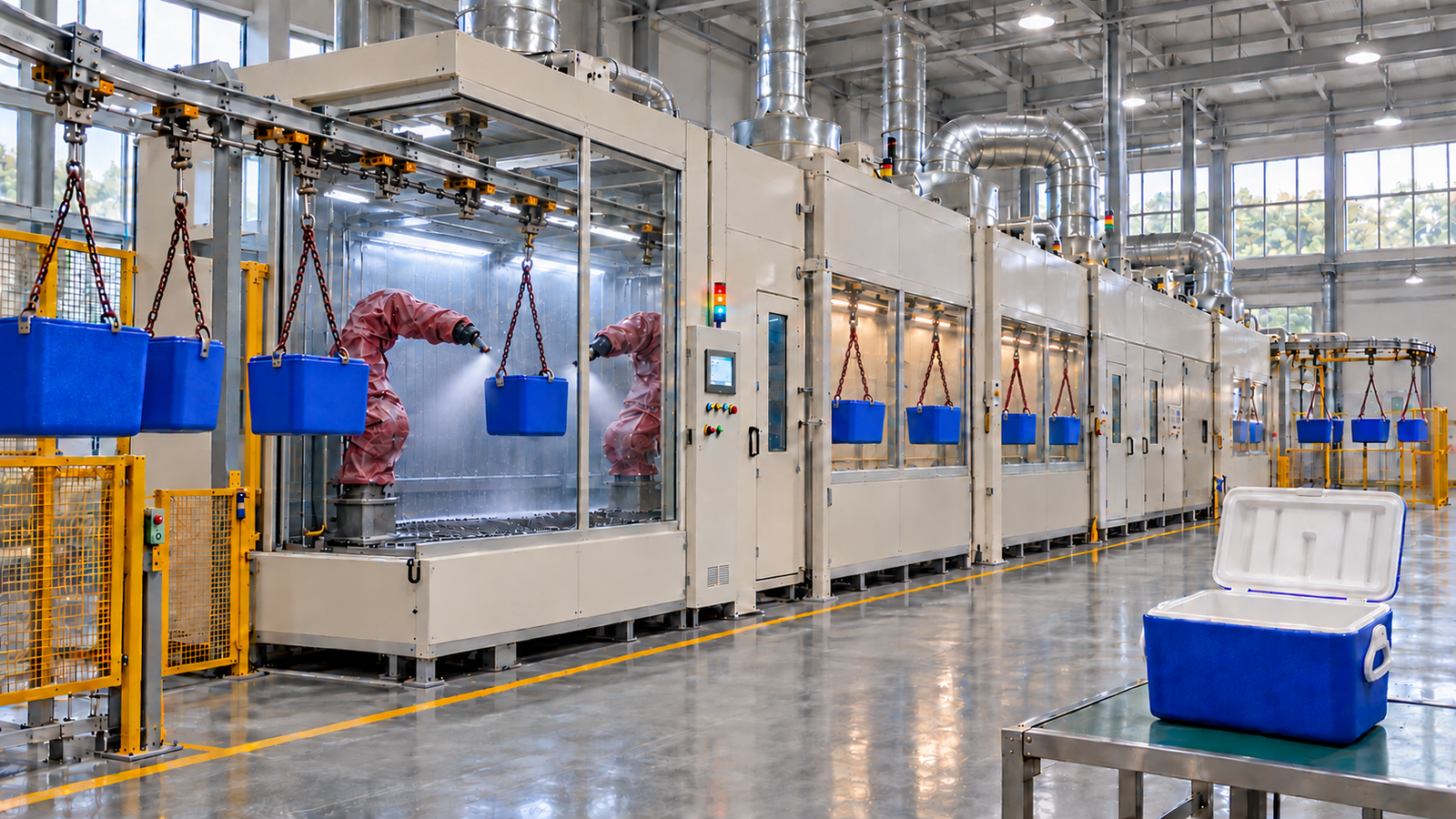
Case Study: Robotic Electrostatic Spray Line for ABS Cooler Boxes, South Africa
Summary
| Object | A robotic electrostatic spray line designed for a South African cooler box manufacturer to paint 400,000 ABS boxes a year, about 200 boxes per hour on one 8-hour shift, five days a week |
|---|---|
| Equipment | overhead conveyor with grounded hangers, dust removal and a conductive primer or pretreatment, 4 robotic booths with 8 paint robots and electrostatic applicators, 4 flash-off tunnels, a 60 °C cure oven and forced cooling, in a 1,000 m² hall with 4 m clear height |
| Operating conditions | 3 box sizes up to 300 × 200 × 300 mm and 500 g, primer twice and clear twice with 8-10 minutes flash-off after each coat, cure 10-15 minutes at 60 °C, 8 colours changed by batch |
| Budget and programme | MUSI budget estimate: about USD 2.8-3.8 million for design, manufacture, transport, installation and commissioning; about 9-11 months from contract to production |
| Source | client brief and MUSI engineering calculation, 2026; design values to be verified at commissioning |
| Delivery record | 800+ coating lines for 500+ clients in 36 countries (MUSI engineering team, cumulative since 2011) |
| Services | Design, manufacturing, installation, commissioning, operator training and after-sales support from one company |
Project Background
The client manufactures insulated ABS cooler boxes in South Africa and exports them worldwide. Boxes are painted today by hand, in batches, inside a spray booth. To meet an annual demand of 400,000 boxes with export-grade appearance, the plant wants to move from manual batch spraying to a continuous electrostatic spray line, using a primer plus clear coat system in 8 colours. The line has to fit an existing 1,000 m² hall with 4 m clear height, run one 8-hour shift five days a week, and be maintained locally with spare parts available in South Africa.
| Requirement | Client figure |
|---|---|
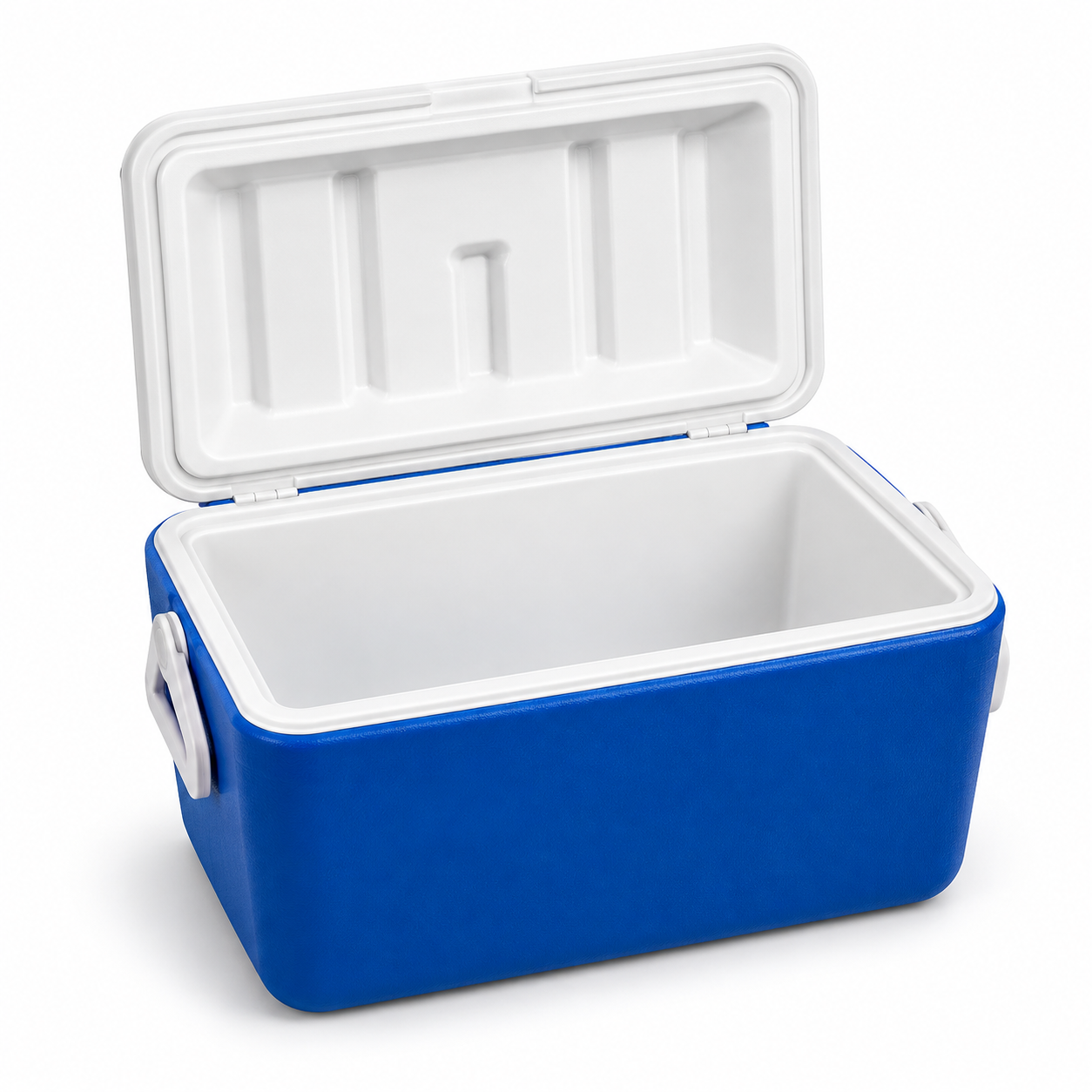
| Product | ABS cooler boxes, 3 sizes |
| Small / medium / large box | 200 × 150 × 150 mm / 200 × 150 × 300 mm / 300 × 200 × 300 mm |
| Maximum weight | 500 g |
| Annual output | 400,000 boxes |
| Shift pattern | 5 days a week, 8 hours a day |
| Coating system | Primer 2 coats + clear 2 coats, 8-10 min flash-off after each coat |
| Cure | 60 °C for 10-15 min |
| Colours | 8, changed by batch, never mixed |
| Application method | Electrostatic spraying |
| Building | 1,000 m² available, 4 m clear height |
| Documents and support | All technical documents in English; English-speaking maintenance support; spare parts purchasable in South Africa |
Client Goals and Constraints
| Output | the client needs 400,000 boxes a year, about 1,600 boxes a day on one shift, and wants to replace manual batch spraying with a continuous line. |
|---|---|
| Consistency | the client wants even film build and appearance across four coats and 8 colours for export orders. |
| Plastic substrate | ABS is an electrical insulator, so how well electrostatic paint wraps onto the box depends on giving the part a conductive path to ground. |
| Space | four coats with 8-10 minutes flash-off each, plus cure and cooling, need about 200 m of conveyor; it has to fit 1,000 m² under a 4 m roof. |
| Maintenance | the plant needs English documentation, English-speaking support and spare parts that can be bought in South Africa, not imported for every repair. |
Comparable MUSI references. Plastic parts and robot painting are covered by delivered projects described on this site: a 60 m fast-cure line in South Africa painting 3.2 million plastic tool housings a year at 6 seconds per piece (case study), a UV curing line in Brazil spraying automotive interior parts electrostatically at a 15-second cycle (case study), and a 10-robot line in Argentina painting PP bumpers at a 60-second cycle (case study).
Why This Configuration Was Chosen
Line rate. 400,000 boxes over about 250 working days is 1,600 boxes a day, or 200 boxes per hour net on an 8-hour shift. The line is designed for 240 boxes per hour, a 20% margin over the net figure for start-up, colour-change gaps, line purging, short stops and rejects; the margin is checked against the client's reject rate and changeover plan in detailed design. Boxes hang one per grounded hanger at a 500 mm pitch: the largest box is 300 mm long and needs about 360 mm if it is turned, plus clearance for the robot path and for curves, so the conveyor runs at about 2.0 m/min.
| Design figure | Value | Basis |
|---|---|---|
| Net output needed | 200 boxes/h | 400,000 ÷ 250 days ÷ 8 h |
| Design output | 240 boxes/h | 20% margin for gaps, stops and rejects |
| Hanger pitch | 500 mm | 300 mm box length (about 360 mm diagonal if turned) plus clearance; checked against robot reach and conveyor curves |
| Conveyor speed | about 2.0 m/min | 240 boxes/h × 0.5 m |
| Each flash-off tunnel | about 20 m of conveyor (10 min) | upper end of the 8-10 min requirement |
| Cure oven | about 30 m of conveyor (15 min dwell at 60 °C) | upper end of the 10-15 min requirement; cure time at object temperature confirmed from the paint data sheet and an oven profile |
| Forced cooling | about 10 m (5 min) | boxes below 35 °C before unloading |
| Total conveyor length | about 200 m | process sections plus turns and return |
A conductive path for the ABS part. Electrostatic applicators transfer paint efficiently to a part that is grounded and conducts. ABS is an insulator, so the design provides a conductive path: a conductive primer, a conductive pretreatment spray or a grounded conductive backing, selected with the client's paint supplier and confirmed by spray trials on sample boxes. Hangers are grounded through the conveyor and resistance to ground is checked below 1 MΩ. The ionised-air blow-off before painting removes dust and surface static only; it does not make the part conductive.
Robots instead of fixed guns or reciprocators. Each booth has two compact paint robots, one on each side of the conveyor, so the four sides and the bottom of a hanging box are reached without turning it; a rotating hanger remains an option. Robots change program with the box size from the conveyor recipe. The applicator, an electrostatic rotary bell or an electrostatic air-atomised gun, is chosen with the paint supplier from spray trials. Robots and applicators are specified with hazardous-area certification (ATEX or IECEx) for the booth zone; protective covers keep them clean but are not a certification. Two or three fixed automatic electrostatic guns or reciprocators per booth lower the budget, but need manual re-setting for each box size and give less even film on edges and corners.
Dry filtration proposed instead of water curtains. Booths are proposed with dry labyrinth-paper and bag filtration: there is no water circuit to treat or top up, which matters where water is costly, and colour changes do not contaminate a shared water tank. The final choice follows the paint system and the overspray load; a water-curtain booth remains an alternative.
Folded layout for 1,000 m² and 4 m. Flash-off tunnels and the oven are built as enclosed serpentine loops, so 200 m of conveyor fits a footprint of about 48 × 16 m. The conveyor rail sits at about 2.7 m; booths are 2.6 m high inside with the filter plenum above them (about 3.2 m in total), air supply units stand on the floor beside the booths, and ducts run at about 3.5 m, all under the 4 m roof. The final layout is confirmed from the client's building drawing.
Oven heating: indirect gas or electric. The oven holds 60 °C ± 2 °C. Heat demand at 60 °C is low; an indirect-fired gas burner (LPG or natural gas) keeps the cure running during grid interruptions, which are a real planning factor in South Africa, and electric heating is the alternative where gas is not available. The choice follows the utilities check. The 15 minutes is conveyor dwell; the time at object temperature needed for cure is confirmed from the paint data sheet and an oven temperature profile. Robot controllers and the PLC are on UPS so programs and positions are held and the line stops safely.
Process Flow
| # | Station | Function | Time / length |
|---|---|---|---|
| 1 | Loading | Operators hang boxes on grounded hangers | about 8 m |
| 2 | Ionised-air blow-off | Removes dust and surface static (not a conductive treatment) | about 3 m |
| 3 | Conductive treatment and flash | Conductive pretreatment spray, unless a conductive primer or grounded backing is used | about 3 min |
| 4 | Booth 1: primer coat 1 | 2 robots, electrostatic applicators, 8-colour change valves | about 5 m |
| 5 | Flash-off 1 | Enclosed tunnel, 25-30 °C, low air velocity | 10 min |
| 6 | Booth 2: primer coat 2 | 2 robots, same colour as booth 1 | about 5 m |
| 7 | Flash-off 2 | Enclosed tunnel | 10 min |
| 8 | Booth 3: clear coat 1 | 2 robots, 2K clear by electronic proportioner | about 5 m |
| 9 | Flash-off 3 | Enclosed tunnel | 10 min |
| 10 | Booth 4: clear coat 2 | 2 robots | about 5 m |
| 11 | Flash-off 4 | Enclosed tunnel | 10 min |
| 12 | Cure oven | Hot-air circulation, 60 °C ± 2 °C | 15 min dwell |
| 13 | Forced cooling | Filtered ambient air | 5 min |
| 14 | Unloading and inspection | Visual check, film build and adhesion sampling | about 8 m |
Scope of Supply
| Item | Configuration | Qty |
|---|---|---|
| Overhead conveyor | about 200 m, grounded hangers at 500 mm pitch (rotating hangers optional), VFD drive, take-up, automatic lubrication, conveyor tracking for the robots | 1 line |
| Loading and blow-off | loading platform, ionised-air blow-off ring | 1 |
| Conductive pretreatment | automatic spray station with ambient flash zone | 1 |
| Robotic spray booths | about 5.0 × 3.0 × 2.6 m inside, downdraft about 0.35 m/s, dry filtration proposed (water curtain alternative), explosion-protected lighting, hazardous-area electrics | 4 |
| Paint robots | compact 6/7-axis paint robots certified for the booth hazardous zone (ATEX or IECEx), with electrostatic rotary bells or electrostatic guns and controllers | 8 |
| Paint supply | 8-colour change valves on the primer robots, electronic 2K proportioning for the clear, pumps, paint mixing room | 1 set |
| Air supply units | filtered, heated make-up air for each booth, about 19,000 m³/h per booth (preliminary; final by air balance) | 4 |
| Flash-off tunnels | enclosed serpentine tunnels, 25-30 °C | 4 |
| Cure oven | hot-air circulation, 60 °C ± 2 °C, indirect gas burner or electric heating, air curtains at both ends | 1 |
| Forced cooling | filtered ambient air tunnel | 1 |
| Exhaust system | booth and tunnel exhaust fans, ducting and stacks | 1 set |
| Line control | PLC, motor control centre, HMI and line SCADA in English, safety interlocks, UPS for PLC and robot controllers | 1 set |
| Fire and gas safety | booth fire detection and suppression, solvent gas detection | 1 set |
Component brands. Key components are available from international brands such as those listed, configurable per customer specification. Brands with their own subsidiary or authorised distribution in South Africa are preferred, so that wear parts can be bought locally; the final list, with local supplier contacts, is part of the handover documents.
| Component | Brand options |
|---|---|
| Paint robots | ABB, FANUC, Yaskawa |
| Electrostatic applicators and colour change | ABB; international tier-one spray gun brands |
| 2K proportioning and paint pumps | International tier-one spray gun brands |
| PLC, HMI and motor control | Siemens, Rockwell Automation (Allen-Bradley), Schneider Electric |
| Variable frequency drives | ABB, Siemens, Danfoss |
| Conveyor geared motors | SEW-EURODRIVE, NORD, Bonfiglioli |
| Bearings and chain | SKF, Schaeffler (FAG), Renold, Tsubaki |
| Pneumatics | Festo, SMC |
| Fans | Nicotra Gebhardt, ebm-papst, Systemair |
| Booth and intake filter media | Camfil, Freudenberg Viledon, Andreae Filters |
| Gas burner | Riello, Weishaupt, Honeywell Maxon |
| Ionised-air blow-off | Simco-Ion, Meech, KEYENCE |
| Sensors | SICK, ifm, Pepperl+Fuchs |
| Hazardous-area lighting and electrics | Eaton Crouse-Hinds, R. STAHL, ABB |
| Fire suppression and gas detection | Kidde, Minimax, Dräger |
Design basis for South Africa: 400 V, 50 Hz supply; electrical installation design to SANS 10142-1; hazardous-area classification and equipment selection to the IEC 60079 (SANS 60079) series; machine guarding and safety to the client's Occupational Health and Safety Act obligations. The applicable editions are confirmed with the client's engineer in the design stage.
Services included: design in English, manufacture, factory pre-assembly and acceptance test, export packing and documents, installation supervision, commissioning, robot programming for the 3 box sizes, operator and maintenance training in English, warranty and spare parts.
Not included: building works, foundations and floor sealing, utilities up to the battery limit (power, gas, compressed air), local permits including any atmospheric emission licence, VOC abatement unless ordered, paint and pretreatment chemicals, South African import duty and VAT, and local labour for unloading and lifting.
Cost and Programme
MUSI budget estimate (October 2026) in US dollars for the configuration on this page; it is not a quotation. Basis: the scope, quantities and exclusions listed above and components from the brand list. The price is fixed in the contract once the open points below are settled.
| Stage | What it covers | Duration |
|---|---|---|
| Design | Site data review, process calculation, layout, 3D model, steel, piping and electrical design, hazardous-area classification, English drawings and manuals, client approval | 6-8 weeks |
| Manufacture | All equipment in the scope of supply including robots and paint equipment, factory pre-assembly and acceptance test (EXW China) | 16-20 weeks from design approval |
| Transport | Export packing, about 14-18 forty-foot containers China to Durban, customs clearance, inland delivery to site | about 6-8 weeks door to door |
| Installation and commissioning | Supervising engineers on site, mechanical and electrical installation, robot programming, paint trials, ramp-up, training | 8-11 weeks on site |
| Total | about USD 2.8-3.8 million for design, manufacture, transport, installation and commissioning | about 9-11 months contract to production |
Options outside the total: VOC abatement (zeolite rotor with RTO or RCO) if the local permit requires it; a two-year spare parts kit; cooling coils in the air supply units for summer temperatures.
Design Targets
The current-process column is the client's description of the manual process, for which no measurements were taken. Each target is verified at commissioning or ramp-up as shown in the last column, and measured results will be added after commissioning.
| Item | Current process (client report) | Design target | Verification |
|---|---|---|---|
| Output | manual batch spraying | 200 good boxes/h net (240 design) | Measured byInternal (witnessed by client) Single / averageAverage Samples1 full shift Test timeRamp-up Method / instrumentCounter at unloading |
| Coats and flash-off | by hand, timed by painter | 4 coats, 10 min flash-off each, fixed by conveyor speed | Measured byInternal Single / averageSingle SamplesEach box size Test timeCommissioning Method / instrumentConveyor speed log |
| Cure | batch | 60 °C ± 2 °C; cure time at object temperature per paint data sheet | Measured byInternal (witnessed by client) Single / averageSingle Samples3 profiles per size Test timeCommissioning Method / instrumentOven data logger with probes on boxes |
| Paint consumption per box | manual spray, not measured | set after spray trials; electrostatic bells on a conductive surface typically reach 60-80% transfer efficiency | Measured byClient Single / averageAverage Samples1 week Test timeAfter ramp-up Method / instrumentPaint used per good box; transfer efficiency, if part of acceptance, by paint-solids mass balance |
| Film build | varies by painter | to the paint supplier's data sheet, per coat | Measured byInternal (witnessed by client) Single / averageAverage Samples5 boxes per colour Test timeCommissioning Method / instrumentUltrasonic coating thickness gauge |
| Adhesion | not measured | ISO 2409 cross-cut, class 0-1 | Measured byThird party or client laboratory Single / averageSingle Samples3 boxes per colour Test timeCommissioning Method / instrumentISO 2409 cross-cut test |
| Colour change | booth cleaned by hand | robot purge in a few minutes plus a short gap of empty hangers | Measured byInternal Single / averageAverage Samples8 colour changes Test timeCommissioning Method / instrumentTimed from last box to first box |
Open Points to Confirm
These items are not fixed by the client brief and are settled in the design stage before the price is finalised:
| Painted surfaces | outer shell only, or lids and liners as well; whether the white rim and interior are masked or painted before assembly. |
|---|---|
| Paint system | availability of a conductive primer or conductive pretreatment from the client's paint supplier, and the data sheet flash-off and cure for each coat. |
| Hangers | fixed hanger, twin-chain sling (as in the illustration) or rotating hanger per box size, chosen after a hanging and grounding trial with sample boxes. |
| Applicator | electrostatic rotary bell or electrostatic air-atomised gun on each robot, chosen from spray trials with the client's paint. |
| Cure | whether 10-15 minutes means time at 60 °C object temperature, confirmed from the paint data sheet. |
| Building | hall length, width and column grid; a 48 × 16 m line footprint needs a hall at least about 50 m long. |
| Utilities | available electrical capacity, gas supply for the oven and compressed air. |
| Permits | whether the local authority requires an atmospheric emission licence and VOC abatement. |
Applicability
This configuration suits plastic or composite parts of up to about 0.5 m and a few kilograms, painted in several coats at high volume, where several sizes and colours run on one line: cooler boxes, housings for tools and appliances, automotive interior trim and similar mouldings. It is not the right choice for single-coat parts at low volume, where a manual or semi-automatic booth costs far less, for parts that cannot be hung and grounded reliably, or where the paint system cannot be made conductive.
Results shown in this case study reflect the stated operating conditions and should not be interpreted as guaranteed performance under different feed, production, environmental, or site conditions.
After-Sales
Commissioning engineers and the support team work in English, and all drawings, manuals, HMI screens and training material are in English. Wear parts and common spares are specified from brands sold in South Africa, and the handover includes a spare parts list with local suppliers. Warranty is 12 months on the complete line, 36 months on critical components and up to 60 months on structural parts. Engineers reply within 24 hours; on-site service visits after handover are agreed in the contract. Details are on our after-sales service page.
FAQ
Can ABS plastic be painted electrostatically?
Yes, when the part has a conductive path to ground. ABS is an insulator, so the line uses a conductive primer, a conductive pretreatment or a grounded backing, chosen with the paint supplier and proven in spray trials. Without it, paint wraps poorly onto edges and recesses and transfer efficiency falls towards that of conventional spraying.
Why use paint robots instead of reciprocators for cooler boxes?
Three box sizes and five painted faces need the applicator path to follow each size. One robot on each side reaches every outer face of a hanging box, switches program from the conveyor recipe and keeps edges and corners even. Fixed guns or reciprocators cost less but need manual re-setting for each size.
How long is a line with four coats and 10-minute flash-offs?
At about 2 m/min, each 10-minute flash-off takes about 20 m of conveyor and a 15-minute cure about 30 m, so the whole line has about 200 m of conveyor. Folding the flash-off tunnels and the oven into serpentine loops fits it into roughly 48 × 16 m.
Does the line fit a 1,000 m² hall with a 4 m roof?
Yes, with a folded layout. The conveyor runs at about 2.7 m, booths are about 3.2 m high including the filter plenum, air supply units stand beside the booths and ducts run at about 3.5 m. The remaining area holds loading, inspection and the paint mixing room.
What does a robotic line like this cost?
For this configuration the MUSI budget estimate is about USD 2.8-3.8 million for design, manufacture, transport to site, installation and commissioning. Building works, utilities, permits, paint, duty and VAT are excluded, and the price is fixed in the contract once the open points are settled.
How long from order to production?
About 9-11 months: 6-8 weeks of design, 16-20 weeks of manufacture and factory testing, about 6-8 weeks of transport door to door, and 8-11 weeks of installation, commissioning and ramp-up. Robot and paint-equipment lead times set most of the manufacturing period.
Can spare parts be bought in South Africa?
Yes for the wear parts and common spares. Components are specified from brands with a subsidiary or authorised distributor in South Africa, such as ABB, Siemens, SEW-EURODRIVE, SMC and Festo, and the handover includes a spare parts list with local suppliers.
What information do you need to quote a robotic paint line?
Part sizes and weights, annual output and shift pattern, the coating system with paint data sheets for flash-off and cure, the number of colours and how often they change, hall length, width, height and column grid, available power, gas and compressed air, and any local permit requirements. Sample parts let us run hanging, grounding and spray trials before the price is fixed.
What is included in the price and what does the buyer provide?
Included: design in English, manufacture, factory pre-assembly and acceptance test, export packing and documents, installation supervision, commissioning, robot programming for the 3 box sizes, operator and maintenance training in English, warranty and spare parts. The buyer provides building works, foundations, utilities up to the battery limit, local permits, paint and pretreatment chemicals, import duty and VAT, and local labour for unloading and lifting.
How are output and paint quality proven at handover?
The line passes a factory acceptance test before shipping. At commissioning and ramp-up each design target is measured as listed in the Design Targets table: output is counted over a full shift, film build is checked with an ultrasonic coating thickness gauge and adhesion with an ISO 2409 cross-cut test.
Is the line designed to South African electrical and hazardous-area standards?
Yes. The design basis is a 400 V, 50 Hz supply, electrical installation design to SANS 10142-1 and hazardous-area classification and equipment selection to the IEC 60079 (SANS 60079) series. The applicable editions are confirmed with the client's engineer in the design stage.
Does a paint line in South Africa need VOC abatement?
It depends on whether the local authority requires an atmospheric emission licence for the plant. This is checked in the design stage; if abatement is required, a zeolite rotor with RTO or RCO is offered as an option outside the total.
What warranty and after-sales support come with the line?
Warranty is 12 months on the complete line, 36 months on critical components and up to 60 months on structural parts. Engineers reply within 24 hours, all documents and training are in English, and on-site service visits after handover are agreed in the contract.
Can the same line paint other plastic parts later?
Yes, for plastic or composite parts of up to about 0.5 m and a few kilograms that can be hung and grounded. Each new part needs its own hanger and robot program, and its paint system must be made conductive.
Get a Similar Solution
Send us the following and we return a layout, line rate calculation and budget for your parts:
- Part drawings or photos, sizes and weights of every model
- Annual output, shifts and working days
- Paint system, number of coats, flash-off and cure data, number of colours and how often they change
- Building size, clear height and available utilities
- If possible, a few sample boxes of each size for a hanging and spray trial
WhatsApp us about this case Contact form
Related
- Robotic coating line (product page)
- Power tool housing coating line in South Africa (case study)
- UV curing line for automotive interior plastic parts (case study)
- Robotic spray painting vs reciprocator: when a robot pays off
- How much floor space a coating line needs
- Importing a coating line from China: shipping, installation and customs
- Paint mixing room
Provided by Lin Cong, Technical Director, MUSI Technology
Published 2026-10-22 · Updated 2026-10-22 · Last technical review: 2026-10-22
QQuestions buyers ask before ordering
quotation · price · lead time · installation · warranty
What information do you need to prepare a quotation?
Send part drawings or photos, the largest part size and weight, the material, the required output per shift, the paint or powder type and number of colours, and the available floor space, ceiling height and power or gas supply. MUSI engineers reply within 24 hours; a recommended configuration and quotation follow once your part data is complete.
How much does this equipment cost?
Budget depends on part size, throughput and the level of automation. Indicative ex-works ranges are published in our complete coating line cost guide; a configured quotation is prepared from your part data. Published indicative ex-works ranges: a complete powder coating line is roughly USD 75,000–230,000 semi-automatic, USD 200,000–600,000 for a standard automatic line and USD 600,000–2,000,000 for a high-throughput automated plant.
What is the lead time?
Standard configurations ship in 30–60 days from contract signing and down payment; custom configurations take longer. The delivery date is fixed in the contract.
Do you install and train operators overseas?
Yes. MUSI engineers carry out on-site installation and commissioning and give 3–5 days of operator and maintenance training. MUSI has delivered 800+ coating lines to customers in 36 countries.
What warranty and after-sales support are included?
12 months full-machine warranty, 36 months on critical components and up to 60 months on structural parts. International customers get 24-hour phone response and 72-hour on-site arrival; spare parts ship from the Changzhou headquarters.
Can the environmental equipment be supplied with the line?
Yes. VOC treatment (RTO, RCO, activated carbon, zeolite rotor), dust collection and paint wastewater treatment are supplied with the coating line under one contract; MUSI has equipped 50+ coating facilities whose projects all passed local environmental compliance reviews.