
Case Study: Automotive Parts Coating Line, Zhejiang
Summary
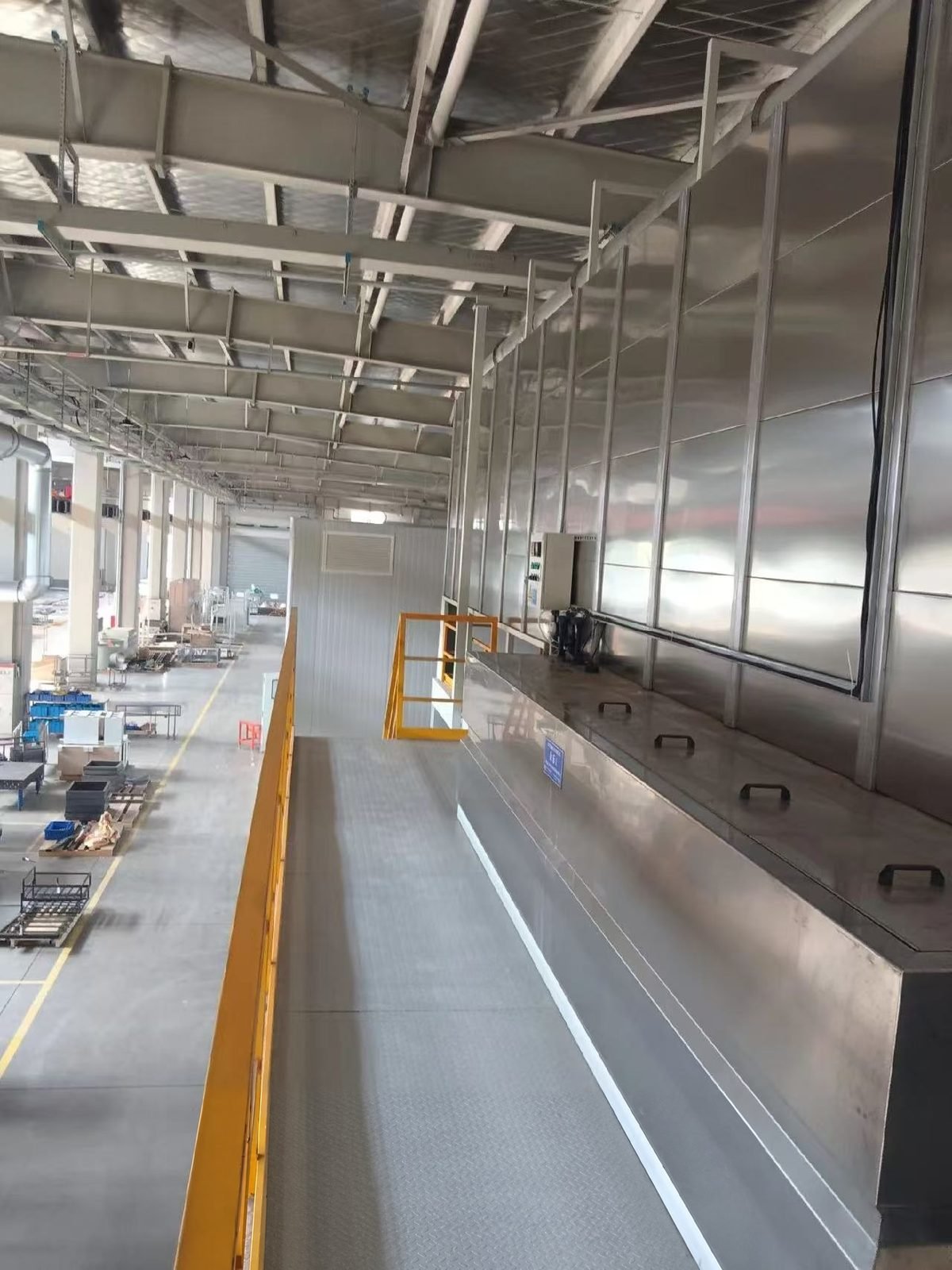
A coating line for an automotive parts manufacturer in Zhejiang built around a multi-stage pretreatment section with a maintenance walkway, feeding parts directly on a chain conveyor into the spray booth and curing oven so cleaned parts are coated without re-handling. The line includes exhaust treatment and runs in the client's regular production in 2026.
Project Background
The client is an automotive parts manufacturer in Zhejiang, part of the province’s dense vehicle-components supply base.
The Challenge
Coating quality on automotive parts starts with surface preparation: oil and residue left from forming and machining cause adhesion failures later. The client needed a line where pretreatment and coating run as one controlled process.
MUSI's Solution
MUSI built the line around a multi-stage pretreatment section with maintenance access, feeding the parts directly on the conveyor into the spray and curing stages so cleaned parts are coated without re-handling.
Equipment Scope
- Multi-stage pretreatment with maintenance walkway
- Chain conveyor
- Spray booth
- Curing oven
- Exhaust treatment
Results
The line runs in the client’s regular production, with pretreatment and coating linked on one conveyor.
Selection logic: why this configuration
A multi-stage pretreatment with full maintenance access was chosen because the client's adhesion failures came from oil and residue left after forming and machining, not from spraying; a walkway keeps nozzles and tanks serviced so the chemistry stays in range. Pretreatment and coating were placed on one conveyor so that a clean surface is never handled before it is coated.
Scope of supply and key components
| Item | Specification | Notes |
|---|---|---|
| Pretreatment | Multi-stage spray tunnel with maintenance walkway | |
| Conveyor | Chain conveyor | |
| Spray booth | Automatic spraying | |
| Curing oven | ||
| Exhaust treatment | Booth and oven exhaust |
Key components
Key components are available from international brands, configurable per customer specification, so that spare parts can be sourced locally over the life of the line. Brand names below are the usual options for this type of equipment; the brands actually fitted are fixed in the contract specification.
| Component | Brands available on request |
|---|---|
| Pretreatment pumps and chemistry | Grundfos CR, KSB Etanorm, Xylem; Henkel BONDERITE, Chemetall Gardobond, PPG Zircobond, Nippon Paint |
| Automatic powder guns and powder feed | Gema OptiGun, Nordson Encore, WAGNER PEA-X1, Sames (formerly SAMES KREMLIN) |
| Oven and dryer gas burners | Riello RS series, Weishaupt monarch WM-G, Baltur TBG, Honeywell Maxon OVENPAK, Eclipse |
| PLC and HMI | Siemens SIMATIC S7-1500, Mitsubishi Electric MELSEC iQ-R, Schneider Electric Modicon, OMRON NX, Rockwell Automation Allen-Bradley |
| Variable-frequency drives | ABB ACS580, Siemens SINAMICS G120, Danfoss VLT, Schneider Electric Altivar, Yaskawa, Mitsubishi Electric |
| Conveyor gear motors | SEW-EURODRIVE, NORD DRIVESYSTEMS, Bonfiglioli, Siemens, Sumitomo Drive Technologies |
| Sensors and temperature controllers | SICK, Pepperl+Fuchs, OMRON E5CC, Honeywell UDC, Yokogawa UT, ifm, KEYENCE |
| Dust collector filter cartridges | Donaldson Ultra-Web, Parker BHA, Camfil, MANN+HUMMEL |
Not included in the scope of supply
- Civil works, foundations and pits
- Building services up to the battery limit: power supply, gas, compressed air, water and drainage
- Local permits, emission approvals and third-party inspections
- Paint or powder supply, unless stated in the contract
Services included with every line: engineering design, manufacturing, shipping documentation, installation supervision, commissioning, operator training, warranty and spare parts.
Typical programme
The durations below are typical for equipment of this class and are given for planning; they are not the recorded schedule of this project. A complete line usually runs 90–180 days from contract to acceptance, a single unit 30–60 days.
| Stage | Typical duration | What happens |
|---|---|---|
| Site survey and workpiece review | 5–10 days | Remote review of drawings and photos, or an engineer visit |
| Layout and detail design | 15–30 days | Layout drawing, utilities list and specification sign-off |
| Manufacturing | 45–90 days | Booths, ovens, conveyor, pretreatment and controls built and pre-assembled at the works |
| Shipping | 20–45 days | Sea freight; equipment shipped in sections for on-site assembly |
| Installation | 15–40 days | MUSI supervision with the client's installation crew or MUSI crew |
| Commissioning, training and acceptance | 7–15 days | Trial runs on the client's parts, operator training, acceptance record |
Applicability and limits
The layout suits plants whose main quality issue is adhesion from surface contamination. Where the coating specification calls for heavy blast profiles or where parts are too large for a spray tunnel, the pretreatment section is designed differently.
Results shown in this case study reflect the stated operating conditions and should not be interpreted as guaranteed performance under different feed, production, environmental, or site conditions.
After-sales and spare parts
Warranty on a MUSI coating line runs from acceptance: 12 months on the complete line excluding consumables, 36 months on critical components such as motors, drives and the PLC, and 60 months on structural parts such as steel structure, ducting and oven bodies. Failures within warranty, excluding misuse, are repaired free of charge.
Support starts remotely: the service line is staffed around the clock, a preliminary diagnosis with recommendations is given within 2 hours, and where a site visit is needed an engineer reaches any major city within 72 hours. A spare-parts inventory is held at the Changzhou headquarters with same-day shipping, and customers can keep a dedicated parts stock at MUSI for emergencies. Details are on the after-sales service page.
FAQ
How many pretreatment stages does an automotive parts line need? Usually degrease, rinse, conversion coating, rinse and a final rinse, with a drying stage before spraying; the exact count follows the coating specification.
Why does the pretreatment have a walkway? So operators can check nozzles, tank levels and chemistry every shift; pretreatment that is not maintained is the usual cause of adhesion failures.
Can parts move from pretreatment to the booth without handling? Yes, on this line the chain conveyor carries parts through pretreatment, drying, spraying and curing in one flow.
What causes adhesion failures on automotive parts? Oil and residue from forming and machining left on the surface; the fix is controlled pretreatment before coating.
Is the line in production? Yes, with pretreatment and coating linked on one conveyor.
Next step: a configuration proposal for a similar line
If your parts, volumes or plant conditions are close to this project, MUSI can return a line configuration and layout proposal. To prepare it we need four things:
- Photos and dimensions of the workpieces, with weight and material
- Required output (pieces per hour or per day, and shifts)
- Number of colours and how often colour changes are needed
- Available floor space and ceiling height, with the utilities on site
Message us on WhatsApp with these details, or use the quotation form.
Published 2026-09-26 · Updated 2026-09-30 · Last technical review: 2026-09-30
Get a Similar Solution
If your industry and requirements match this case, contact MUSI to schedule a free consultation. We'll design an optimal solution based on your specific workpieces, capacity, and facility.
Provided by Lin Cong, Technical Director, MUSI Technology