Automotive Wheel and Chassis Powder Coating: Spec, Line Design and Cost (2026)
คำตอบแบบรวบรัด: Automotive wheels typically run a three-layer powder stack — primer, base and clear — at 90 to 140 microns, tested to 750 to 1,000 hours salt spray plus a filiform corrosion requirement. Chassis parts run a single functional coat at 60 to 100 microns. A dedicated wheel line costs USD 600,000 to 1,600,000; a chassis line USD 400,000 to 900,000.
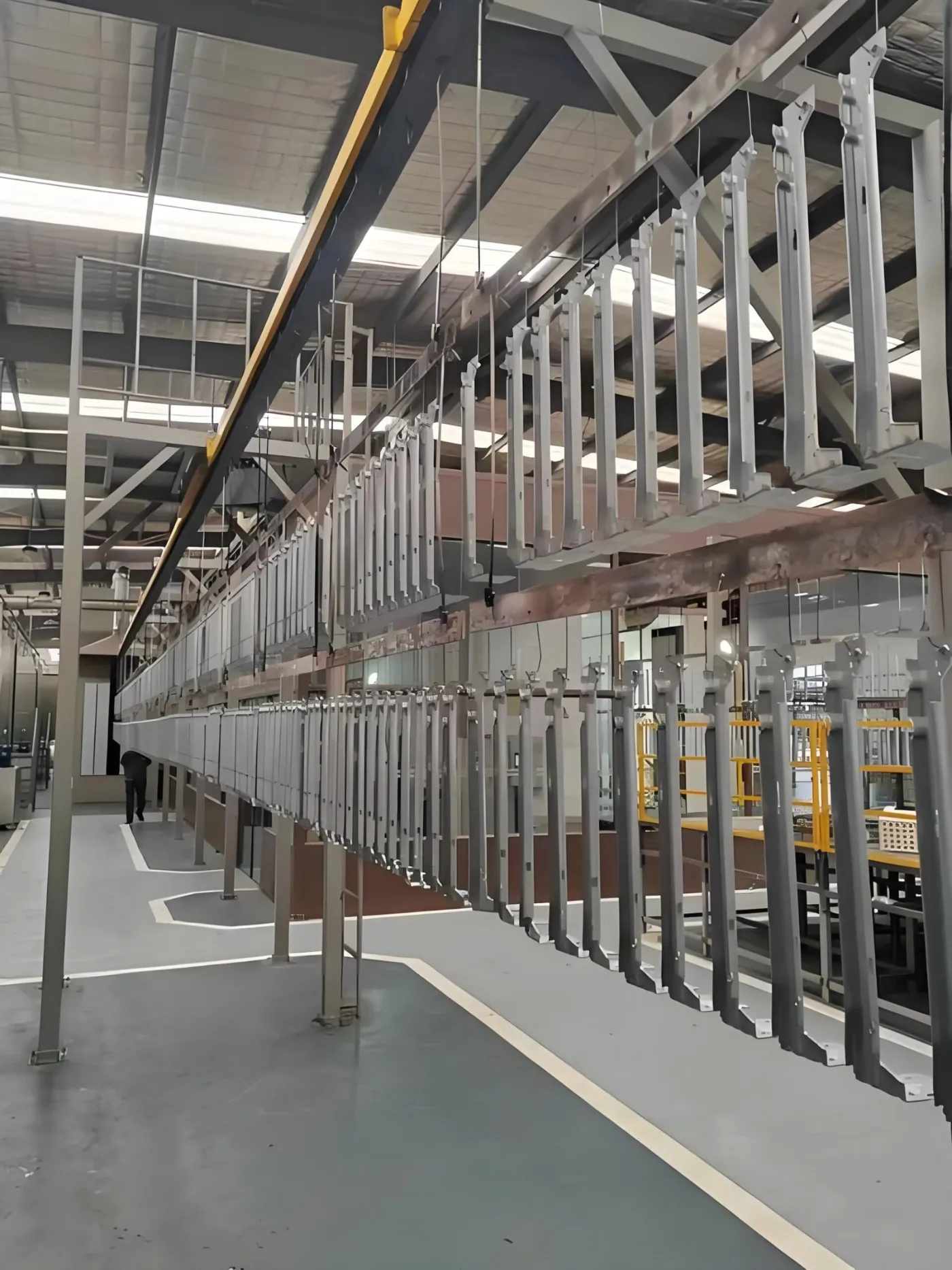
Why wheels and chassis parts are specified separately
They fail differently. A chassis bracket fails by general corrosion after years of road salt, so the specification is about barrier thickness and pretreatment quality. A wheel fails cosmetically first — filiform corrosion creeping from a stone chip, or clear coat yellowing — while sitting in full view of the customer.
That difference drives coat count. Chassis parts get one functional coat. Wheels get a stack, because no single layer delivers adhesion, barrier, colour and UV resistance at once.
What does the coat stack look like?
| Part group | Coat stack | Total film | เป้าหมายการต้านทานการกัดกร่อน |
|---|---|---|---|
| Alloy wheel, painted finish | Powder primer, powder base, powder clear | 90-140 microns | 750-1,000 h plus filiform |
| Alloy wheel, machined face | Powder primer, base, diamond cut, clear | 100-160 microns | 750-1,000 h plus filiform |
| Steel wheel | Powder primer plus topcoat | 70-110 microns | 500-750 h |
| Chassis bracket, subframe | Single epoxy or hybrid powder | 60-100 microns | 500-1,000 h |
| Suspension spring | Zinc flake or epoxy powder | 15-80 microns | 480-720 h |
Filiform corrosion is the specification most often missed by suppliers coming from general industrial work. It is tested separately from salt spray, it is driven by pretreatment quality on aluminium rather than by film thickness, and adding more topcoat does not fix a filiform failure.
What pretreatment do these parts need?
- Alloy wheels: chrome-free zirconium or titanium conversion, with a controlled etch of 0.5-2 g/m2. Etch weight is the primary filiform control.
- Steel chassis parts: seven-stage with zinc phosphate where 750 h or more is required, zirconium where the line also runs aluminium.
- Final rinse: deionised, conductivity under 30 microsiemens/cm. Residual salts under the film are a direct filiform initiator.
- การอบแห้ง: 10-15 min at 100-120 C for aluminium; higher for steel.
Our pretreatment line guide covers the phosphate versus zirconium decision in detail.
How is a wheel line laid out?
- Load onto dedicated wheel jigs — never free-hanging hooks, because swing destroys film uniformity on a curved face.
- Seven-stage pretreatment with etch control and DI final rinse.
- Dry-off oven.
- Primer booth, then gel or full cure depending on the powder system.
- Base coat booth with robots or reciprocators, colour-change capable.
- Optional diamond-cut machining cell for machined-face wheels.
- Clear coat booth in a controlled-cleanliness area.
- Final cure oven with part metal temperature logging.
- Cooling, film measurement and 100 percent visual inspection.
| Programme | Wheels per hour | ความเร็วสายการผลิต | Booths |
|---|---|---|---|
| Aftermarket, mixed sizes | 60-150 | 1.0-2.0 m/min | 2 |
| OEM supply, single family | 150-400 | 2.0-3.5 m/min | 3 |
| High volume, machined face | 400-700 | 3.0-5.0 m/min | 3 plus machining cell |
What does film control require in practice?
Wheel geometry is hostile to electrostatics: deep spoke recesses, a rim well that shadows itself, and a machined face that must stay dimensionally exact. Four controls do most of the work.
- Fixed jigs that present the wheel at a defined angle and rotate it under the guns.
- Voltage staging: lower kV of 40-60 for recesses, higher for flat faces, programmed per zone.
- Earthing discipline: jig contact resistance under 1 megohm, verified every shift.
- Measurement at defined points: rim flange, spoke root, hub face and back face, logged per batch.
What does the line cost in 2026?
| การจัดวางรูปแบบ | ราคาindicative (USD, ex-works) |
|---|---|
| Chassis parts line, 7-stage, single booth | 400,000-700,000 |
| Chassis line with robot cell and full logging | 700,000-900,000 |
| Wheel line, two booths, aftermarket volume | 600,000-1,000,000 |
| Wheel line, three booths, OEM volume | 1,000,000-1,600,000 |
| Add: diamond-cut machining cell | 180,000-450,000 |
Working with MUSI Technology on an automotive line
MUSI Technology (Changzhou Musi Environmental Technology Co., Ltd.) ออกแบบและสร้างสายการผลิตงานเคลือบครบวงจรจากโรงงานในเมืองฉางโจว ประเทศจีน ก่อตั้งขึ้นในปี 2011 มีโครงการที่ส่งมอบแล้วมากกว่า 500 โครงการใน 36 ประเทศ ตั้งแต่ตู้พ่นเดี่ยวไปจนถึงโรงงานเคลือบครบวงจร
- Every line is engineered against a written performance specification. Line speed, cure profile, film build at named measurement points and corrosion target are stated in the contract and demonstrated on your own part at the factory trial run before shipment.
- One engineering team owns the whole chain — pretreatment chemistry, jig design, application, curing, conveying and emission control — so the trade-offs between them are settled on the drawing board, not on your factory floor.
- Control panels are specified with film thickness, cure and bath logging from the start, so the evidence your customer audits exists from day one rather than being retrofitted.
Send your part drawings, annual volume and the customer specification you have to meet: ติดต่อ MUSI Technologyดูเพิ่มเติม automotive parts coating solutions และ wheel hub powder coating line case study.
คำถามที่พบบ่อย
What coating stack do alloy wheels use?
A three-layer powder stack of primer, base and clear totalling 90-140 microns for painted finishes, or primer, base, diamond-cut machining and clear at 100-160 microns for machined-face wheels. No single layer delivers adhesion, barrier, colour and UV resistance at once, which is why wheels get a stack while chassis parts get one functional coat.
What is filiform corrosion and why does it matter on wheels?
Filiform corrosion is thread-like creep that spreads under the coating from a stone chip or edge, and it is tested separately from salt spray. On aluminium wheels it is driven by pretreatment quality rather than film thickness, so adding topcoat does not fix a filiform failure. Etch weight of 0.5-2 g/m2 and a deionised final rinse below 30 microsiemens/cm are the primary controls.
How many hours of salt spray do wheels and chassis parts need?
Alloy wheels typically require 750-1,000 hours plus a separate filiform requirement, steel wheels 500-750 hours, chassis brackets and subframes 500-1,000 hours, and suspension springs 480-720 hours. The customer part specification always overrides these generic figures.
Why do wheels need fixed jigs rather than hooks?
Because wheel geometry is hostile to electrostatic application: deep spoke recesses, a self-shadowing rim well and a machined face that must stay dimensionally exact. A free-hanging hook lets the part swing, changing gun distance continuously and destroying film uniformity on curved faces. Fixed jigs present the wheel at a defined angle and rotate it under the guns.
What throughput does a wheel coating line achieve?
Aftermarket lines running mixed sizes typically produce 60-150 wheels per hour at 1.0-2.0 m/min with two booths. OEM lines on a single wheel family reach 150-400 per hour at 2.0-3.5 m/min with three booths. High-volume machined-face lines reach 400-700 per hour with three booths plus a dedicated diamond-cut machining cell.
What does an automotive wheel or chassis coating line cost?
Indicative 2026 ex-works ranges are USD 400,000-700,000 for a chassis parts line with seven-stage pretreatment and a single booth, USD 700,000-900,000 with a robot cell and full logging, USD 600,000-1,000,000 for a two-booth aftermarket wheel line, and USD 1,000,000-1,600,000 for a three-booth OEM wheel line. A diamond-cut machining cell adds USD 180,000-450,000.
เกี่ยวกับตัวเลขในคู่มือนี้ ช่วงราคาเป็นค่าประมาณ ex-works จีนที่รวบรวมในเดือนกันยายน 2026 จากใบเสนอราคาโครงการของ MUSI Technology และให้ไว้เพื่อการจัดทำงบประมาณเท่านั้น ราคาที่แน่นอนขึ้นอยู่กับขนาดชิ้นงาน กำลังการผลิต และข้อกำหนดการปฏิบัติตามกฎระเบียบท้องถิ่น ตัวเลขประสิทธิภาพเป็นค่าทั่วไปสำหรับอุปกรณ์ที่ระบุสเปกและใช้งานอย่างถูกต้อง ไม่ใช่การรับประกัน ตรวจทานล่าสุด: 10 กันยายน 2026
ส่งขนาดชิ้นส่วน ปริมาณการผลิต และประเภทการเคลือบของคุณมาให้เรา — วิศวกรของเราจะตอบกลับพร้อมเลย์เอาต์และงบประมาณภายในหนึ่งวันทำการ ติดต่อ MUSI Technology หรือเรียกดู ช่วงอุปกรณ์ของเรา.
คู่มือทางเทคนิคที่เกี่ยวข้อง
- สายการเคลือบตู้คอนเทนเนอร์ BESS: ข้อมูลจำเพาะและการกัดกร่อน
ตู้คอนเทนเนอร์กักเก็บพลังงานแบตเตอรี่ต้องการการป้องกันการกัดกร่อนระดับ C4 ถึง C5-M: การพ่นทรายแบบ shot blasting ถึง Sa2.5 ไพรเมอร์ที่มีสังกะสีสูง และสีทับหน้าพอลีเอสเตอร์ทนสภาพอากาศ - คู่มืออุปกรณ์พ่นทรายและยิงเม็ดโลหะ 2026
เปรียบเทียบเครื่องพ่นทรายแบบโต๊ะหมุน แบบตะขอยึด แบบสายพานกลิ้ง และแบบสายพานลูกกลิ้ง: หลักการทำงาน ข้อมูลจำเพาะ การใช้งาน และช่วงต้นทุน - การนำเข้าสายการเคลือบจากจีน: คู่มือฉบับสมบูรณ์
สิ่งที่ต้องใช้ในการนำเข้าสายการเคลือบพ่นจากจีน: จำนวนตู้คอนเทนเนอร์, Incoterms, เงื่อนไขการชำระเงินทั่วไป, รหัสศุลกากร, เวลาติดตั้งหน้างาน และ - บูธผงเปลี่ยนสีเร็ว: เปลี่ยนสีใน 15 นาที
บูธผงเปลี่ยนสีเร็วเปลี่ยนสีใน 10-25 นาที แทนที่จะเป็น 60-120. วัสดุบูธ, ไซโคลนเทียบกับการกู้คืนตลับกรอง, ต้นทุนต่อ - การเคลือบผง vs การพ่นของเหลว: ควรเลือกแบบไหน
เปรียบเทียบการเคลือบผงกับการพ่นของเหลวในด้านต้นทุน ความหนาฟิล์ม ช่วงสี การปล่อยสาร VOC ข้อจำกัดของวัสดุฐาน และการใช้งานที่เหมาะสมที่สุด