Case Study: Container Shot Blasting Line, Yangzhou
Summary
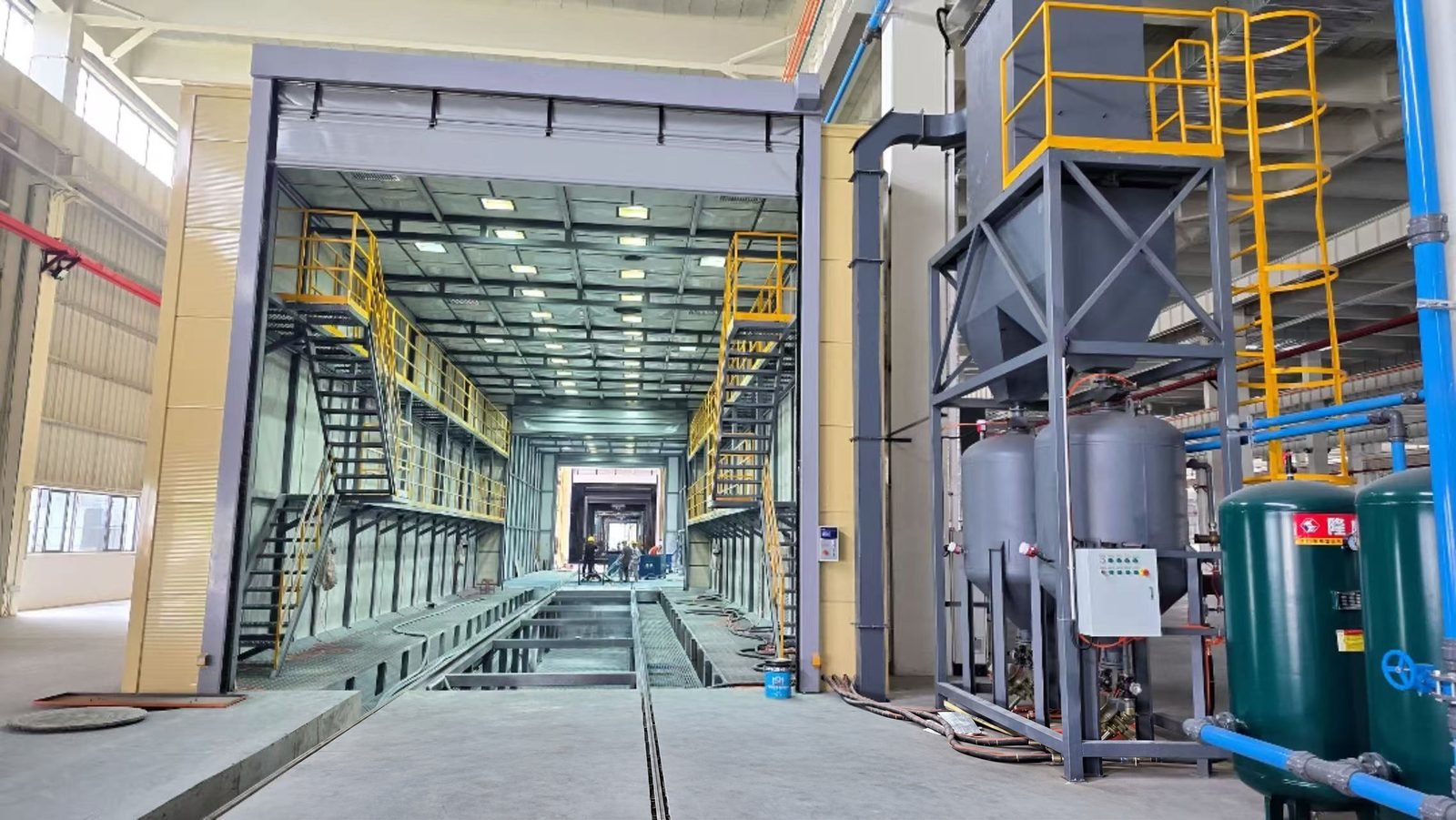
A container-scale shot blasting line for the Yangzhou base of a major container group, preparing welded box bodies for painting by removing mill scale, weld spatter and rust evenly across very large surfaces while the dust stays inside the room. The line comprises an automatic blasting room with blasting on both sides and the top, abrasive recovery back to the blast pots, cartridge dust collection and a cleaning room that blows residual abrasive and dust off the box before painting. The reference configuration on this page gives the typical sizing for 20-ft boxes. The line is in production in 2026.
Project Background
The client’s Yangzhou base, part of a major container group, builds standard and special containers, reefers, energy-storage containers and modular buildings. MUSI supplied a shot blasting line for container surface preparation.
The group's customers are ocean carriers and container leasing companies, Evergreen Marine among them; the Yangzhou base also builds energy-storage containers and modular buildings.
The Challenge
Paint on a container is only as good as the steel underneath it. Welded box bodies come out of fabrication with mill scale, weld spatter and rust, and all of it has to be removed evenly across very large surfaces before painting, while the dust stays inside the room.
MUSI's Solution
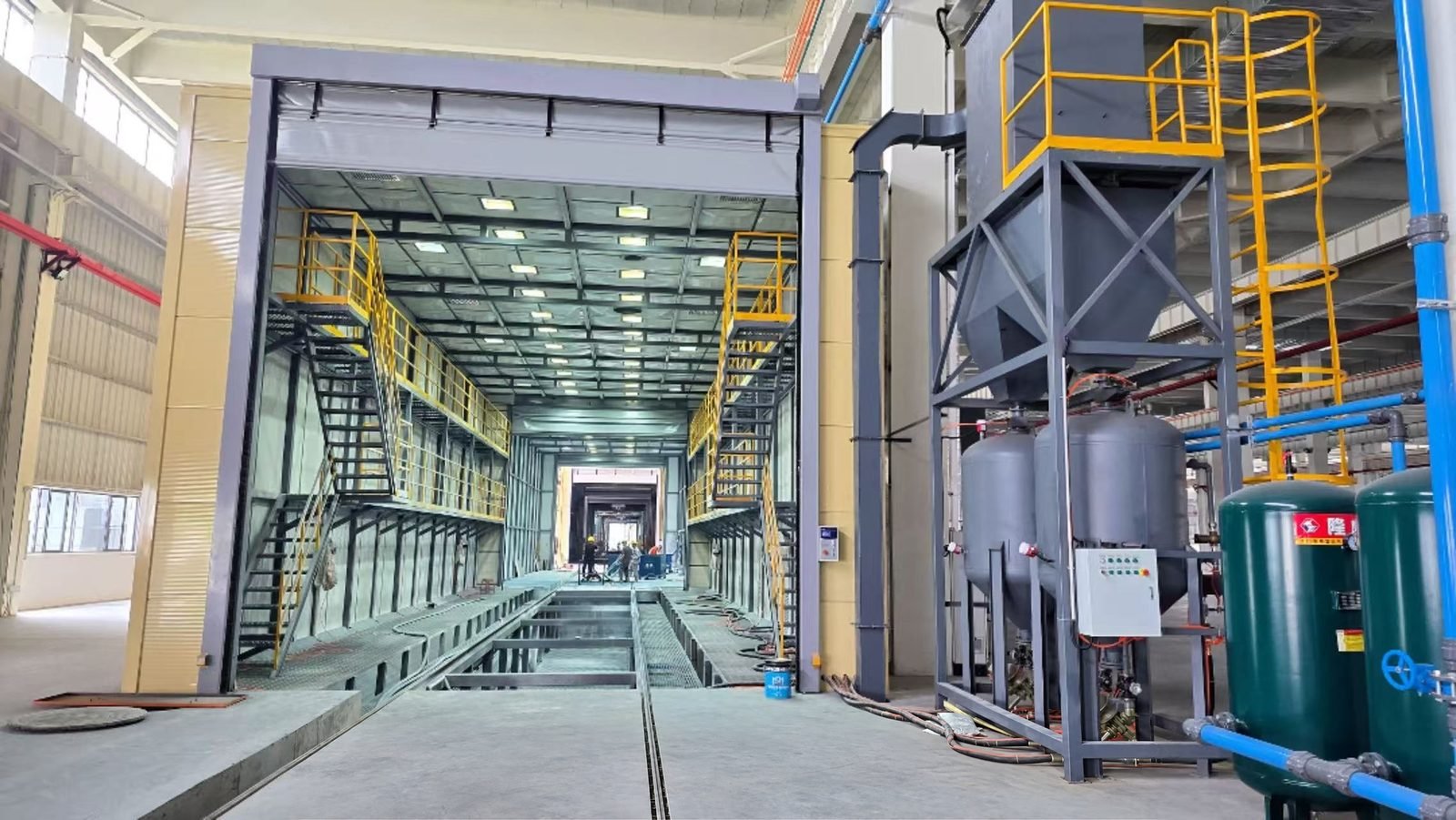
MUSI supplied a container-scale blasting line: a blasting room with automatic blasting on the sides and top, abrasive recovery that returns the media to the blast pots, and cartridge dust collection, followed by a cleaning room that blows residual abrasive and dust off the box before it moves to painting.
Equipment Scope
- Automatic shot blasting room
- Abrasive recovery and storage hopper
- Cartridge dust collector
- Cleaning room with automatic blow-off
Reference Configuration: Container Shot Blasting
Typical configuration of an automatic blasting section for 20-ft boxes, taken from a current container-scale line design:
| Blasting room | 10 × 6.6 × 5 m steel-structure room with wear-resistant lining and grating floor |
|---|---|
| Automation | Three servo reciprocators (both sides and top) with pressure blast pots and boron carbide nozzles; manual station for the underside |
| Abrasive recovery | Screw conveyors, bucket elevator, separator and storage hopper |
| Dust collection | Cartridge dust collector with pulse-jet cleaning |
| Cleaning room | 10 × 6.6 × 5 m, automatic blow-off nozzles on both sides and top |
| Controls | PLC with touch screen, door interlocks and emergency stops |
Results
The line is in production at the Yangzhou plant, preparing container bodies for painting.
Selection logic: why this configuration
Automatic blasting on the sides and top with a manual station for the underside was chosen over fully manual blasting because container faces are large and flat, where servo reciprocators give an even profile at production speed, while the underside has fittings that an operator handles more easily. A separate cleaning room with automatic blow-off was included so abrasive is not carried into the paint booths.
Scope of supply and key components
| Item | Specification | Notes |
|---|---|---|
| Blasting room | Automatic blasting on both sides and top, manual underside | Reference: 10 × 6.6 × 5 m, three servo reciprocators |
| Abrasive recovery | Screw conveyors, bucket elevator, separator, storage hopper | |
| Dust collection | Cartridge collector with pulse-jet cleaning | |
| Cleaning room | Automatic blow-off nozzles | Reference: 10 × 6.6 × 5 m |
| Controls | PLC with touch screen, door interlocks, emergency stops |
Key components
Key components are available from international brands, configurable per customer specification, so that spare parts can be sourced locally over the life of the line. Brand names below are the usual options for this type of equipment; the brands actually fitted are fixed in the contract specification.
| Component | Brands available on request |
|---|---|
| Steel shot and grit | Ervin AMASTEEL, Winoa W Abrasives, Pometon |
| Dust collector filter cartridges | Donaldson Ultra-Web, Parker BHA, Camfil, MANN+HUMMEL |
| PLC and HMI | Siemens SIMATIC S7-1500, Mitsubishi Electric MELSEC iQ-R, Schneider Electric Modicon, OMRON NX, Rockwell Automation Allen-Bradley |
| Variable-frequency drives | ABB ACS580, Siemens SINAMICS G120, Danfoss VLT, Schneider Electric Altivar, Yaskawa, Mitsubishi Electric |
| Conveyor gear motors | SEW-EURODRIVE, NORD DRIVESYSTEMS, Bonfiglioli, Siemens, Sumitomo Drive Technologies |
| Compressed air for powder feed and instruments | Atlas Copco GA, Ingersoll Rand RS, KAESER ASD, Sullair |
| Pneumatics | Festo, SMC, Parker Hannifin, Norgren |
| Explosion isolation, venting and spark detection | Fike, REMBE Q-Rohr, Firefly, IEP Technologies, BS&B Safety Systems |
Not included in the scope of supply
- Civil works, foundations and pits
- Building services up to the battery limit: power supply, gas, compressed air, water and drainage
- Local permits, emission approvals and third-party inspections
- Paint or powder supply, unless stated in the contract
- Painting equipment: this project covers surface preparation only
Services included with every line: engineering design, manufacturing, shipping documentation, installation supervision, commissioning, operator training, warranty and spare parts.
Typical programme
The durations below are typical for equipment of this class and are given for planning; they are not the recorded schedule of this project. A complete line usually runs 90–180 days from contract to acceptance, a single unit 30–60 days.
| Stage | Typical duration | What happens |
|---|---|---|
| Data review and sizing | 3–7 days | Exhaust data or part drawings reviewed remotely |
| Design | 10–20 days | General arrangement and connection points |
| Manufacturing | 30–60 days | Unit built and factory tested |
| Shipping | 20–45 days | Sea freight |
| Installation and connection | 7–25 days | Ducting, gas or utilities connected on site |
| Commissioning and acceptance | 5–10 days | Performance run and acceptance record |
Applicability and limits
The configuration is sized for 20-ft and 40-ft steel box bodies; blast profile and cleanliness grade are set by the paint specification, and abrasive consumption depends on the steel condition entering the room. Aluminium or stainless boxes need a different abrasive and are not covered by this design.
Results shown in this case study reflect the stated operating conditions and should not be interpreted as guaranteed performance under different feed, production, environmental, or site conditions.
After-sales and spare parts
Warranty on a MUSI coating line runs from acceptance: 12 months on the complete line excluding consumables, 36 months on critical components such as motors, drives and the PLC, and 60 months on structural parts such as steel structure, ducting and oven bodies. Failures within warranty, excluding misuse, are repaired free of charge.
Support starts remotely: the service line is staffed around the clock, a preliminary diagnosis with recommendations is given within 2 hours, and where a site visit is needed an engineer reaches any major city within 72 hours. A spare-parts inventory is held at the Changzhou headquarters with same-day shipping, and customers can keep a dedicated parts stock at MUSI for emergencies. Details are on the after-sales service page.
FAQ
Why blast a container before painting? Mill scale, weld spatter and rust left on the steel cause the paint to fail early; blasting gives a clean, uniform profile the primer can bond to.
How is a container blasted automatically? Servo reciprocators on both sides and the top move pressure-blast nozzles along the box while it stands in the room; the underside is finished from a manual station.
What happens to the abrasive? It falls through the grating floor to screw conveyors, is lifted, separated from dust and fines and returned to the blast pots from a storage hopper.
How is dust kept out of the paint shop? A cartridge dust collector keeps the blast room under negative pressure, and a cleaning room with automatic blow-off removes residual abrasive before the box moves to painting.
Is this line also a painting line? No, this project is the surface-preparation section; the group's painting lines are described in the related case studies.
Next step: a configuration proposal for a similar line
If your parts, volumes or plant conditions are close to this project, MUSI can return a line configuration and layout proposal. To prepare it we need four things:
- Photos and dimensions of the workpieces, with weight and material
- Required output (pieces per hour or per day, and shifts)
- Number of colours and how often colour changes are needed
- Available floor space and ceiling height, with the utilities on site
Message us on WhatsApp with these details, or use the quotation form.
Published 2026-09-26 · Updated 2026-09-30 · Last technical review: 2026-09-30
Get a Similar Solution
If your industry and requirements match this case, contact MUSI to schedule a free consultation. We'll design an optimal solution based on your specific workpieces, capacity, and facility.
Provided by Lin Cong, Technical Director, MUSI Technology