Energy-Storage Container Coating Line for the Middle East: Designing for Heat, Sand and UV
Quick answer: An energy-storage container built for the Gulf has to survive three things a European box never sees: summer surface temperatures far above ambient, wind-blown sand, and relentless UV. The coating line that makes those boxes has to deliver a thicker, UV-stable topcoat system with no dust in the film, and the paint shop itself has to keep working when outside air is hot and dusty.
What the site does to the box
Battery enclosures in desert solar-plus-storage projects sit in direct sun for their whole life. Dark surfaces heat up well beyond air temperature, which pushes the paint system and the thermal management inside the box. Sand abrades exposed edges and door frames, and UV breaks down binders that are not built for it, leading to chalking and colour drift within a few summers.
| Topcoat choice | aliphatic polyurethane or fluoropolymer liquid topcoats, or super-durable powder, in light, high-reflectance colours. |
|---|---|
| Film build | a primer–intermediate–topcoat system rather than a single coat, so edges and weld seams keep enough film after years of abrasion. |
| Edges and seams | automatic reciprocators on both sides, top and bottom, plus robot or manual stripe coating on door frames and lifting points. |
Keeping the paint shop clean and cool
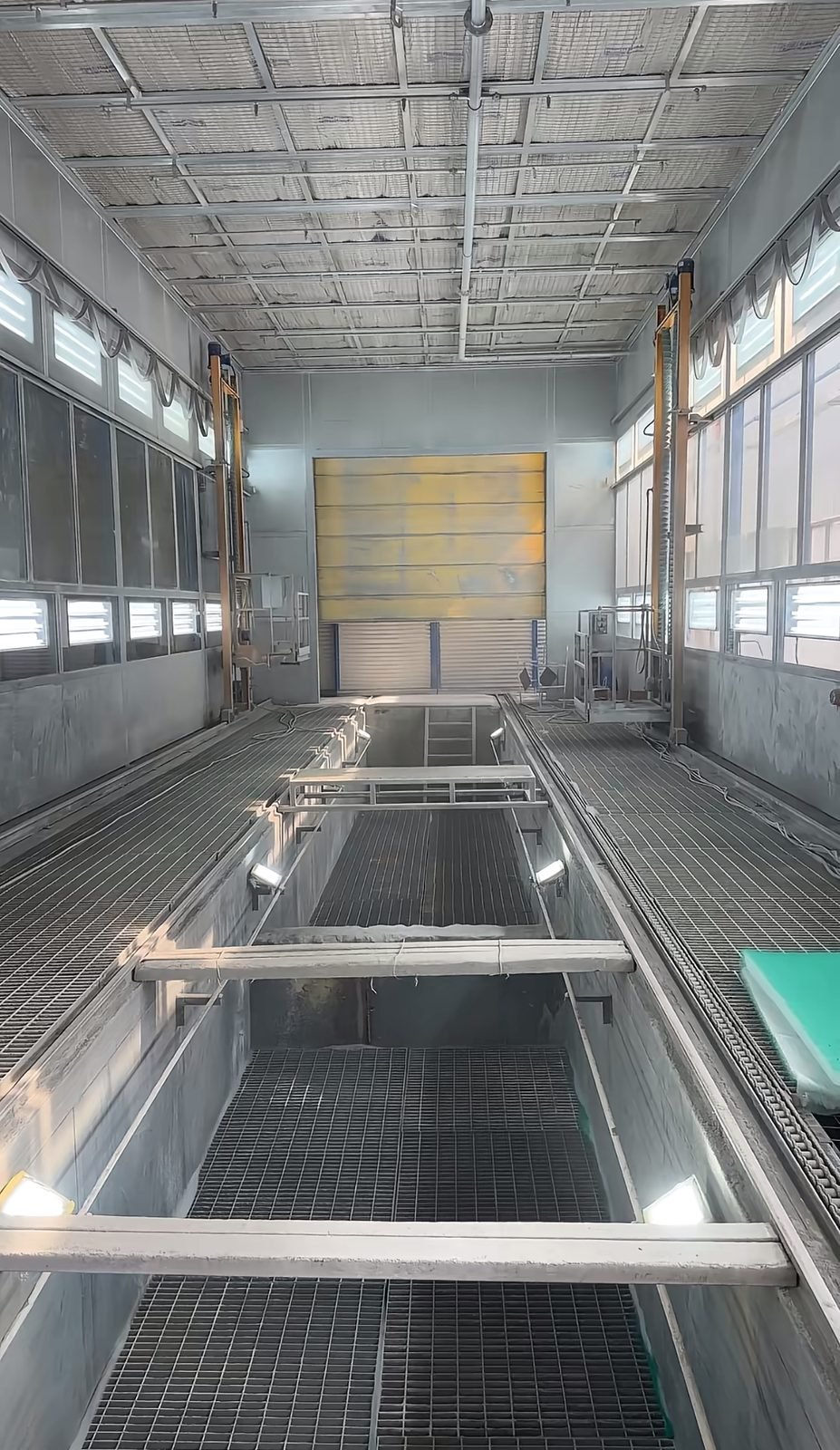
A dust-free film starts with the air. Booths should run under slight positive pressure on filtered supply air, with high-speed roller doors between stations so sand does not ride in with the boxes. In summer, conditioning the booth supply air keeps paint viscosity and flash-off times stable; without it, the same paint behaves differently in June and in January.
Blasting matters as much as painting: an automatic blasting room with abrasive recovery and a cartridge dust collector, followed by a blow-off cleaning room, removes mill scale and leaves a profile the primer can grip.
Reference line configuration
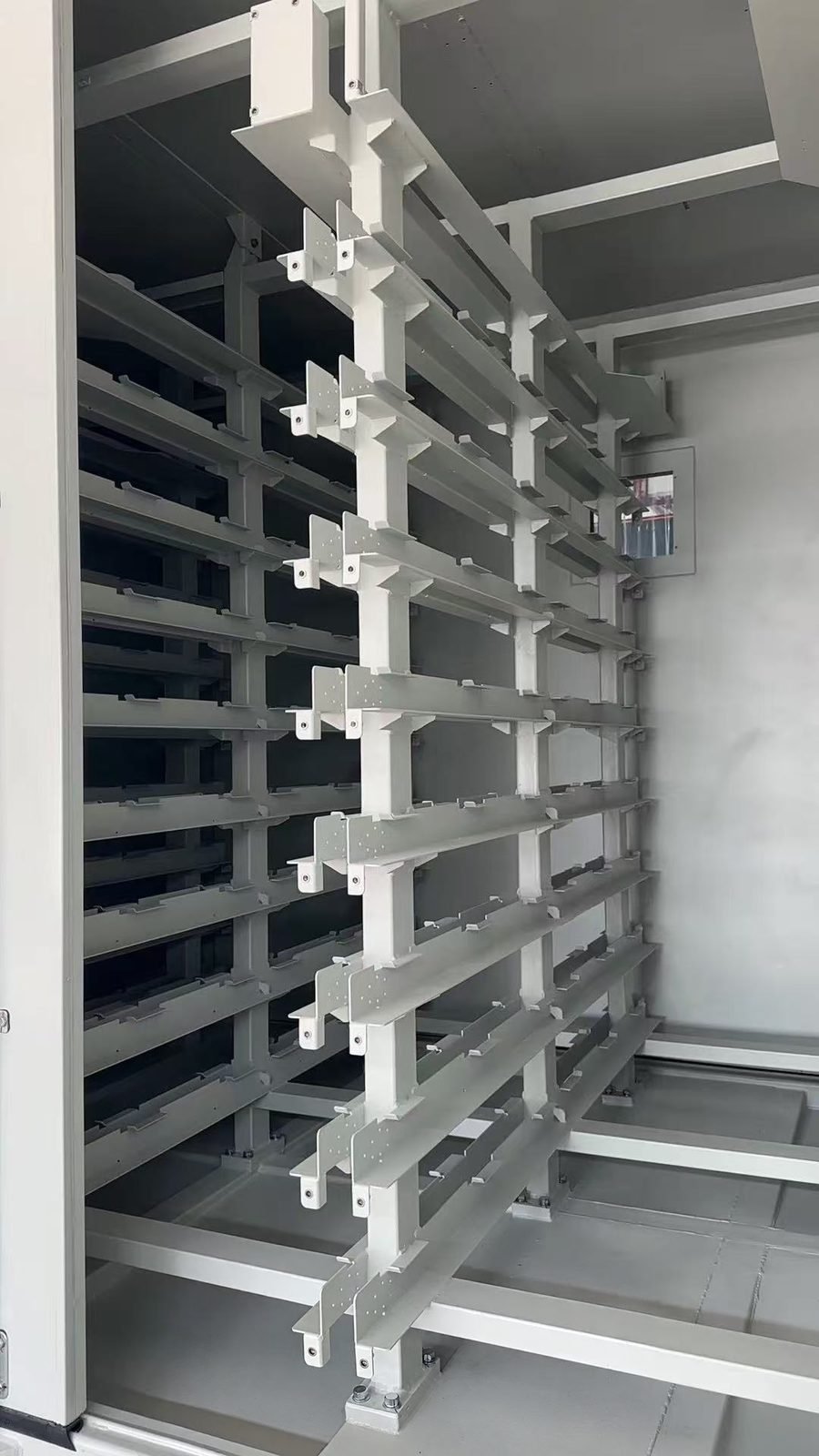
For reference, a current 20-ft energy-storage box line design handles boxes of 6,058 × 2,438 × 2,591 mm up to 2,500 kg on a box-pulling chain, with automatic blasting, primer, intermediate and topcoat booths of 10 × 6.6 × 5.2 m, paint drying at 80–120 °C, powder curing at 200–220 °C, a rain test chamber and 160,000 m³/h of VOC treatment. The full table is on our container line case; MUSI’s fastest energy-storage box lines release one finished box per minute.
FAQ
Powder or liquid for desert boxes? Both work. Liquid systems allow a thick multi-coat build and easy colour change; super-durable powder gives excellent UV resistance with no solvent emissions. Many lines combine powder and liquid stations.
Do the insides need coating? Yes. Interior surfaces see condensation cycles, so an interior-cavity primer, often applied by robot, is part of the design.
Where MUSI Technology fits
MUSI designs complete energy-storage box lines — blasting, pretreatment, booths, ovens, conveying, rain testing and VOC treatment — and has delivered them to leading battery makers. Send your box size, output and paint system and our engineers will prepare a layout.
Provided by Lin Cong, Technical Director, MUSI Technology
Send us your part size, throughput and coating type — our engineers reply with a layout and budget within one working day. Contact MUSI Technology or browse our equipment range.
Further Reading
- ProductsEnergy Storage Container Coating Line
- IndustryEnergy Storage Container Coating
- Technical guidesEnergy Storage Container Coating Line: Corrosion Spec and Layout (2026)
Energy-Storage Box Painting Lines for Europe: Meeting VOC Limits Without Losing Throughput
Coating Energy-Storage Enclosures for Coastal and Offshore Sites: Designing for ISO 12944 C5 and CX
Energy-Storage Cabinet Coating Lines in Southeast Asia: Controlling Humidity, Flash Rust and Cure
Energy-Storage Container Painting Lines for North America: Air Permits, Booth Safety and High Throughput
Energy-Storage Box Coating Lines for Africa: Compact Lines for Local Assembly
Energy-Storage Box Painting Lines for Latin America: Desert Sun, Altitude and Local Content
Energy-Storage Box Coating Lines for India: Scaling Local BESS Enclosure Production
Coating Energy-Storage Cabinets for Cold Climates: Nordic, Canadian and Central Asian Plants - Case StudiesEnergy-Storage Cabinet Spray Coating Line, Jiangsu
Energy-Storage Enclosure Painting Line for a Global Battery Maker
Energy-Storage Cabinet & Container Painting Line, Jiangyin