Case Study: Energy-Storage Cabinet & Container Painting Line, Jiangyin
Summary
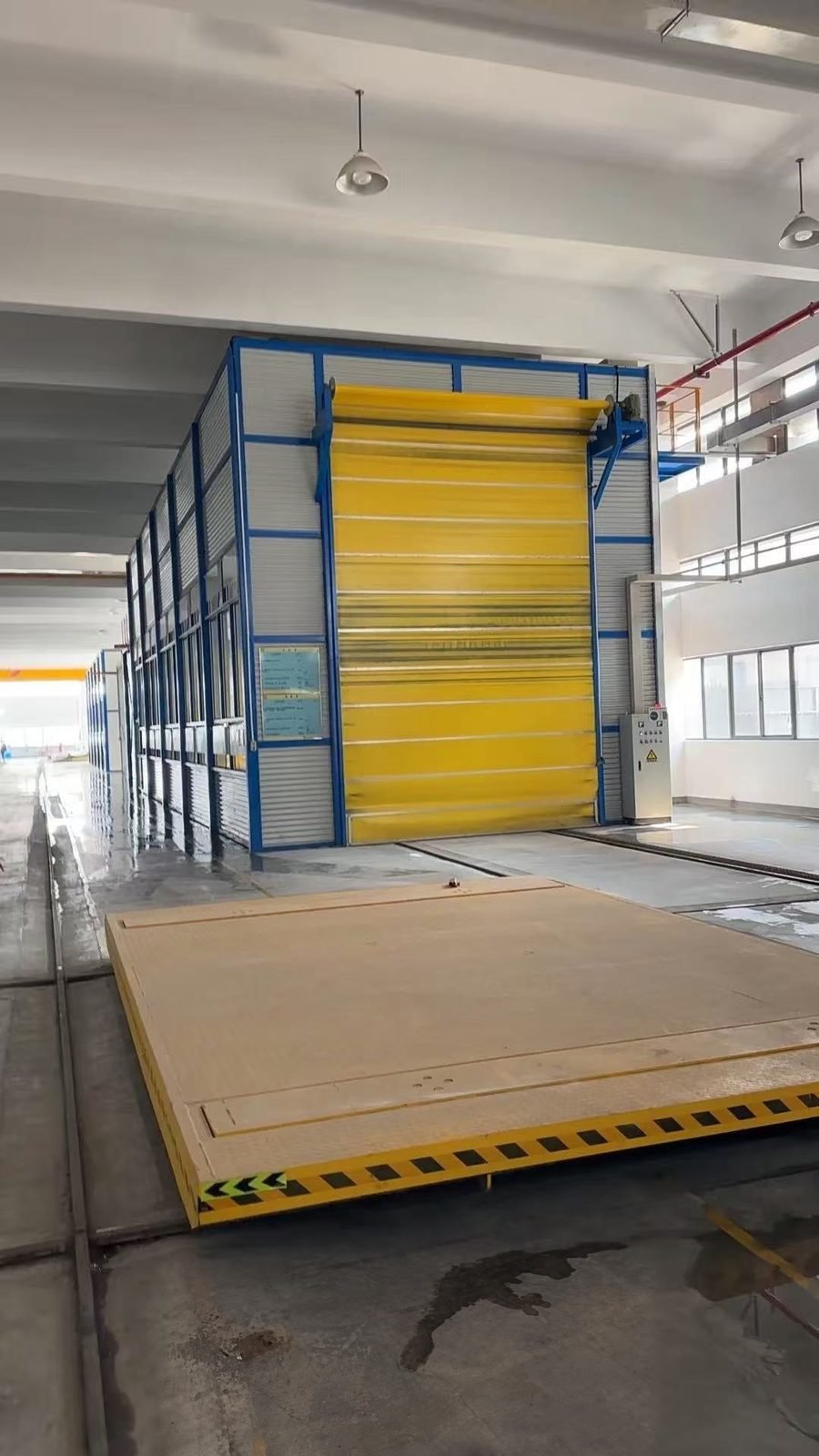
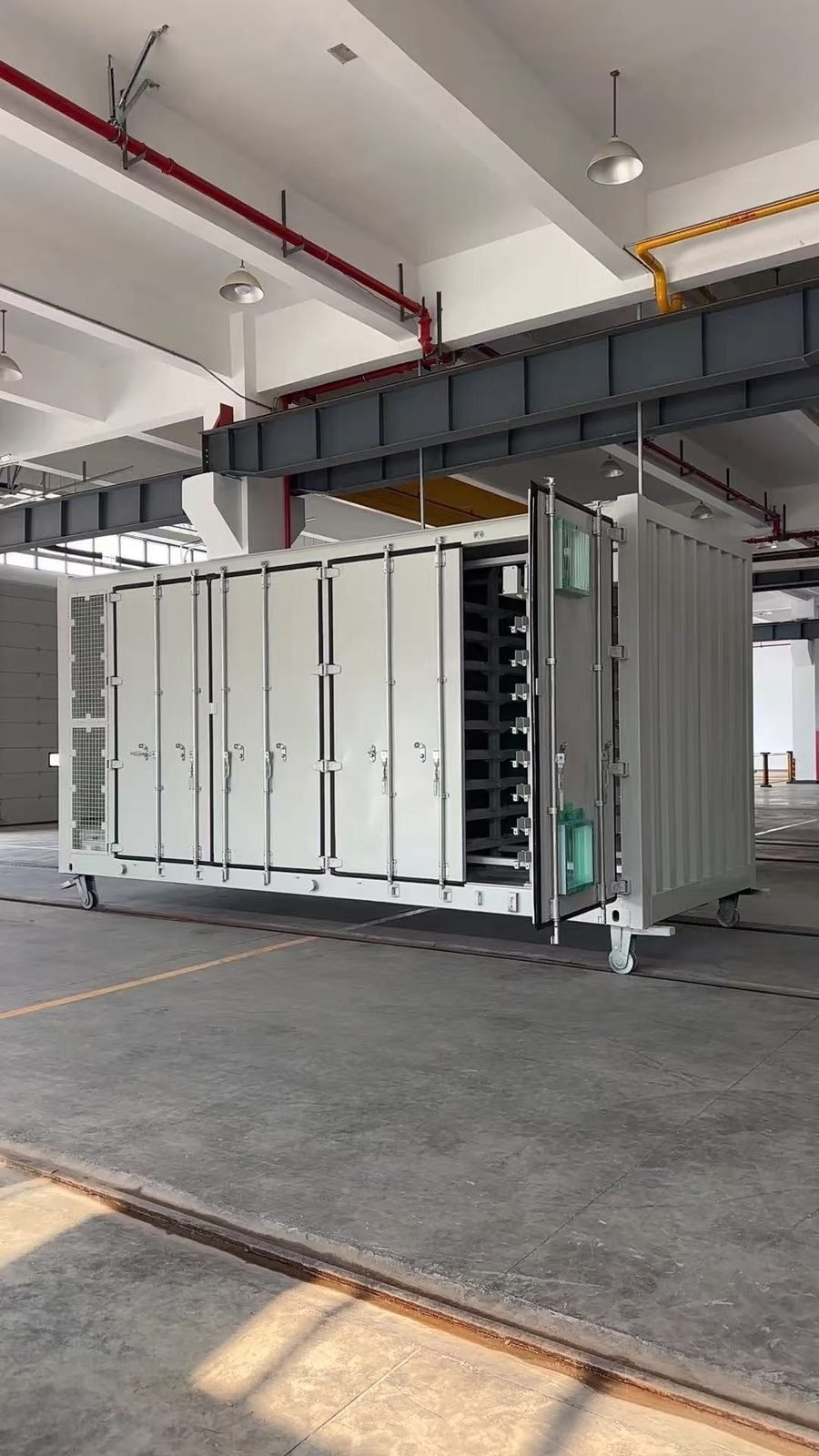
An energy-storage box painting line for a system integrator with offices in Shanghai and a factory in Jiangyin, Jiangsu, which builds air-cooled and liquid-cooled storage cabinets, 20-ft battery containers and PCS-Boost containers for power stations, grids, charging stations and commercial users. The line comprises surface preparation, container-scale paint booths for primer and topcoat with a high-speed roller door and transfer cart, drying and forced cooling, and exhaust with VOC treatment. The reference configuration on this page is a current 20-ft box line design. The line is in production in 2026.
Project Background
The client is an energy-storage system integrator with offices in Shanghai and a factory in Jiangyin, Jiangsu. It builds air-cooled and liquid-cooled storage cabinets, 20-ft battery containers and PCS-Boost containers for power stations, grids, charging stations and commercial users. MUSI supplied its energy-storage box painting line.
The Challenge
An energy-storage box stands outdoors for the whole service life of the batteries inside it. The paint has to protect the steel against sun, rain and corrosion for years, every seam and door frame has to be covered, and output has to keep up with fast-growing storage demand.
MUSI's Solution
MUSI supplied a painting line sized for energy-storage boxes: surface preparation, container-scale paint booths for primer and topcoat, drying and forced cooling, and exhaust treatment, with boxes moved between stations so each one follows the same sequence and receives the same film build.
Equipment Scope
- Surface preparation
- Container-scale paint booths for primer and topcoat
- Drying and forced cooling
- Transfer system between stations
- Exhaust and VOC treatment
Reference Configuration: 20-ft Energy-Storage Box Line
The figures below come from a current 20-ft energy-storage box line design. They show how a line of this type is typically configured; each plant’s line is sized to its own product mix and output.
| Workpiece | 20-ft box, 6,058 × 2,438 × 2,591 mm, up to 2,500 kg |
|---|---|
| Conveyor | Box-pulling chain (32A roller chain), approx. 280 m |
| Surface preparation | Automatic shot blasting room (10 × 6.6 × 5 m) with servo reciprocators on both sides and top; cleaning room with automatic blow-off; abrasive recovery and cartridge dust collector |
| Liquid paint booths | Primer, intermediate and topcoat booths, 10 × 6.6 × 5.2 m, reciprocators on both sides, top and bottom; interior-cavity primer applied by robot |
| Robots | Yaskawa 7-axis explosion-proof, 15 kg payload, 2,700 mm reach, on travel rails |
| Paint supply | High-pressure airless automatic guns from international tier-one spray gun brands; 2K automatic mixing for primer, intermediate and topcoat |
| Powder booth | Automatic, 9.8 × 4.9 × 4.2 m; cyclone and cartridge recovery; explosion isolation valves and flameless venting |
| Ovens | Paint drying 80–120 °C; powder curing 200–220 °C; direct natural-gas heating (280,000 and 440,000 kcal/h burners); forced cooling after each oven |
| Quality check | Rain test chamber, 10 × 6 × 5 m |
| VOC treatment | 160,000 m³/h dry filtration + activated carbon adsorption + catalytic combustion |
| Output | Reference layout: 20 boxes per 12 hours. MUSI’s fastest energy-storage box lines release one finished box per minute. |
Results
The line paints the enclosures for the client’s cabinets and containers. At their fastest, MUSI’s energy-storage box lines release one finished box per minute.
Selection logic: why this configuration
Booths sized for 20-ft containers were chosen so that the client's cabinets and containers share the same stations, with cabinets moved on rail carts and painted with doors open to reach the interior. A high-speed roller door on the booth was specified to hold booth pressure between cart movements, and drying with forced cooling keeps primer-to-topcoat time short.
Scope of supply and key components
| Item | Specification | Notes |
|---|---|---|
| Surface preparation | ||
| Paint booths | Container-scale, high-speed roller door, transfer cart | |
| Drying | Drying and forced cooling | |
| Transfer system | Rail carts between stations | |
| Exhaust and VOC treatment |
Key components
Key components are available from international brands, configurable per customer specification, so that spare parts can be sourced locally over the life of the line. Brand names below are the usual options for this type of equipment; the brands actually fitted are fixed in the contract specification.
| Component | Brands available on request |
|---|---|
| Automatic liquid guns, pumps and 2K proportioners | International tier-one spray gun, pump and 2K proportioner brands |
| Painting robots | ABB IRB 5500, FANUC P-350iA, Yaskawa MOTOMAN MPX series, KUKA, Kawasaki |
| Oven and dryer gas burners | Riello RS series, Weishaupt monarch WM-G, Baltur TBG, Honeywell Maxon OVENPAK, Eclipse |
| PLC and HMI | Siemens SIMATIC S7-1500, Mitsubishi Electric MELSEC iQ-R, Schneider Electric Modicon, OMRON NX, Rockwell Automation Allen-Bradley |
| Variable-frequency drives | ABB ACS580, Siemens SINAMICS G120, Danfoss VLT, Schneider Electric Altivar, Yaskawa, Mitsubishi Electric |
| Booth ceiling and intake filter media | Freudenberg Viledon, AAF SureStop, Camfil, MANN+HUMMEL |
| RTO ceramic media and burners | Lantec MLM, Honeywell Maxon line burners, Riello RS, Eclipse |
| Sensors and temperature controllers | SICK, Pepperl+Fuchs, OMRON E5CC, Honeywell UDC, Yokogawa UT, ifm, KEYENCE |
Not included in the scope of supply
- Civil works, foundations and pits
- Building services up to the battery limit: power supply, gas, compressed air, water and drainage
- Local permits, emission approvals and third-party inspections
- Paint or powder supply, unless stated in the contract
Services included with every line: engineering design, manufacturing, shipping documentation, installation supervision, commissioning, operator training, warranty and spare parts.
Typical programme
The durations below are typical for equipment of this class and are given for planning; they are not the recorded schedule of this project. A complete line usually runs 90–180 days from contract to acceptance, a single unit 30–60 days.
| Stage | Typical duration | What happens |
|---|---|---|
| Site survey and workpiece review | 5–10 days | Remote review of drawings and photos, or an engineer visit |
| Layout and detail design | 15–30 days | Layout drawing, utilities list and specification sign-off |
| Manufacturing | 45–90 days | Booths, ovens, conveyor, pretreatment and controls built and pre-assembled at the works |
| Shipping | 20–45 days | Sea freight; equipment shipped in sections for on-site assembly |
| Installation | 15–40 days | MUSI supervision with the client's installation crew or MUSI crew |
| Commissioning, training and acceptance | 7–15 days | Trial runs on the client's parts, operator training, acceptance record |
Applicability and limits
The reference configuration is a design for 20-ft boxes and its output is a design value; the line is sized to the client's cabinet and container mix. Liquid-cooled cabinets carry fittings and ports that are masked per drawing before painting.
Results shown in this case study reflect the stated operating conditions and should not be interpreted as guaranteed performance under different feed, production, environmental, or site conditions.
After-sales and spare parts
Warranty on a MUSI coating line runs from acceptance: 12 months on the complete line excluding consumables, 36 months on critical components such as motors, drives and the PLC, and 60 months on structural parts such as steel structure, ducting and oven bodies. Failures within warranty, excluding misuse, are repaired free of charge.
Support starts remotely: the service line is staffed around the clock, a preliminary diagnosis with recommendations is given within 2 hours, and where a site visit is needed an engineer reaches any major city within 72 hours. A spare-parts inventory is held at the Changzhou headquarters with same-day shipping, and customers can keep a dedicated parts stock at MUSI for emergencies. Details are on the after-sales service page.
FAQ
Can cabinets and 20-ft containers share one painting line? Yes, with booths sized for the container and cabinets moved on rail carts; both follow the same primer, topcoat and drying sequence.
Why a high-speed roller door on the booth? To keep booth pressure and clean air while carts move in and out, instead of leaving a large opening during transfers.
How are cabinet interiors painted? Cabinets are painted with doors open on the cart so interior faces and door returns receive the same film as the exterior.
What products does the client build? Air-cooled and liquid-cooled storage cabinets, 20-ft battery containers and PCS-Boost containers for utilities, grids, charging stations and commercial users.
Is the line running? Yes, painting the enclosures for the client's cabinets and containers.
Next step: a configuration proposal for a similar line
If your parts, volumes or plant conditions are close to this project, MUSI can return a line configuration and layout proposal. To prepare it we need four things:
- Photos and dimensions of the workpieces, with weight and material
- Required output (pieces per hour or per day, and shifts)
- Number of colours and how often colour changes are needed
- Available floor space and ceiling height, with the utilities on site
Message us on WhatsApp with these details, or use the quotation form.
Published 2026-09-26 · Updated 2026-09-30 · Last technical review: 2026-09-30
QQuestions buyers ask before ordering
quotation · price · lead time · installation · warranty
What information do you need to prepare a quotation?
Send part drawings or photos, the largest part size and weight, the material, the required output per shift, the paint or powder type and number of colours, and the available floor space, ceiling height and power or gas supply. MUSI engineers reply within 24 hours; a recommended configuration and quotation follow once your part data is complete.
How much does this equipment cost?
Budget depends on part size, throughput and the level of automation. Indicative ex-works ranges are published in our complete coating line cost guide; a configured quotation is prepared from your part data. Published indicative ex-works ranges: a complete powder coating line is roughly USD 75,000–230,000 semi-automatic, USD 200,000–600,000 for a standard automatic line and USD 600,000–2,000,000 for a high-throughput automated plant.
What is the lead time?
Standard configurations ship in 30–60 days from contract signing and down payment; custom configurations take longer. The delivery date is fixed in the contract.
Do you install and train operators overseas?
Yes. MUSI engineers carry out on-site installation and commissioning and give 3–5 days of operator and maintenance training. MUSI has delivered 800+ coating lines to customers in 36 countries.
What warranty and after-sales support are included?
12 months full-machine warranty, 36 months on critical components and up to 60 months on structural parts. International customers get 24-hour phone response and 72-hour on-site arrival; spare parts ship from the Changzhou headquarters.
Can the environmental equipment be supplied with the line?
Yes. VOC treatment (RTO, RCO, activated carbon, zeolite rotor), dust collection and paint wastewater treatment are supplied with the coating line under one contract; MUSI has equipped 50+ coating facilities whose projects all passed local environmental compliance reviews.
Get a Similar Solution
If your industry and requirements match this case, contact MUSI to schedule a free consultation. We'll design an optimal solution based on your specific workpieces, capacity, and facility.
Provided by Lin Cong, Technical Director, MUSI Technology