Energy-Storage Box Painting Lines for Europe: Meeting VOC Limits Without Losing Throughput
Quick answer: In the EU, a paint shop coating energy-storage boxes is a solvent-using installation under the Industrial Emissions Directive (2010/75/EU, Annex VII). The practical route to compliance is a combination of lower-solvent paints (waterborne or high-solids) and end-of-pipe treatment sized for the booth and oven exhaust — designed in from the start, not bolted on later.
Where the emissions come from
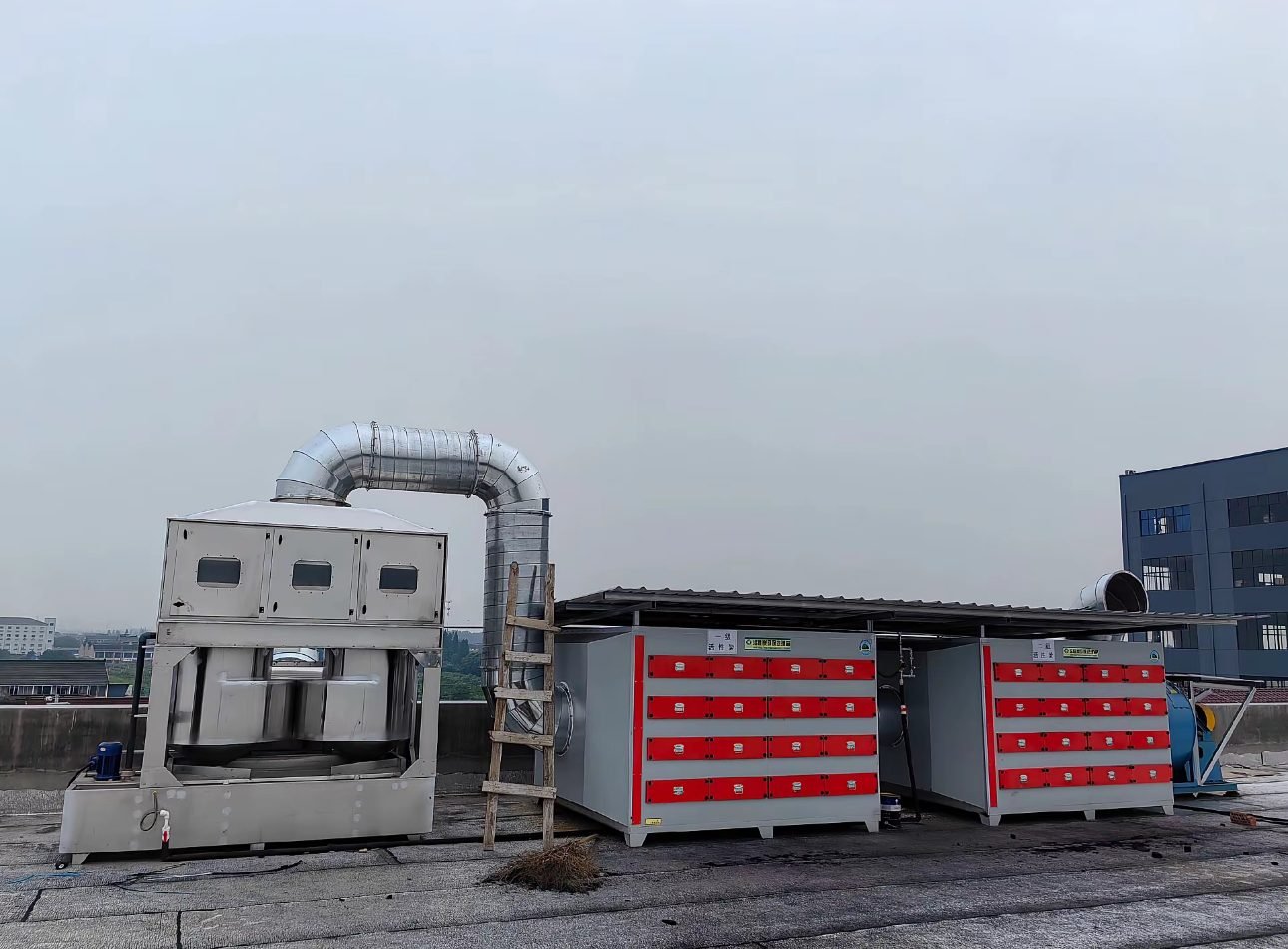
Most solvent leaves the paint in the booth and during flash-off, and the rest in the drying oven. Booth exhaust is high-volume and dilute; oven exhaust is small and concentrated. Treating them the same way wastes energy, so line design starts by separating the two streams.
| Booth exhaust | dry filtration for overspray, then concentration — activated carbon adsorption or a zeolite rotor — before destruction. |
|---|---|
| Oven exhaust and desorption air | catalytic combustion or regenerative thermal oxidation, with heat recovered back into the oven. |
| Paint side | waterborne primers and high-solids topcoats cut the load before any treatment is needed. |
| Delivery record | 800+ coating lines for 500+ clients in 36 countries (MUSI engineering team, cumulative since 2011) |
| Services | Design, manufacturing, installation, commissioning, operator training and after-sales support from one company |
Designing the booths for lower-solvent paint
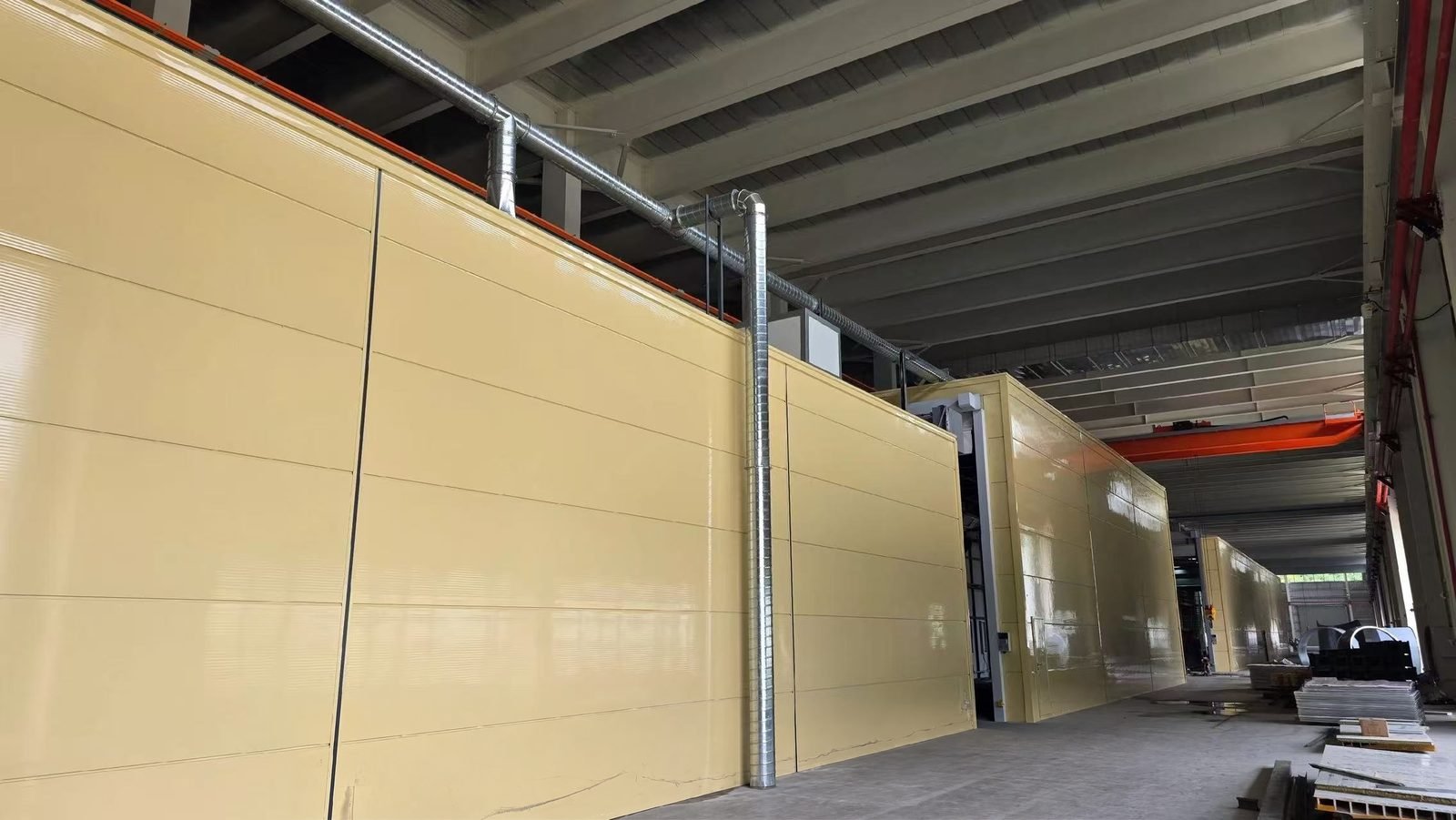
Waterborne paints need controlled humidity and temperature to flash off predictably, so booth supply air should be conditioned and the line should include a flash-off zone before the oven. Insulated booth walls and ovens keep energy use down, which matters when energy prices are part of the business case.
Reference line configuration
For reference, a current 20-ft energy-storage box line design handles boxes of 6,058 × 2,438 × 2,591 mm up to 2,500 kg on a box-pulling chain, with automatic blasting, primer, intermediate and topcoat booths of 10 × 6.6 × 5.2 m, paint drying at 80–120 °C, powder curing at 200–220 °C, a rain test chamber and 160,000 m³/h of VOC treatment. The full table is on our container line case; MUSI’s fastest energy-storage box lines release one finished box per minute.
FAQ
Is powder coating an option? Yes. Powder emits no solvent and overspray is recovered, which makes it attractive under EU rules; the trade-off is higher cure temperature and less flexibility for thick multi-coat systems.
Carbon adsorption or RTO? It depends on air volume and solvent load. Our VOC treatment guide compares the options.
Where MUSI Technology fits
MUSI supplies the paint line and the exhaust treatment as one system, so airflows and heat recovery are balanced from day one. Send your target output and paint system for a preliminary layout.
Provided by Lin Cong, Technical Director, MUSI Technology
Send us your part size, throughput and coating type — our engineers reply within 24 hours, and a layout and budget follow once your part data is complete. Contact MUSI Technology or browse our equipment range.
Further Reading
- ProductsEnergy Storage Container Coating Line
- IndustryEnergy Storage Container Coating
- Technical guidesEnergy Storage Container Coating Line: Corrosion Spec and Layout (2026)
Energy-Storage Container Coating Line for the Middle East: Designing for Heat, Sand and UV
Coating Energy-Storage Enclosures for Coastal and Offshore Sites: Designing for ISO 12944 C5 and CX
Energy-Storage Cabinet Coating Lines in Southeast Asia: Controlling Humidity, Flash Rust and Cure
Energy-Storage Container Painting Lines for North America: Air Permits, Booth Safety and High Throughput
Energy-Storage Box Coating Lines for Africa: Compact Lines for Local Assembly
Energy-Storage Box Painting Lines for Latin America: Desert Sun, Altitude and Local Content
Energy-Storage Box Coating Lines for India: Scaling Local BESS Enclosure Production
Coating Energy-Storage Cabinets for Cold Climates: Nordic, Canadian and Central Asian Plants - Case StudiesEnergy-Storage Cabinet Spray Coating Line, Jiangsu
Energy-Storage Enclosure Painting Line for a Global Battery Maker
Energy-Storage Cabinet & Container Painting Line, Jiangyin
QQuestions buyers ask before ordering
quotation · price · lead time · installation · warranty
What information do you need to prepare a quotation?
Send part drawings or photos, the largest part size and weight, the material, the required output per shift, the paint or powder type and number of colours, and the available floor space, ceiling height and power or gas supply. MUSI engineers reply within 24 hours; a recommended configuration and quotation follow once your part data is complete.
How much does this equipment cost?
Budget depends on part size, throughput and the level of automation. Indicative ex-works ranges are published in our complete coating line cost guide; a configured quotation is prepared from your part data. Published indicative ex-works ranges: a complete powder coating line is roughly USD 75,000–230,000 semi-automatic, USD 200,000–600,000 for a standard automatic line and USD 600,000–2,000,000 for a high-throughput automated plant.
What is the lead time?
Standard configurations ship in 30–60 days from contract signing and down payment; custom configurations take longer. The delivery date is fixed in the contract.
Do you install and train operators overseas?
Yes. MUSI engineers carry out on-site installation and commissioning and give 3–5 days of operator and maintenance training. MUSI has delivered 800+ coating lines to customers in 36 countries.
What warranty and after-sales support are included?
12 months full-machine warranty, 36 months on critical components and up to 60 months on structural parts. International customers get 24-hour phone response and 72-hour on-site arrival; spare parts ship from the Changzhou headquarters.
Can the environmental equipment be supplied with the line?
Yes. VOC treatment (RTO, RCO, activated carbon, zeolite rotor), dust collection and paint wastewater treatment are supplied with the coating line under one contract; MUSI has equipped 50+ coating facilities whose projects all passed local environmental compliance reviews.