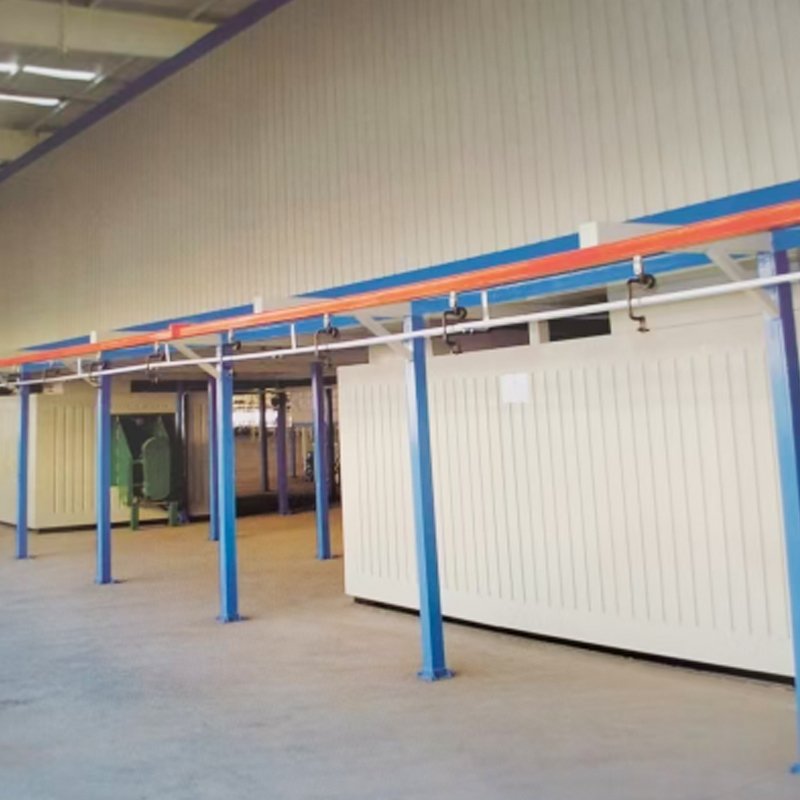
Case Study: Sheet Metal Cabinet Drying Oven
Summary
A bridge-type gas curing oven for a German manufacturer of industrial control cabinets supplying the power, rail and renewable-energy sectors, replacing an electric oven that took 35% of the line's operating cost. The new oven has an 18 × 3 × 2.8 m working chamber, five independently controlled zones, 70% heat recovery and a 230 °C maximum, and it holds temperature uniformity at ±2.5 °C against the client's ±3 °C requirement. Annual energy cost fell by about 38%, or USD 115,000, as reported after the 2023 changeover.
Project Background
The client is a manufacturer of industrial control cabinets in Germany, supplying power, rail transit, and renewable energy industries. Their existing oven had high energy consumption (electricity 35% of operating costs) and unstable temperature uniformity. Replacement was needed.
The Challenge
Client's core requirements for the new oven: temperature uniformity ±3 °C (vs ±10 °C previously), 30% lower energy use, integration with existing overhead chain.
MUSI's Solution
MUSI proposed a bridge-type gas oven: U-shape body to reduce heat loss + multi-zone temp control + 70% heat recovery + high-speed circulation fan. Total energy savings 35%+.
Equipment Configuration
| Oven type | Bridge gas oven |
|---|---|
| Effective dimensions | Internal 18×3×2.8 m |
| Heating | Direct natural gas |
| Max temperature | 230 °C |
| Temp. uniformity | ±3 °C |
| Zoning | 5 independent zones |
| Heat recovery | 70% |
| Annual energy savings | ~38% (vs original electric) |
Equipment used on this line
- Automatic spray coating lines — overhead chain, floor belt and robotic flexible lines
Implementation
50-day delivery (oven + accessories only — no full line). Client's old electric oven removed, MUSI's new oven in place + gas connected within 7 days.
Results
Temperature uniformity stable at ±2.5 °C. Annual energy cost reduced by $115K USD (~38%) — additional investment recovered in 3.5 years. Client has scheduled rollout to two more factories.
Client Feedback
"Energy efficiency has always been our pain point. MUSI's design is rigorous, the savings data is real, and exceeded our expectations."
— Project Manager, Client Side
Selection logic: why this configuration
A gas-fired bridge oven was chosen over a new electric oven because gas was the cheaper energy on site and the U-shaped bridge keeps heat in the tunnel without doors. Five zones with separate control were specified, rather than a single-zone tunnel, because ±3 °C uniformity on 18 m cannot be held with one burner. Seventy percent heat recovery on the exhaust was included because the oven runs two shifts and the payback was inside four years.
Scope of supply and key components
| Item | Specification | Notes |
|---|---|---|
| Curing oven | Bridge type, 18 × 3 × 2.8 m internal | Connected to the existing overhead chain |
| Heating | Direct natural gas, 230 °C max | |
| Zoning | 5 independent zones | ±3 °C uniformity specified, ±2.5 °C measured |
| Heat recovery | 70% on exhaust | |
| Circulation | High-speed circulation fans | |
| Changeover | Old electric oven removed, new oven connected within 7 days |
Key components
Key components are available from international brands, configurable per customer specification, so that spare parts can be sourced locally over the life of the line. Brand names below are the usual options for this type of equipment; the brands actually fitted are fixed in the contract specification.
| Component | Brands available on request |
|---|---|
| Oven and dryer gas burners | Riello RS series, Weishaupt monarch WM-G, Baltur TBG, Honeywell Maxon OVENPAK, Eclipse |
| PLC and HMI | Siemens SIMATIC S7-1500, Mitsubishi Electric MELSEC iQ-R, Schneider Electric Modicon, OMRON NX, Rockwell Automation Allen-Bradley |
| Variable-frequency drives | ABB ACS580, Siemens SINAMICS G120, Danfoss VLT, Schneider Electric Altivar, Yaskawa, Mitsubishi Electric |
| Sensors and temperature controllers | SICK, Pepperl+Fuchs, OMRON E5CC, Honeywell UDC, Yokogawa UT, ifm, KEYENCE |
| Low-voltage switchgear and relays | Schneider Electric TeSys, ABB AF, Siemens SIRIUS, OMRON, Eaton |
| Conveyor bearings | SKF, NSK, Schaeffler FAG, Timken, NTN |
Not included in the scope of supply
- Civil works, foundations and pits
- Building services up to the battery limit: power supply, gas, compressed air, water and drainage
- Local permits, emission approvals and third-party inspections
- Paint or powder supply, unless stated in the contract
- Gas supply line to the oven battery limit
- Conveyor modifications
Services included with every line: engineering design, manufacturing, shipping documentation, installation supervision, commissioning, operator training, warranty and spare parts.
Typical programme
The durations below are typical for equipment of this class and are given for planning; they are not the recorded schedule of this project. A complete line usually runs 90–180 days from contract to acceptance, a single unit 30–60 days.
| Stage | Typical duration | What happens |
|---|---|---|
| Data review and sizing | 3–7 days | Exhaust data or part drawings reviewed remotely |
| Design | 10–20 days | General arrangement and connection points |
| Manufacturing | 30–60 days | Unit built and factory tested |
| Shipping | 20–45 days | Sea freight |
| Installation and connection | 7–25 days | Ducting, gas or utilities connected on site |
| Commissioning and acceptance | 5–10 days | Performance run and acceptance record |
Results: before and after
Figures are those published on this page; measurement party, sample size, test date and method are not on record here and are left blank rather than estimated.
| Metric | Before | After | Change | Measured by | Single / average | Samples | Test date | Method / instrument |
|---|---|---|---|---|---|---|---|---|
| Temperature uniformity | ±10 °C | ±2.5 °C | 4× tighter | |||||
| Annual energy cost | electric oven | −38% (USD 115,000) | −38% | |||||
| Payback on extra investment | — | 3.5 years | — |
Applicability and limits
The 38% saving compares gas against the electric oven it replaced at the client's tariffs; where electricity is cheap or gas is unavailable the comparison changes. ±2.5 °C uniformity was measured with the oven loaded with sheet-metal cabinets; heavier plate or dense loading changes the profile and is sized case by case.
Results shown in this case study reflect the stated operating conditions and should not be interpreted as guaranteed performance under different feed, production, environmental, or site conditions.
After-sales and spare parts
Warranty on a MUSI coating line runs from acceptance: 12 months on the complete line excluding consumables, 36 months on critical components such as motors, drives and the PLC, and 60 months on structural parts such as steel structure, ducting and oven bodies. Failures within warranty, excluding misuse, are repaired free of charge.
Support starts remotely: the service line is staffed around the clock, a preliminary diagnosis with recommendations is given within 2 hours, and where a site visit is needed an engineer reaches any major city within 72 hours. A spare-parts inventory is held at the Changzhou headquarters with same-day shipping, and customers can keep a dedicated parts stock at MUSI for emergencies. Details are on the after-sales service page.
FAQ
How much energy can a new curing oven save? On this project about 38% a year, from a bridge design that keeps heat in the tunnel, five-zone control and 70% recovery on the exhaust, compared with the previous electric oven.
What temperature uniformity is realistic in an 18 m oven? The client required ±3 °C; the oven measured ±2.5 °C with five zones and high-speed circulation. Single-zone tunnels of this length usually show ±8–10 °C.
Can a new oven connect to an existing conveyor? Yes. The oven was built around the existing overhead chain route, and the changeover from the old oven took seven days including gas connection.
Gas or electric heating for a curing oven? Gas where it is available and cheaper per kWh, as here; electric where gas is unavailable or the oven is small and runs intermittently.
What was the delivery time? Fifty days for the oven and accessories, then a seven-day changeover on site.
Next step: a configuration proposal for a similar line
If your parts, volumes or plant conditions are close to this project, MUSI can return a line configuration and layout proposal. To prepare it we need four things:
- Photos and dimensions of the workpieces, with weight and material
- Required output (pieces per hour or per day, and shifts)
- Number of colours and how often colour changes are needed
- Available floor space and ceiling height, with the utilities on site
Message us on WhatsApp with these details, or use the quotation form.
Provided by Lin Cong, Technical Director, MUSI Technology · Published 2026-05-02 · Updated 2026-09-30 · Last technical review: 2026-09-30
QQuestions buyers ask before ordering
quotation · price · lead time · installation · warranty
What information do you need to prepare a quotation?
Send part drawings or photos, the largest part size and weight, the material, the required output per shift, the paint or powder type and number of colours, and the available floor space, ceiling height and power or gas supply. MUSI engineers reply within 24 hours; a recommended configuration and quotation follow once your part data is complete.
How much does this equipment cost?
Budget depends on part size, throughput and the level of automation. Indicative ex-works ranges are published in our complete coating line cost guide; a configured quotation is prepared from your part data. Published indicative ex-works ranges: a complete powder coating line is roughly USD 75,000–230,000 semi-automatic, USD 200,000–600,000 for a standard automatic line and USD 600,000–2,000,000 for a high-throughput automated plant.
What is the lead time?
Standard configurations ship in 30–60 days from contract signing and down payment; custom configurations take longer. The delivery date is fixed in the contract.
Do you install and train operators overseas?
Yes. MUSI engineers carry out on-site installation and commissioning and give 3–5 days of operator and maintenance training. MUSI has delivered 800+ coating lines to customers in 36 countries.
What warranty and after-sales support are included?
12 months full-machine warranty, 36 months on critical components and up to 60 months on structural parts. International customers get 24-hour phone response and 72-hour on-site arrival; spare parts ship from the Changzhou headquarters.
Can the environmental equipment be supplied with the line?
Yes. VOC treatment (RTO, RCO, activated carbon, zeolite rotor), dust collection and paint wastewater treatment are supplied with the coating line under one contract; MUSI has equipped 50+ coating facilities whose projects all passed local environmental compliance reviews.
Get a Similar Solution
If your industry and requirements match this case, contact MUSI to schedule a free consultation. We'll design an optimal solution based on your specific workpieces, capacity, and facility.