Paint Booth Lighting: Lux Levels, Fixtures and Layout
Quick answer: Paint booth lighting is normally designed for 100-150 foot-candles (about 1,080-1,610 lux) measured 3 ft above the floor, the IES recommendation reported in the US trade press; EN 12464-1 tables give 750-1,000 lux for spraying and 1,000-1,500 lux at Ra 90 for inspection and touch-up. Daylight-balanced lamps of 5,000-6,500 K with CRI 90 or higher support colour matching. Fixtures sit behind sealed glass in the ceiling, upper corners and side walls, and must suit the hazardous-area classification of their location (Class I, Division 1 or 2 in the US; Zone 1 or 2 under ATEX). LED fixtures save 40-50 % energy against fluorescent T8.
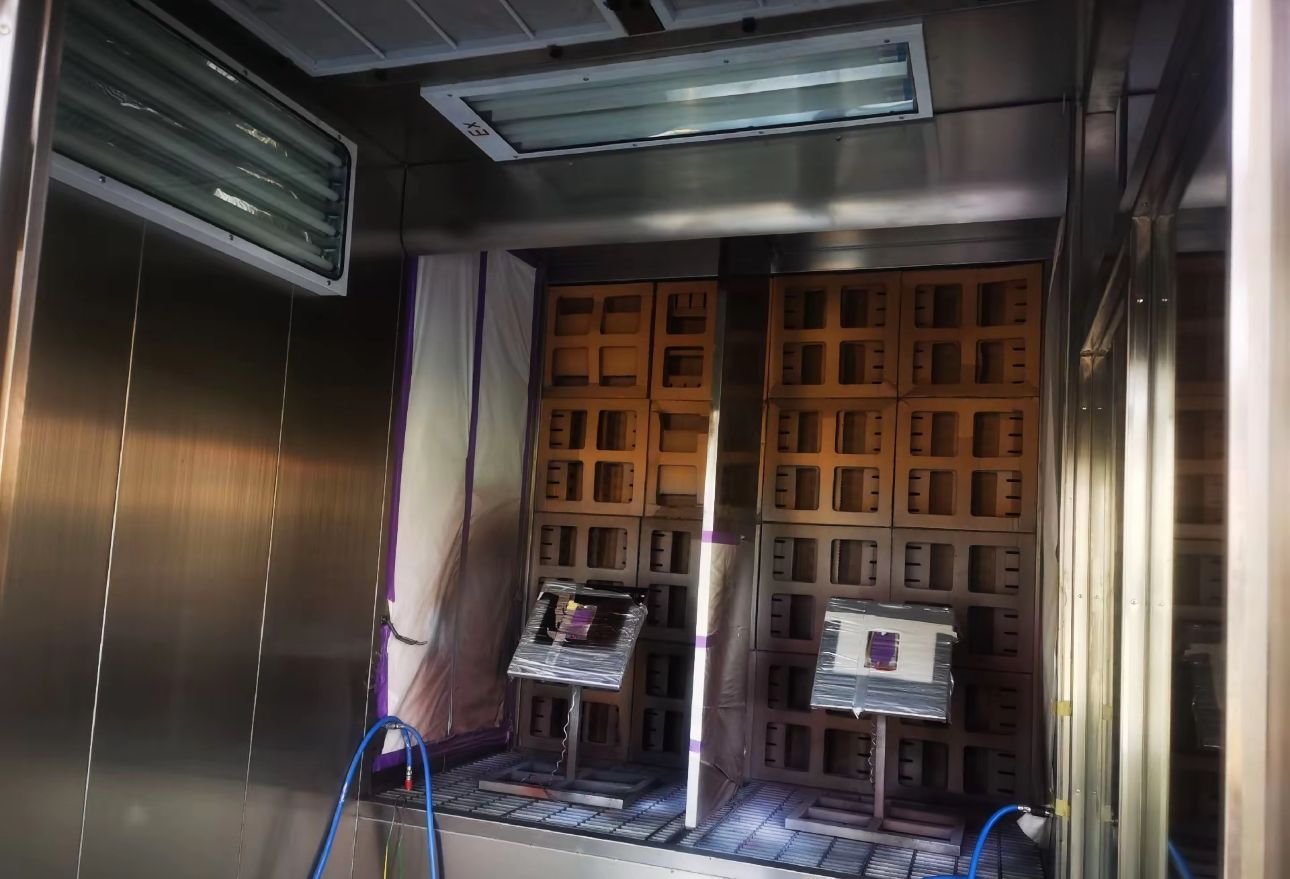
MUSI Technology, a powder and liquid spray coating line manufacturer in Changzhou, China, lays out booth lighting with ceiling, angled corner and side wall fixtures behind sealed glass and selects fixtures to the hazardous-area classification stated by the customer, so that the booth is lit to the level the specification requires.
How much light does a paint booth need?
A paint booth needs roughly 100-150 foot-candles (about 1,080-1,610 lux) at the work, which is the Illuminating Engineering Society (IES) recommendation for paint spray booths as reported in the US trade press. The reading is taken with a light meter about 3 ft (0.9 m) above the floor. European lighting tables built on EN 12464-1 arrive at a similar band. These are design references, not legal limits.
| Task or area | Recommended level | Colour rendering | Reference |
|---|---|---|---|
| Paint spray booth, general | 100-150 fc (about 1,080-1,610 lux) at 3 ft height | Not stated | IES recommendation, as reported in US trade press |
| Small spray booths | 60-100 fc (about 650-1,080 lux) | Not stated | Lighting supplier design guidance |
| Spraying chamber, polishing chamber | 750-1,000 lux (about 70-93 fc) | Ra 80 | EN 12464-1 table as published by a luminaire maker (EU) |
| Paint inspection, touch-up, polishing | 1,000-1,500 lux (about 93-139 fc) | Ra 90, 4,000-6,500 K | EN 12464-1 table as published by a luminaire maker (EU) |
| Booth in a car maker’s body shop certification scheme | At least 93 fc (about 1,000 lux) | Not stated | One OEM programme, reported by the trade |
| Paint mix room in the same scheme | At least 70 fc (about 750 lux) | Not stated | One OEM programme, reported by the trade |
What colour temperature and CRI suit colour matching?
Daylight-balanced lamps of 5,000-6,500 K with a colour rendering index (CRI) of 90 or higher are the usual recommendation from lighting suppliers for colour matching, because the painted part will be judged outdoors. The EN 12464-1 table agrees in substance: Ra 90 and 4,000-6,500 K for inspection and touch-up, Ra 80 for the spraying chamber itself. Among fluorescent tubes, cool white at about 4,100 K is the common stock item and 6,500 K is the daylight grade, so the lamp code is worth checking at every relamp.
Where should paint booth lights be placed?
Paint booth lights should be spread over the ceiling and the side walls so that horizontal and vertical surfaces are both lit and the painter does not work in a shadow. Lighting designers check vertical as well as horizontal illuminance for this reason. The angle matters as much as the quantity: the painter judges wet film by the reflection of a fixture in the surface, so a fixture whose reflection cannot be seen in the panel does little for finish quality.
| Fixture position | Purpose | Note |
|---|---|---|
| Ceiling, between filter banks | General level on roofs, bonnets and other horizontal faces | A common automotive baseline is eight four-tube ceiling fixtures |
| Angled upper corner (hip) fixtures | Light thrown across and down onto upper side faces; reflection visible to the painter | Reduces the shadow cast by the painter |
| Side wall fixtures at mid height | Vertical illuminance on doors, panels and hung parts | Extra fixtures beyond the ceiling set are a common option |
| Lower side wall fixtures | Sills, undersides, lower racks | Most exposed to overspray; glass needs frequent cleaning |
Fixtures sit outside the airstream behind sealed glass. Inside-access fixtures hinge open into the booth, which makes relamping simple when the booth backs onto a wall. Rear-access fixtures are serviced from outside the cabin and leave the interior seal undisturbed. Tempered lenses are reported as 4-5 times stronger than ordinary glass of the same size.
Do paint booth lights have to be explosion proof?
Not always: the answer depends on the hazardous-area classification of the place where the fixture is mounted and on the code in force at the site. In the US system the spray area is a Class I, Division 1 location and a fixture inside it must be explosion proof. Booth fixtures are therefore normally mounted outside the spray area and shine through sealed panels, and the US trade press describes them as carrying Class I, Division 2 approval. The local authority and a qualified electrical engineer decide the classification.
| Reference | Jurisdiction | Requirement in outline |
|---|---|---|
| OSHA 29 CFR 1910.107(b)(10) | US | Light through glass panels only from fixed units; panels noncombustible, isolating the spray area, and arranged so residue on them is not heated to a dangerous temperature |
| OSHA 29 CFR 1910.107(c)(6)-(7) | US | Within 20 ft of a spraying area, equipment must not spark in normal operation and lamps must be totally enclosed and guarded |
| OSHA 29 CFR 1910.107(c)(8) | US | No portable lamps in the spraying area during spraying |
| NFPA 33 / NEC (NFPA 70) | US | Spray area interior Class I, Division 1; Division 2 extends 3 ft from booth openings |
| ATEX / DSEAR zone system | EU / UK | Zone 1: explosive atmosphere likely occasionally in normal operation, Category 2 equipment. Zone 2: not likely and short-lived, Category 3 equipment |
| Government guidance sheet for vehicle spray booths | Jersey | Mount lights outside the booth behind fixed, sealed, 30-minute fire-resistant glazing where possible |
Are LED paint booth lights better than fluorescent T8 tubes?
LED fixtures use less energy for the same light and last longer than fluorescent T8 tubes, which is why they are now the usual choice for new booths. T8 tubes (1 inch diameter) had already replaced the 1.5 inch T12, whose production has ended. The figures below are from trade press and a US Department of Energy guide and are indicative.
| Point | Fluorescent T8 | LED |
|---|---|---|
| Energy for equal light | Baseline | 40-50 % saving reported in trade press |
| Rated life | 2,000-10,000 h in one trade source; 20,000 h and more in another | 50,000-100,000 h reported |
| Heat | Tube and ballast add heat behind the glass | Very little heat emitted (US DOE) |
| Light direction | All round the tube; relies on reflector | Directional, less reflector loss (US DOE) |
| Output over life | Falls as the tube ages | Check the lumen-maintenance rating of the fixture |
For the booth builder the settings that control lighting are fixture count and position, a two-level circuit for prep and spray, and an interlock between the lights, the exhaust fan and the spray air. Key components are available from international brands such as R. STAHL for explosion-protected LED luminaires and Siemens, Allen-Bradley and Mitsubishi Electric for control and interlock hardware (configurable per customer specification). Booth layouts are covered on the industrial paint spray booth page and in the liquid spray coating line guide.
How are paint booth lights maintained?
Paint booth lights are maintained by keeping the glass clean, replacing failed lamps at once and keeping the walls white. Overspray film on the lenses and dark walls are the two usual reasons a booth falls below its design level. White walls return light to the part; test sprays darken them. Timely exhaust filter changes reduce the overspray reaching the glass, as explained in the spray booth filter guide.
| Check | What to do | Why |
|---|---|---|
| Lens glass | Wipe off overspray film; renew peelable film if used | Film cuts output and shifts colour |
| Lamps | Replace missing or failed tubes with the same colour code | Mixed or missing lamps create bands and shadows |
| Seals and gaskets | Inspect after every relamp | Keeps the fixture isolated from the spray area |
| Walls and ceiling | Keep white; no test sprays on panels | Reflected light fills shadows |
| Obstructions | Move racks and equipment away from fixtures | Blocked fixtures light nothing |
| Light level | Meter reading 3 ft above the floor, logged | Shows decline before defects appear |
FAQ
How many lumens or foot-candles do paint booth lights need to deliver? Design to the level at the work, not to lamp lumens: 100-150 foot-candles (about 1,080-1,610 lux) at 3 ft above the floor is the IES figure reported in the US trade press. The number of fixtures then follows from booth size, wall colour and fixture output.
Are explosion proof paint booth lights required inside the booth? A fixture mounted inside the spray area, a Class I, Division 1 location in the US system, must be explosion proof. Most booths avoid this by mounting fixed fixtures outside the spray area behind sealed glass panels. The local code and the authority having jurisdiction decide.
What colour temperature is used for paint booth LED lights? Lighting suppliers recommend daylight-balanced 5,000-6,500 K with CRI 90 or higher for colour matching. The EN 12464-1 table for paint inspection and touch-up gives 4,000-6,500 K and Ra 90. Use one colour temperature throughout the booth.
Can fluorescent T8 tubes be replaced with LED tubes in an existing booth? Often yes, but the hazardous-location approval belongs to the fixture as supplied. Confirm with the fixture maker that an LED tube or retrofit kit keeps that approval before changing anything, and keep the same colour temperature in every fixture.
Where MUSI Technology fits
MUSI Technology designs liquid paint booths with lighting, airflow and filtration planned together, so that fixture positions suit the parts and the hazardous-area classification of the site. Details are on the industrial paint spray booth page; project questions can be sent through the contact page.
Provided by Lin Cong, Technical Director, MUSI Technology
Send us your part size, throughput and coating type — our engineers reply with a layout and budget within one working day. Contact MUSI Technology or browse our equipment range.
Related technical guides
- Powder Coating Pretreatment Line: Stages & Cost
A pretreatment line degreases, rinses and chemically converts the metal surface before coating. Three, five and seven-stage layouts, phosphate versus. - BESS Container Coating Line: Spec & Corrosion
Battery energy storage containers need C4 to C5-M corrosion protection: shot blasting to Sa2.5, zinc-rich primer and weather-resistant polyester topcoat. - EV Battery Pack Housing Coating Line: Specs & Cost
Battery pack housings need dielectric strength, thermal stability and corrosion life in one coating. Powder versus liquid compared, film build targets,. - Spray Coating Line: Types, Specs & Cost (2026)
What a spray coating line costs, how the main types compare on throughput and finish, and the specs to fix before you ask for quotations. - Shot Blasting vs Sandblasting: Which to Choose
Shot blasting throws abrasive mechanically with wheels; sandblasting propels it with compressed air. Compared on throughput, energy cost per m2, surface.