Energy-Storage Container Painting Lines for North America: Air Permits, Booth Safety and High Throughput
Quick answer: A US or Canadian plant painting energy-storage containers has to plan three things early: the air permit (in the US, surface coating of metal parts falls under EPA NESHAP 40 CFR Part 63 Subpart MMMM plus state rules), spray booth fire safety (NFPA 33 is the reference standard for spray application of flammable and combustible materials), and a layout that reaches the output a fast-growing storage market demands.
Permits shape the paint system
The paint you choose sets the emissions you must permit and control. Low-VOC and waterborne systems, or powder, reduce the load; where solvent paints are needed, the line should be designed with capture and treatment of booth and oven exhaust. Getting this into the design before equipment is ordered avoids expensive retrofits.
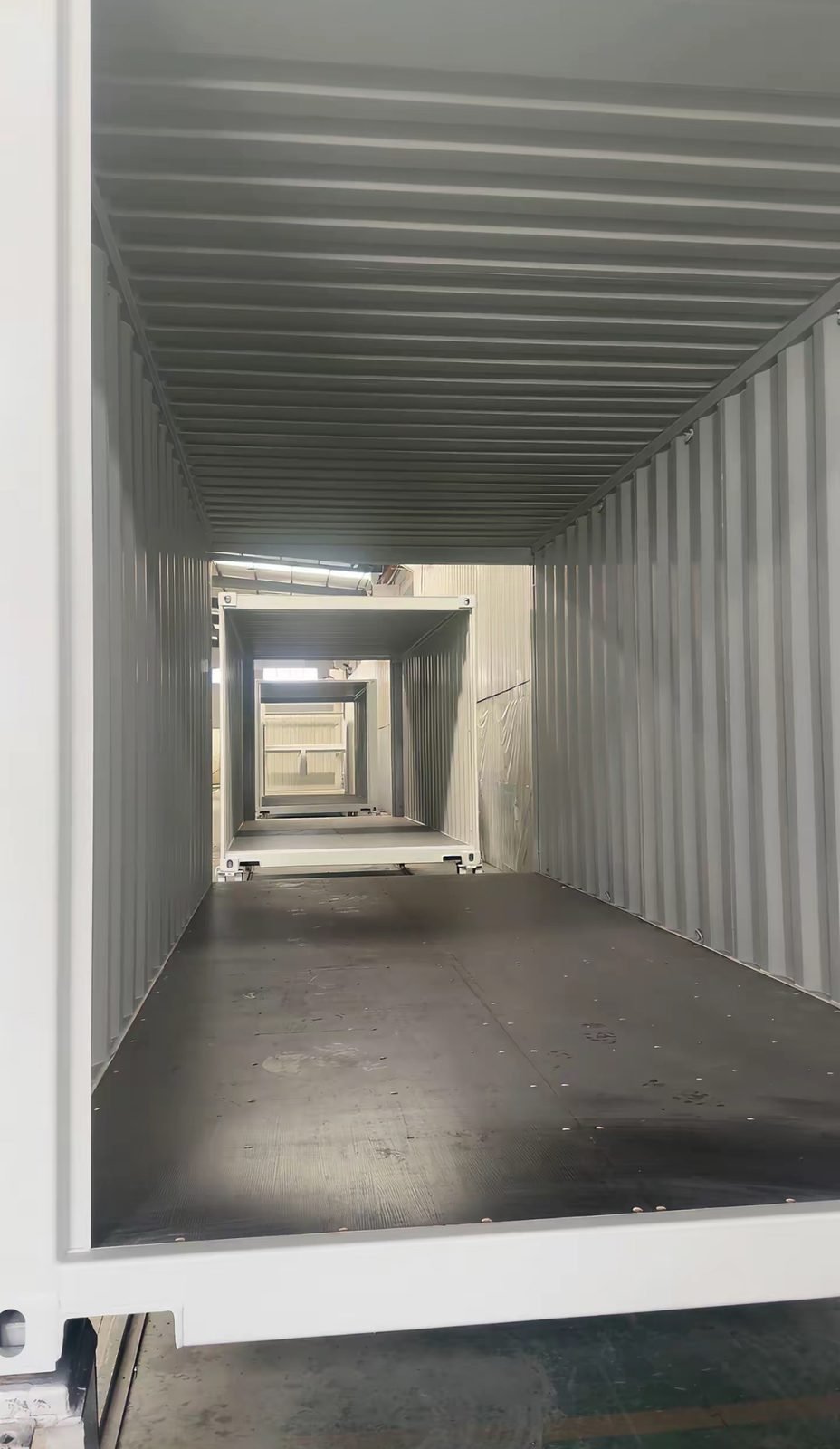
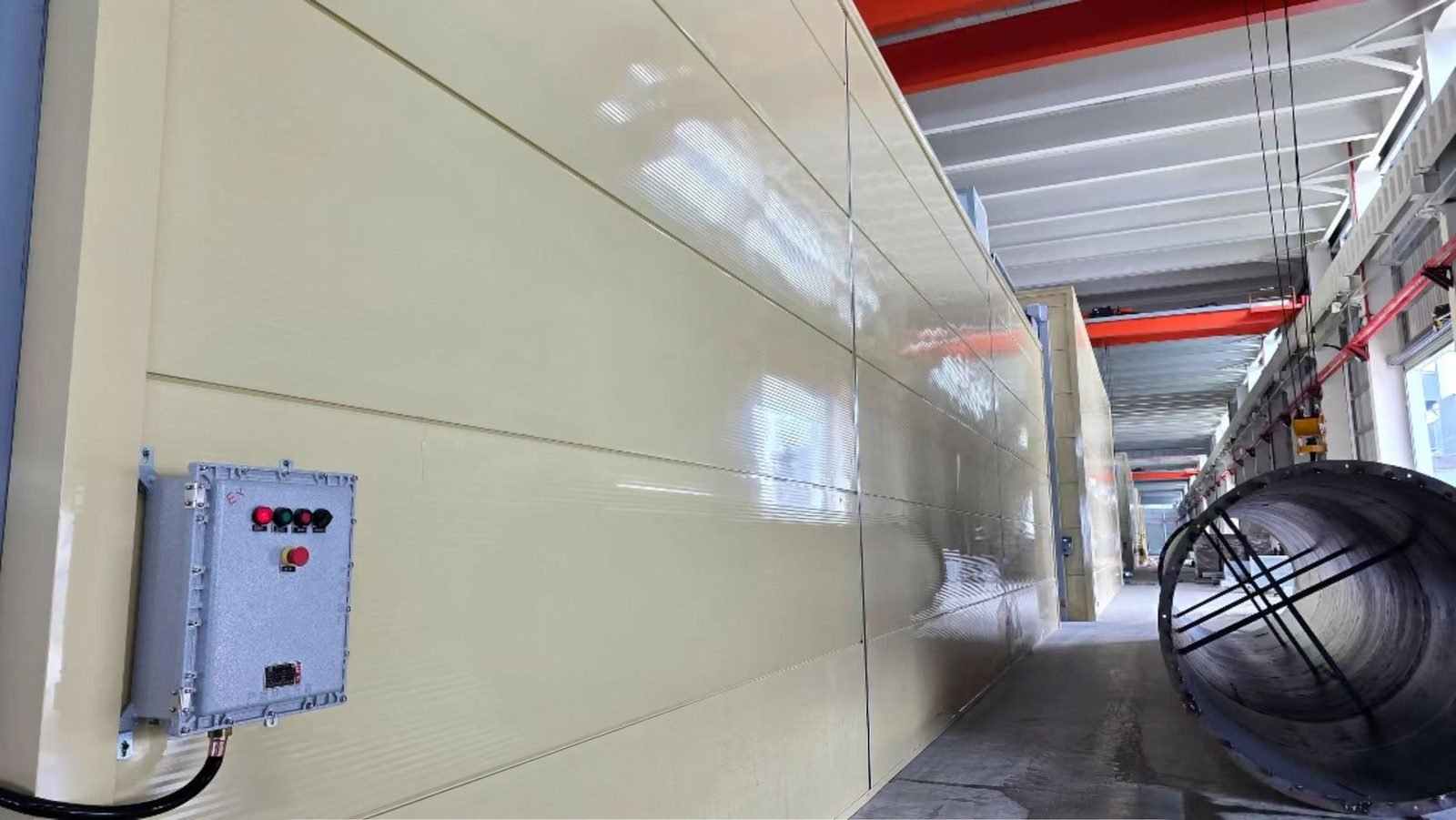
Booth safety by design
- Explosion-proof lighting, motors and control boxes inside hazardous zones.
- Interlocks between exhaust fans, spray equipment and doors.
- Fire detection and suppression suited to the booth and paint type.
- Clear separation between paint mixing rooms and occupied areas.
Throughput
High-volume box lines use a continuous box-pulling chain, automatic reciprocators for the large faces, robots for interior cavities and 2K automatic mixing, so output depends on equipment settings rather than on crew size.
Reference line configuration
For reference, a current 20-ft energy-storage box line design handles boxes of 6,058 × 2,438 × 2,591 mm up to 2,500 kg on a box-pulling chain, with automatic blasting, primer, intermediate and topcoat booths of 10 × 6.6 × 5.2 m, paint drying at 80–120 °C, powder curing at 200–220 °C, a rain test chamber and 160,000 m³/h of VOC treatment. The full table is on our container line case; MUSI’s fastest energy-storage box lines release one finished box per minute.
FAQ
Can the line be built in China and installed in the US? Yes. Equipment is built and pre-tested in China, shipped in containers and installed on site; electrical components can be specified to local standards.
Where MUSI Technology fits
MUSI designs energy-storage box lines as complete systems — booths, ovens, conveying, rain test and exhaust treatment. Send your output target and paint system for a preliminary layout.
Provided by Lin Cong, Technical Director, MUSI Technology
Send us your part size, throughput and coating type — our engineers reply within 24 hours, and a layout and budget follow once your part data is complete. Contact MUSI Technology or browse our equipment range.
Further Reading
- ProductsEnergy Storage Container Coating Line
- IndustryEnergy Storage Container Coating
- Technical guidesEnergy Storage Container Coating Line: Corrosion Spec and Layout (2026)
Energy-Storage Container Coating Line for the Middle East: Designing for Heat, Sand and UV
Energy-Storage Box Painting Lines for Europe: Meeting VOC Limits Without Losing Throughput
Coating Energy-Storage Enclosures for Coastal and Offshore Sites: Designing for ISO 12944 C5 and CX
Energy-Storage Cabinet Coating Lines in Southeast Asia: Controlling Humidity, Flash Rust and Cure
Energy-Storage Box Coating Lines for Africa: Compact Lines for Local Assembly
Energy-Storage Box Painting Lines for Latin America: Desert Sun, Altitude and Local Content
Energy-Storage Box Coating Lines for India: Scaling Local BESS Enclosure Production
Coating Energy-Storage Cabinets for Cold Climates: Nordic, Canadian and Central Asian Plants - Case StudiesEnergy-Storage Cabinet Spray Coating Line, Jiangsu
Energy-Storage Enclosure Painting Line for a Global Battery Maker
Energy-Storage Cabinet & Container Painting Line, Jiangyin
QQuestions buyers ask before ordering
quotation · price · lead time · installation · warranty
What information do you need to prepare a quotation?
Send part drawings or photos, the largest part size and weight, the material, the required output per shift, the paint or powder type and number of colours, and the available floor space, ceiling height and power or gas supply. MUSI engineers reply within 24 hours; a recommended configuration and quotation follow once your part data is complete.
How much does this equipment cost?
Budget depends on part size, throughput and the level of automation. Indicative ex-works ranges are published in our complete coating line cost guide; a configured quotation is prepared from your part data. Published indicative ex-works ranges: a complete powder coating line is roughly USD 75,000–230,000 semi-automatic, USD 200,000–600,000 for a standard automatic line and USD 600,000–2,000,000 for a high-throughput automated plant.
What is the lead time?
Standard configurations ship in 30–60 days from contract signing and down payment; custom configurations take longer. The delivery date is fixed in the contract.
Do you install and train operators overseas?
Yes. MUSI engineers carry out on-site installation and commissioning and give 3–5 days of operator and maintenance training. MUSI has delivered 800+ coating lines to customers in 36 countries.
What warranty and after-sales support are included?
12 months full-machine warranty, 36 months on critical components and up to 60 months on structural parts. International customers get 24-hour phone response and 72-hour on-site arrival; spare parts ship from the Changzhou headquarters.
Can the environmental equipment be supplied with the line?
Yes. VOC treatment (RTO, RCO, activated carbon, zeolite rotor), dust collection and paint wastewater treatment are supplied with the coating line under one contract; MUSI has equipped 50+ coating facilities whose projects all passed local environmental compliance reviews.