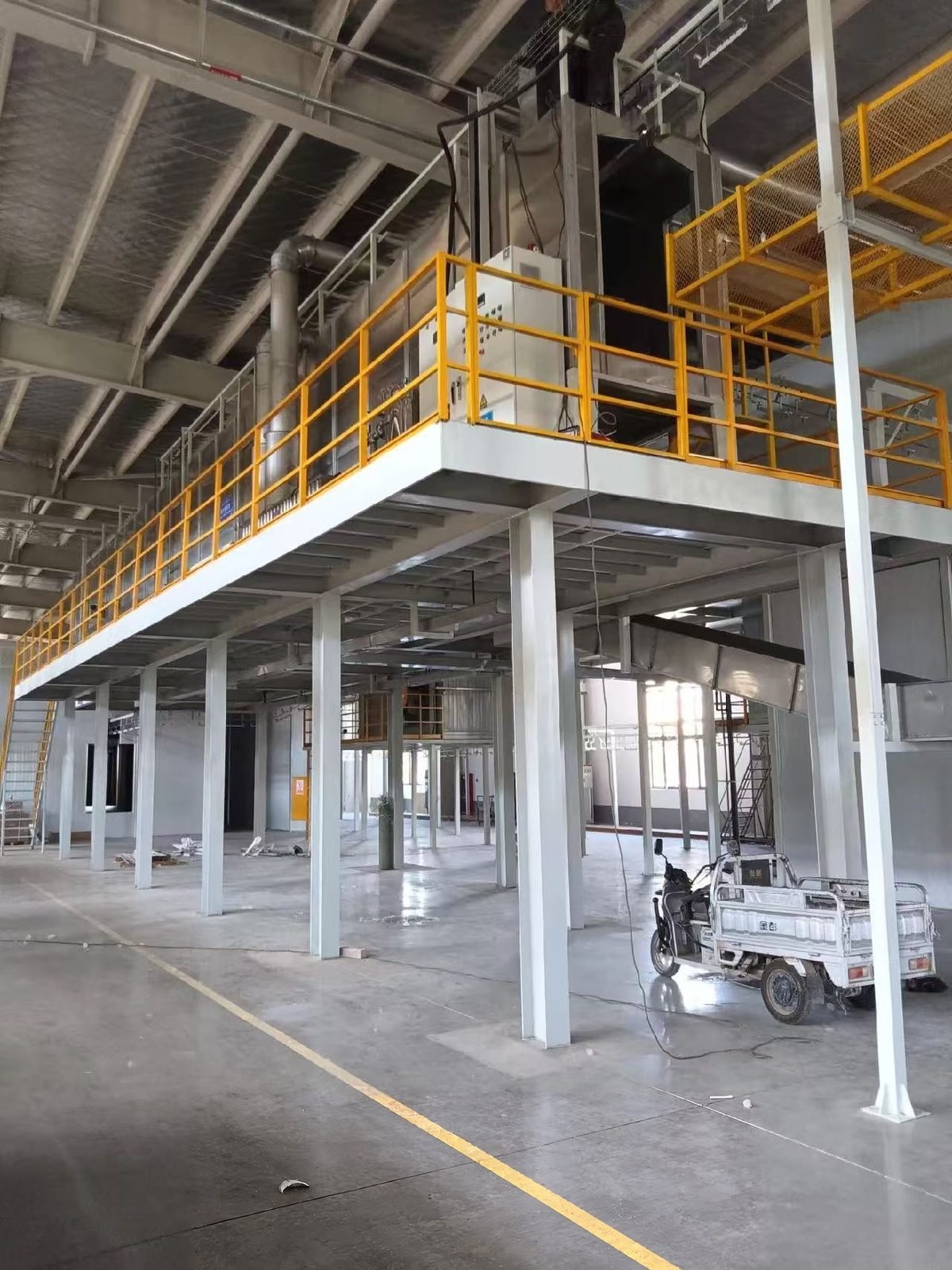
Powder Coating Curing Oven
A powder coating curing oven melts and cross-links the applied powder at a part temperature of about 150-200 °C. MUSI Technology builds batch, continuous tunnel and infrared combination ovens for job shops and conveyorised lines, each sized from part mass and line speed.
Built for coaters who need every part, light or heavy, to reach the powder maker's cure schedule with an even temperature across the whole work envelope.
Technical Specifications
Values below are typical ranges for this equipment type. The figures for your line are fixed in the written specification after we review your parts, output and site.
| Part (object) temperature for powder cure | About 150-200 °C, set by the powder data sheet |
|---|---|
| Maximum oven rating | About 260 °C (500 °F) for most industrial curing ovens |
| Temperature uniformity | ±5.5 °C (±10 °F) of set point, checked with a nine-point thermocouple survey |
| Recirculation air | At least 3 chamber volumes per minute; 3-4 is a common design figure |
| Insulation | Rule of thumb 1 inch of 6 lb density insulation per 100 °F; 6 inch (about 150 mm) mineral wool panels for 300-500 °F ovens |
| Reference cure schedule (standard powders) | 10 min at 180-200 °C object temperature, depending on chemistry |
| Heat source | Direct-fired gas, indirect-fired gas with heat exchanger, electric resistance, electric or gas catalytic infrared |
| Infrared dwell (high-intensity emitters, fast-cure powder) | 30-90 s; low to medium intensity IR runs 8-20 min, similar to convection |
| Pre-ignition purge (NFPA 86 concept) | At least four changes of the oven volume before the burner may light |
| Exhaust while curing | Minimum 3 air changes per hour; 7-8 per hour advised for consistent colour and gloss |
| Part openings on tunnel ovens | Kept within a few inches of the part window, with room for part sway |
Oven Configuration
- Insulated tongue-and-groove panel enclosure with mineral wool fill and sealed joints
- Heater box: gas burner (direct or with heat exchanger) or electric heater bank
- Recirculation fan with supply ducts along the lower side walls and a ceiling return
- Exhaust fan with purge timer and airflow interlock to the heat source
- Air seals or vestibules at the part openings (tunnel ovens) or insulated doors (batch ovens)
- Control panel with PLC, temperature controller, high-limit thermostat and touch screen
Batch oven, tunnel oven or infrared: which powder coating oven fits your work?
The choice follows how parts move. A powder coating batch oven suits carts and changing part sizes, a tunnel oven suits a conveyor running at fixed speed, and infrared is added where heat-up time limits the line.
| Point of comparison | Batch (box) oven | Continuous tunnel oven | Infrared or IR + convection |
|---|---|---|---|
| How parts move | Loaded on carts or racks, door closed for each load | Carried through on an overhead or floor conveyor | Conveyor passes between emitter panels, often ahead of a convection zone |
| How heat reaches the part | Recirculated hot air | Recirculated hot air, usually in more than one zone | Radiant energy travelling in a straight line to surfaces facing the emitter |
| Typical time in the oven | Heat-up of the load plus the cure time on the data sheet | Heat-up plus cure time, fixed by oven length and line speed | 30-90 s with high-intensity IR on fast-cure powder; an IR boost of one or two minutes can cut total oven time by about 25-30% |
| Strong point | Flexible for large, heavy or mixed parts | Steady output and repeatable cure at a set line speed | Fast heat-up, little air movement over un-melted powder, short footprint |
| Limitation | Output limited by load and unload cycle | Needs air seals at the openings and a fixed part window | Recesses and shadowed areas heat slowly; deep or massive parts gain least |
| Usual application | Job shops, long structural sections, low volume | Automatic lines for sheet metal, extrusions, wheels, cabinets | Flat panels, heavy castings needing a boost, MDF with low-bake powder |
Gas, electric or infrared: how do the heat sources compare?
Cured film quality is the same from any heat source that brings the part to schedule; the differences are in running cost, cleanliness of the oven air and response time.
| Heat source | How it works | Effect on the coating | Where it is used |
|---|---|---|---|
| Direct-fired gas | Burner fires into the recirculated air stream; no heat exchanger | Combustion products reach the film; a poorly adjusted flame can add yellowing on light colours | Most conveyorised powder ovens where gas is available |
| Indirect-fired gas | Flame and flue gas stay in the heater box; oven air passes over a heat exchanger | No combustion products on the film, so less risk of discolouration or haze | Whites, clears and appearance-critical work |
| Electric resistance | Heater elements in the recirculated air stream | Clean air, same convection behaviour as indirect gas | Batch ovens and sites without a gas supply |
| Electric infrared | Tungsten (short wave) or nichrome (medium wave) filaments in quartz tubes | Very fast surface heating; short wave is the most intense and can over-cure exposed faces | Gel or boost zones, flat parts, fast-cure powders |
| Gas catalytic infrared | Flameless catalytic oxidation of gas on the emitter surface; medium to long wave only | Broader emission spectrum than electric IR, gentler heating | Pre-gel zone ahead of a gas convection oven |
How is a powder coating oven sized from line speed and cure time?
Oven length is line speed multiplied by the time the part must spend inside. The figures in the right-hand column are a worked example with generic values, not a quotation.
| Step | Formula | Worked example (illustrative values only) |
|---|---|---|
| 1. Part envelope | Largest part width x height x length, plus clearance for sway | Example part window 0.8 m wide x 1.8 m high |
| 2. Heat-up time | Steel rule of thumb: about 6 min for the first mm of wall, about 3 min for each further mm | 3 mm steel: 6 + 3 + 3 = 12 min |
| 3. Cure time at temperature | Taken from the powder data sheet | 10 min at 180 °C object temperature |
| 4. Time in oven | Heat-up time + cure time | 12 + 10 = 22 min |
| 5. Conveyor length inside oven | Line speed x time in oven | 2 m/min x 22 min = 44 m, which can be folded into several passes |
| 6. Recirculation fan | Chamber volume x at least 3 turnovers per minute | 100 m³ x 3 = 300 m³/min (18,000 m³/h) |
| 7. Purge time before ignition | (Oven volume x 4) ÷ exhaust fan flow | (100 m³ x 4) ÷ 50 m³/min = 8 min |
| 8. Burner or heater rating | Heat to parts, hangers and chain + panel loss + opening loss + exhaust loss, plus a safety factor | Calculated per project from part weight per hour |
Components
Key components are available from international brands such as Riello, Weishaupt and Maxon (Honeywell) for gas burners, Ziehl-Abegg for process air fans, Siemens, Allen-Bradley and Mitsubishi Electric for PLC and HMI and Datapaq (Fluke Process Instruments) for oven temperature profiling (configurable per customer specification).
Application References
Used on lines coating sheet-metal enclosures and cabinets, aluminium extrusions, alloy wheels, steel furniture, agricultural and construction machinery parts, fabricated frames, castings and MDF panels.
Engineering Commitment
Every line is engineered against a written performance specification. Line speed, cure profile, film build and emission level are stated in the contract and demonstrated on your own part at the factory trial run before shipment. One engineering team owns the whole chain — pretreatment, application, curing, conveying and emission control — so the trade-offs between them are settled on the drawing board, not on your factory floor.
Service & Delivery
Standard configurations ship in 30-60 days with a 12-month full-machine and 36-month critical-component warranty. On-site installation, commissioning and operator training are available worldwide, and process tuning and spare parts support continue for the working life of the line.
Frequently Asked Questions
What temperature does a powder coating oven run at?
Most thermoset powders cure with the part itself at about 150-200 °C, and a common schedule is 10 minutes at 180-200 °C object temperature. Industrial curing ovens are usually rated to about 260 °C (500 °F), which leaves margin for heavier parts and faster heat-up.
How long does a part stay in a powder curing oven?
Time in the oven is heat-up time plus the cure time on the powder data sheet. Thin sheet metal can reach temperature in two to three minutes, while a heavy alloy wheel may need about 30 minutes before the cure clock starts, so the oven is sized for the heaviest part.
Is a batch oven or a tunnel oven better for a new powder line?
A powder coating batch oven is the usual choice when parts are loaded on carts, vary widely in size or run in small lots. A continuous tunnel oven fits a conveyor line with steady volume, because oven length and line speed then fix the cure for every part.
Does a direct-fired gas powder coat oven discolour the finish?
It can on light colours if the burner is poorly adjusted, because combustion products mix with the oven air; a clean blue flame and adequate exhaust limit the effect. An indirect-fired oven keeps flue gas behind a heat exchanger and is the safer choice for whites and clears.
Why does a gas powder coating oven purge before it lights?
NFPA 86 treats ovens of this kind as Class A equipment with a fire or explosion hazard. Before the burner may fire, the exhaust fan must change the oven volume at least four times, and the heat source stays interlocked with exhaust and recirculation airflow.