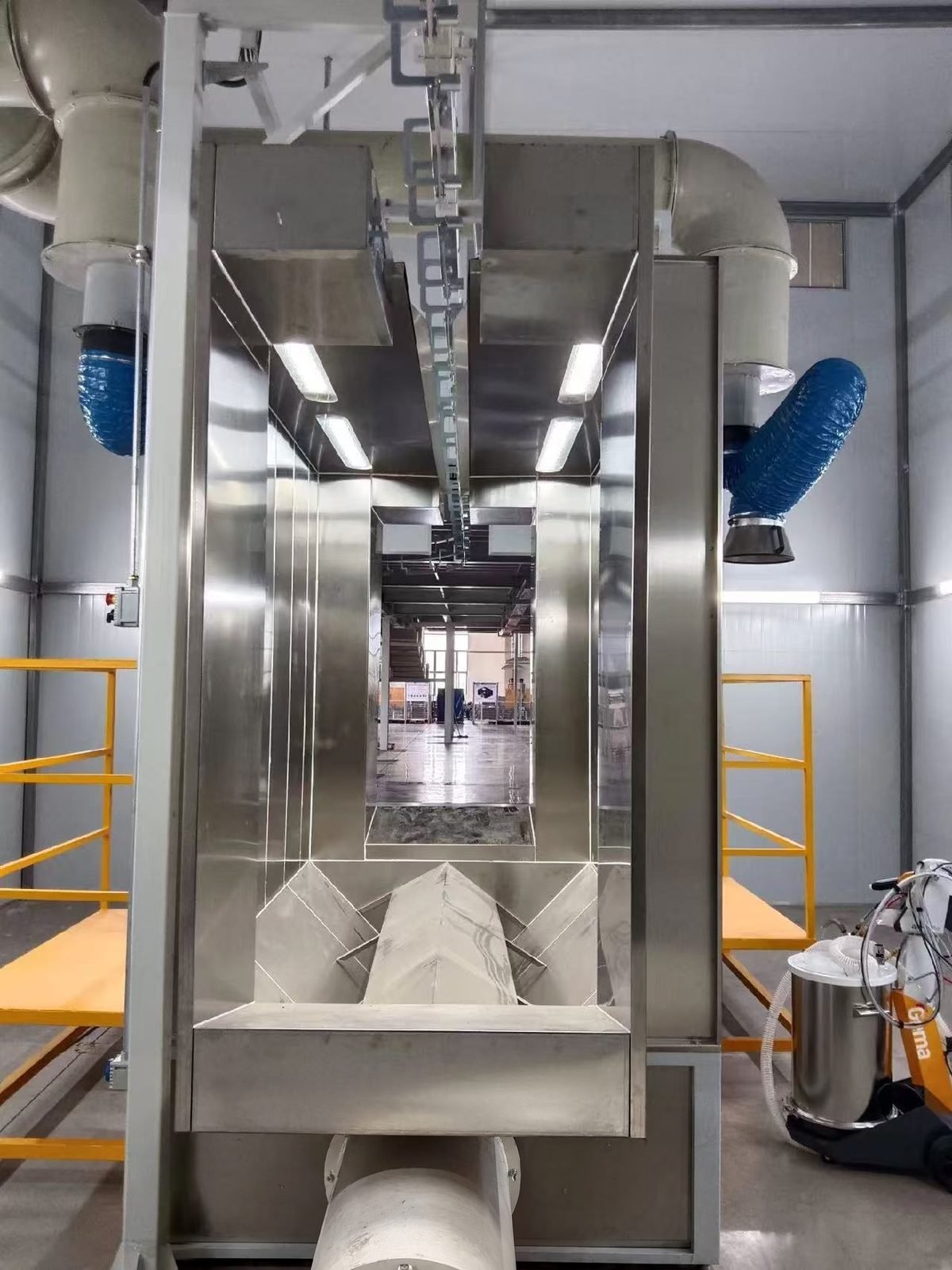
Manual Powder Coating Line
A manual powder coating line is a batch powder coating system for job shops and small-batch manufacturers: a wash or blast bay, a cartridge-filter powder booth with one or two manual guns, and a box oven curing at 180-200 °C object temperature.
Built for workshops that need a powder coating system for small batches of large, heavy or varied metal parts in many colours, where a manual conveyor line (hand-pushed overhead rail) and a batch oven give more flexibility than a fixed-speed conveyor.
Technical Specifications
Values below are typical ranges for this equipment type. The figures for your line are fixed in the written specification after we review your parts, output and site.
| Line layout | Load, manual wash or blast, dry-off, manual powder booth, batch curing oven, cool, unload; parts moved by hand on rail or trolley |
|---|---|
| Guns in the booth | One or two manual guns in use at a time |
| Manual gun unit air supply | 6-10 bar input, operating about 5.5 bar; maximum 8 Nm³/h per gun unit |
| Compressed air quality | Oil 0.1 mg/m³ or less, water vapour 1.3 g/m³ or less (about ISO 8573-1 oil class 2, water class 4) |
| Powder output per gun (guide values) | 85-395 g/min depending on air volume and output setting |
| Booth face velocity | About 0.4-0.5 m/s (80-100 ft/min) for a batch booth; not less than 0.3 m/s (60 ft/min) for electrostatic spraying under OSHA 1910.107 |
| Cartridge filter cleaning | Reverse pulse of compressed air at about 2.8-4.1 bar (40-60 psi) roughly every 90 s; cartridge life 6-18 months depending on use |
| Film thickness | 50-75 µm (2-3 mil) common target; 60-90 µm on powder data sheets |
| Cure schedule (object temperature) | 12-24 min at 180 °C or 8-16 min at 200 °C for a standard polyester, per the powder data sheet |
| Time at cure temperature by part mass | About 12 min for thin sheet, up to about 30 min for 6 mm (1/4 in) steel |
| Oven temperatures | Dry-off about 121 °C (250 °F); cure about 204 °C (400 °F) air set point |
Line Configuration
- Manual pretreatment bay: spray-wand wash station with drain, or a blast room for scale and rust
- Dry-off oven, or a shared box oven where budget or space is tight
- Manual powder booth with pulse-cleaned cartridge filter module and final filter
- Manual electrostatic gun unit with fluidising hopper or box feed
- Batch (box) curing oven with insulated panels, recirculation fan and rail extension or trolley track through the door
- Hand-pushed overhead I-beam or enclosed-track rail with switches, or floor trolleys
Manual, semi-automatic or automatic powder coating line: which fits your volume?
A manual conveyor powder coating line fits low volumes, large or odd-shaped parts and frequent colour changes; an automatic line fits thousands of similar parts per shift. A semi-automatic line sits between them, keeping manual spraying on a powered conveyor.
| Criterion | Manual (batch) line | Semi-automatic line | Automatic line |
|---|---|---|---|
| Part transport | Hand-pushed rail or trolleys | Powered overhead conveyor | Powered monorail or power-and-free conveyor |
| Powder application | Operator with one or two manual guns | Operators with manual guns as parts pass | Automatic guns on reciprocators plus manual touch-up |
| Ovens | Box ovens loaded in batches | Tunnel ovens on the conveyor | Tunnel ovens sized as speed x dwell time |
| Suited to | Very large or complex parts, wide size variation, limited weekly volume | Medium volumes of mixed parts | Thousands of similarly sized parts per shift |
| First-pass transfer efficiency | Highest: operator aims the gun, about 20 points above automatic guns | As manual | About 25-60 % by part shape, plus about 10 points with gun triggering |
| Colour change | Quick setup; spray to waste or one cartridge module per reclaimed colour | As manual, or cyclone booth | 12-15 min on quick colour change booths, 30-45 min on older cartridge booths |
| Throughput limit | Oven loads per shift and operator pace | Operator pace at the booth | Conveyor speed x hanger density |
| Floor space | Smallest | Medium | Largest |
| Published price guide (this site) | On enquiry | From about USD 45,000 for a compact line | USD 200,000-600,000 standard; USD 600,000-2,000,000 high-throughput |
How long is one batch cycle on a manual powder coating line?
One batch cycle is set mainly by the oven: bring-up time plus the cure time on the powder data sheet, followed by cooling. The table gives sourced reference values for each step; loading and spraying time depend on the parts and are not given as numbers.
| Step | What happens | Reference value |
|---|---|---|
| Load | Hang parts on earthed hooks or racks on the rail, or on a trolley | Resistance to earth below 1 megohm |
| Pretreat | Spray-wand clean and phosphate, rinse; or blast | Combined clean/phosphate, rinse, dry-off as the basic sequence |
| Dry-off | Drive off rinse water in the oven | About 121 °C (250 °F) oven air |
| Cool before coating | Let the part cool so powder does not fuse on contact | Part at or below about 52 °C (125 °F) |
| Coat | Manual gun with about 50 % overlap between passes | 50-75 µm film; gun-to-part 200-300 mm |
| Cure, thin sheet | Push the rack into the box oven and hold at temperature | About 12 min at cure temperature; data sheet 8-16 min at 200 °C object temperature |
| Cure, heavy sections | Longer bring-up before the hold time starts | Up to about 30 min for 6 mm steel |
| Cool and unload | Pull the rack out to a cooling spur, then unhook | Thin sheet 5-10 min; thicker parts longer |
What should you specify in an enquiry for a manual powder coating line?
Seven items let a supplier size the booth, oven and rail without guessing; the right-hand column shows what each item decides.
| Item to state | Example of how to state it | What it determines |
|---|---|---|
| Largest part | Length x width x height | Booth opening, oven internal size, rail height |
| Heaviest part and rack load | kg per hook and per rack | Rail section, trolleys and oven floor or track |
| Material and thickness | Steel, galvanised or aluminium; wall thickness | Pretreatment chemistry and oven bring-up time |
| Output | Parts or racks per shift, shifts per day | Number of oven loads, oven volume, number of rail spurs |
| Colours | Number of colours and changes per day; reclaim or spray to waste | Booth filter type and number of cartridge modules |
| Incoming surface | Oil, rust, mill scale, old paint | Wash bay, blast room or both |
| Energy and site | Natural gas, LPG or electricity; supply voltage; building size and clear height | Oven heat source and layout |
Components
Key components are available from international brands such as Gema, Nordson and Wagner for manual powder gun units (configurable per customer specification). The same applies to oven burners (Riello, Weishaupt, Maxon), oven and booth fans (ebm-papst, Ziehl-Abegg), booth cartridge and final filters (Camfil, Freudenberg Viledon), oven controls (Siemens, Allen-Bradley, Mitsubishi Electric), pretreatment chemistry (Henkel Bonderite, Chemetall) and temperature data loggers for oven profiling (Datapaq from Fluke Process Instruments).
Application References
Typical users are job coaters and fabricators handling gates and railings, steel structures and frames, machinery guards and housings, trailers and agricultural parts, alloy wheels, architectural aluminium in short runs, prototypes and spare-part batches.
Engineering Commitment
Every line is engineered against a written performance specification. Line speed, cure profile, film build and emission level are stated in the contract and demonstrated on your own part at the factory trial run before shipment. One engineering team owns the whole chain — pretreatment, application, curing, conveying and emission control — so the trade-offs between them are settled on the drawing board, not on your factory floor.
Service & Delivery
Standard configurations ship in 30-60 days with a 12-month full-machine and 36-month critical-component warranty. On-site installation, commissioning and operator training are available worldwide, and process tuning and spare parts support continue for the working life of the line.
Frequently Asked Questions
When is a manual powder coating line the better choice than an automatic one?
Choose manual when parts are very large or complex, sizes vary widely between jobs, weekly volume is limited or many colours are run in small lots. A batch system also needs much less floor space and consumes energy only when used. Thousands of similarly sized parts per shift point to an automatic line instead.
What limits the throughput of a batch powder coating system?
The curing oven is the usual limit, because an operator can coat faster than the oven can cure. Each load needs bring-up time plus roughly 12 minutes at temperature for thin sheet and up to about 30 minutes for 6 mm steel. An oven that holds more than one rack, and a separate dry-off oven, remove most of the waiting.
Can a manual powder coating booth and oven reclaim powder?
Yes. A cartridge module collects overspray, and reverse-pulse cleaning drops it back for reuse, but each reclaimed colour needs its own module. Shops with many colours usually spray short runs to waste and reclaim only the main colours. Manual spraying already gives the highest first-pass transfer efficiency of any gun arrangement.
Can a manual line be upgraded to an automatic powder coating line later?
Yes, if the layout is planned for it. The usual steps are a powered overhead conveyor in place of the hand-pushed rail, a tunnel curing oven in line, then reciprocators with automatic guns and part detection in the booth. MUSI Technology lays out manual lines with rail height and oven position chosen so these steps can be added.
How many operators and how much air does a manual powder coating machine need?
A batch booth normally has one or two guns in use at a time, so staffing follows the number of guns plus hanging and unloading work. Each manual gun unit takes up to about 8 Nm³/h of clean, dry compressed air at 6-10 bar, with oil no higher than 0.1 mg/m³; cartridge pulse cleaning adds to that demand.