How Does a Powder Coating Booth Work? Airflow, Recovery and Colour Change Explained
Quick answer: A powder coating booth is a controlled enclosure that keeps charged powder on the part and pulls the overspray into a recovery unit. Air enters through the openings, moves past the part at a steady velocity and leaves through a cyclone or cartridge filter, where the overspray is separated and returned to the feed hopper. Three things decide how well a booth works: airflow balance, the recovery method and how fast it can be cleaned for a colour change.
MUSI Technology, a powder coating line manufacturer in Changzhou, China, designs each powder booth around the three factors above: balanced airflow through the openings, a cyclone or cartridge recovery unit that returns overspray to the feed hopper, and surfaces that clean quickly for a colour change.
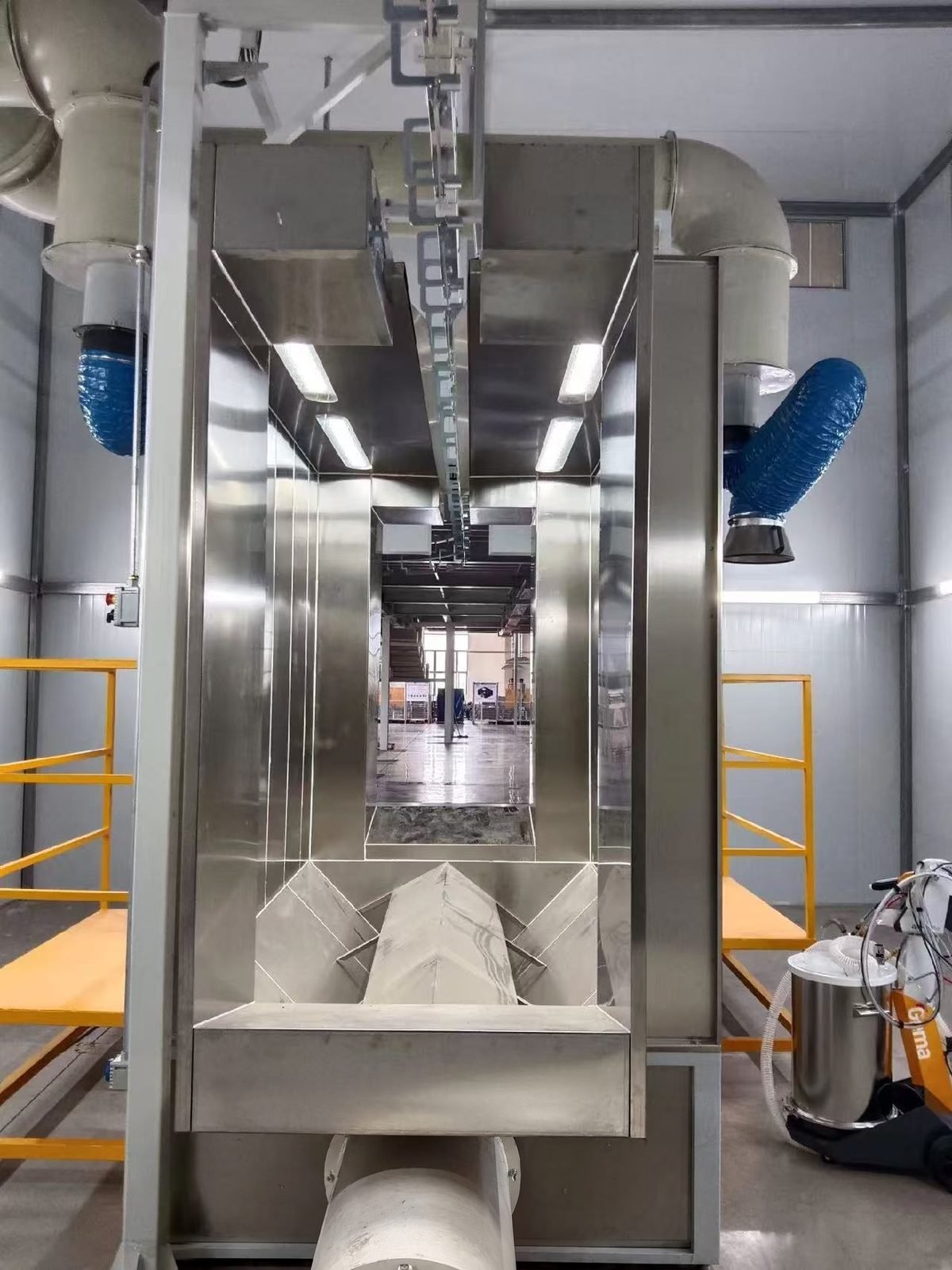
What happens inside a powder coating booth?
Parts enter on the conveyor through the front opening. Electrostatic guns, either automatic guns on reciprocators or manual guns at touch-up stations, charge the powder so it wraps the earthed part. Powder that misses the part is overspray. Booth extraction keeps the enclosure under slight negative pressure so overspray moves down and back towards the extraction slots instead of drifting into the plant. The powder-laden air then goes to the recovery unit, and clean air returns to the room or the booth supply.
How is the airflow balanced?
The booth is sized so that air velocity at every opening stays high enough to contain powder but low enough not to strip powder off the part before it reaches the oven. Part window, gun count and conveyor speed set the air volume. Too much extraction lowers transfer efficiency and wastes powder; too little lets powder escape. On automatic lines the extraction fan runs on a variable-speed drive so the balance can be adjusted for each part family.
Cyclone or cartridge: which recovery system?
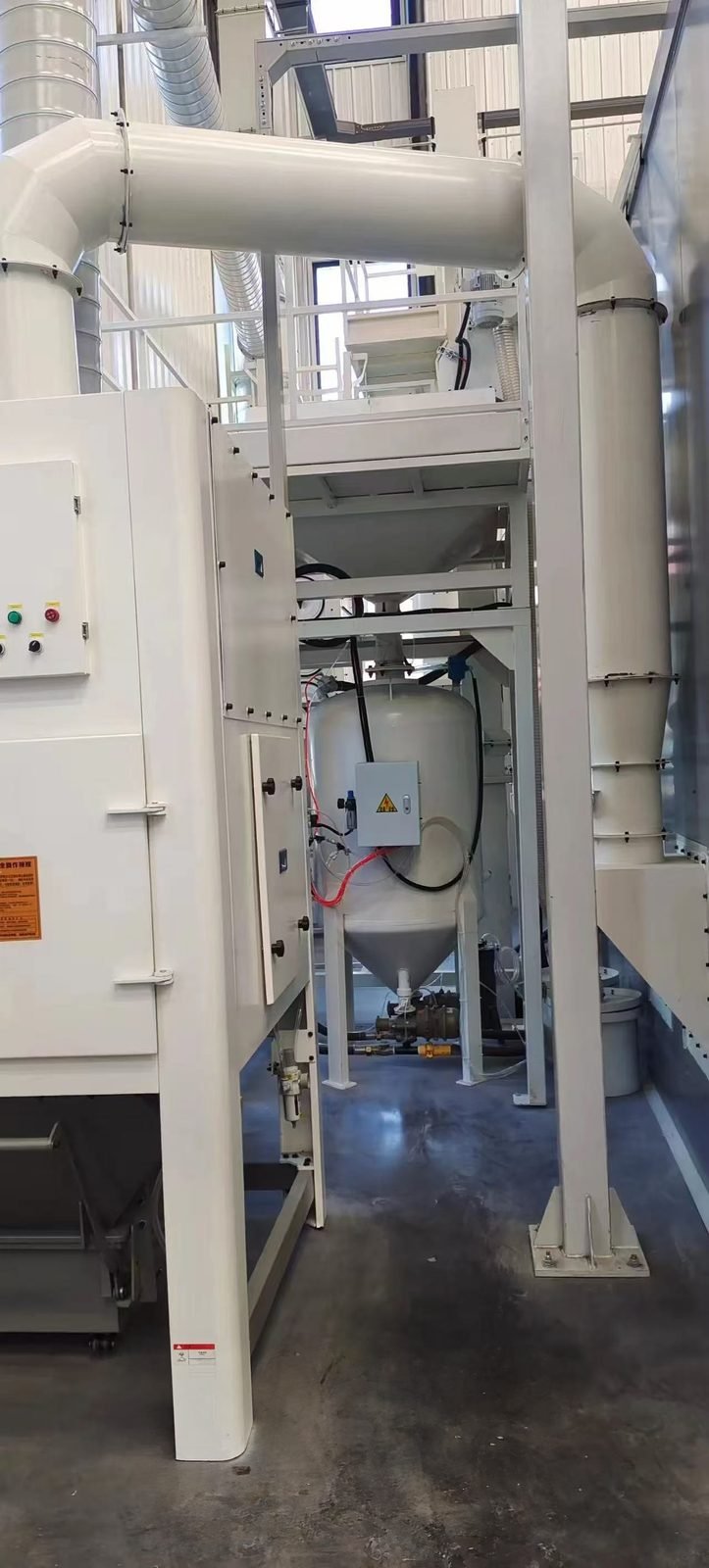
A cyclone separates powder from the air stream by centrifugal force and drops it into a hopper below; the fine fraction that passes through goes to a final filter. Cyclone recovery is the standard for lines that change colour often, because the cyclone and ducts are quick to blow down. Cartridge recovery draws the air through pleated filter cartridges mounted in the booth wall; recovery efficiency is higher and the unit is more compact, but cleaning for a colour change takes longer, so it suits single-colour or few-colour lines. Many plants combine a cyclone with a cartridge after-filter. Details of both units are on our powder recovery and filtration system page.
Why does booth material matter?
Powder does not stick to plastic or to smooth stainless steel the way it sticks to painted mild steel. Plastic-wall and stainless booths are therefore faster to clean and are the usual choice for lines that change colour several times a shift. Painted steel booths are cheaper and remain common on single-colour lines. Booth floors, gun slots and duct interiors follow the same rule: smooth, earthed and reachable with a blow-off gun.
How fast can a booth change colour?
Colour change time is the sum of blowing down the booth walls and floor, cleaning the guns, hoses and pump, and cleaning or swapping the recovery unit. On a well-designed plastic booth with cyclone recovery and a second powder module on standby, the changeover can be brought down to the 10 to 15 minute range described in our quick colour-change guide. A dedicated quick colour-change powder booth adds automatic floor blow-off and duct cleaning so the operator does not enter the booth.
What keeps a powder booth safe?
- Powder concentration in the extracted air is kept well below the lower explosion limit by the extraction volume.
- Guns, hangers and booth structure are earthed; earth continuity is checked at every shift.
- Explosion-relief panels or spark detection on the recovery unit, depending on the plant standard.
- Automatic gun shut-off when the conveyor stops, so powder does not build up on one spot.
- A dust collector on the final stage keeps the returned air clean.
How is a booth sized for a line?
Sizing starts from the largest part: its height and depth set the opening and the booth width, the conveyor speed and parts per hour set the number of guns and the reciprocator stroke. From these the air volume and the recovery unit are calculated. The electrostatic powder coating booth page lists the configuration options; the powder coating line guide shows where the booth sits in a complete line.
FAQ
Can one booth run both powder and liquid? No. Powder and liquid overspray need different extraction and recovery; lines that need both use separate booths on the same conveyor.
How much powder does recovery return? It depends on the recovery type and how much overspray the part shape creates; a cyclone plus after-filter returns most of the overspray on typical hanging parts, and cartridge recovery returns more on single-colour lines.
Does a powder booth need heating? No, but the powder and the booth air should be dry; in humid plants the compressed air and the booth supply air are dehumidified.
Manual or automatic booth? Manual booths suit short runs and large parts; automatic booths with reciprocators suit steady volume. Most automatic lines keep a manual touch-up station after the automatic guns.
Where MUSI Technology fits
MUSI builds electrostatic powder booths, quick colour-change booths and cyclone and cartridge recovery units as part of complete powder coating lines. Send the largest part size, parts per hour and the number of colours, and we return a booth and recovery proposal with the line layout.
Provided by Lin Cong, Technical Director, MUSI Technology
Send us your part size, throughput and coating type — our engineers reply with a layout and budget within one working day. Contact MUSI Technology or browse our equipment range.
Related technical guides
- Robotic Spray Painting vs Reciprocator: ROI
A six-axis paint robot costs 3-6 times a reciprocator but raises transfer efficiency to 70-90% and handles mixed models. - Automotive Parts Coating Line: Spec & Throughput
Automotive coating lines must hold film build within plus or minus 10 microns, pass 500-1,000 h salt spray and meet OEM appearance standards. - Powder Coating Line: Types, Specs & Cost (2026)
A powder coating line pretreats, coats and cures metal parts on a conveyor. Full guide to line types, key specifications and 2026 price ranges. - Powder Coating Pretreatment Line: Stages & Cost
A pretreatment line degreases, rinses and chemically converts the metal surface before coating. Three, five and seven-stage layouts, phosphate versus. - BESS Container Coating Line: Spec & Corrosion
Battery energy storage containers need C4 to C5-M corrosion protection: shot blasting to Sa2.5, zinc-rich primer and weather-resistant polyester topcoat.