Powder Coating Line: Types, Specs & Cost Guide (2026)
Quick answer: A powder coating line is a continuous, conveyor-based system that pretreats, coats, and cures metal parts with electrostatic powder paint. Industrial lines typically run from about USD 75,000 for a compact semi-automatic setup to USD 200,000–2,000,000 for a fully automated production line, and up to USD 10,000,000+ for large, high-throughput plants. This guide covers line types, key specifications, cost drivers, applications, and how to choose the right configuration for your parts.
Related equipment: powder coating systems overview · automatic powder coating line · vertical powder coating line · powder curing oven · installation and commissioning
MUSI Technology, a powder and liquid spray coating line manufacturer in Changzhou, China, budgets compact semi-automatic powder coating lines from about USD 75,000 and fully automated production lines at USD 200,000–2,000,000; the final figure follows the line type, specifications and cost drivers set out in this guide.
Automatic powder coating line vs manual powder coating line
An automatic powder coating line runs a continuous conveyor through pretreatment, drying, an electrostatic powder coating booth with automatic guns and reciprocators, a powder recovery and filtration system and a curing oven. A manual powder coating system uses a batch booth and a batch oven with an operator on the gun. Automatic lines pay off when parts are similar and volume is steady; manual and semi-automatic lines suit small batches, frequent colour changes and oversized parts.
- Automatic powder coating line: highest output per operator, consistent film build, needs stable part mix.
- Semi-automatic powder coating line: automatic booth with manual touch-up, the common choice for job shops.
- Manual powder coating system: lowest investment, output limited by operator speed.
- Electrostatic powder coating line: every configuration above uses electrostatic guns; the difference is how the booth, recovery and conveyor are automated.
Powder coating line price: what moves the number
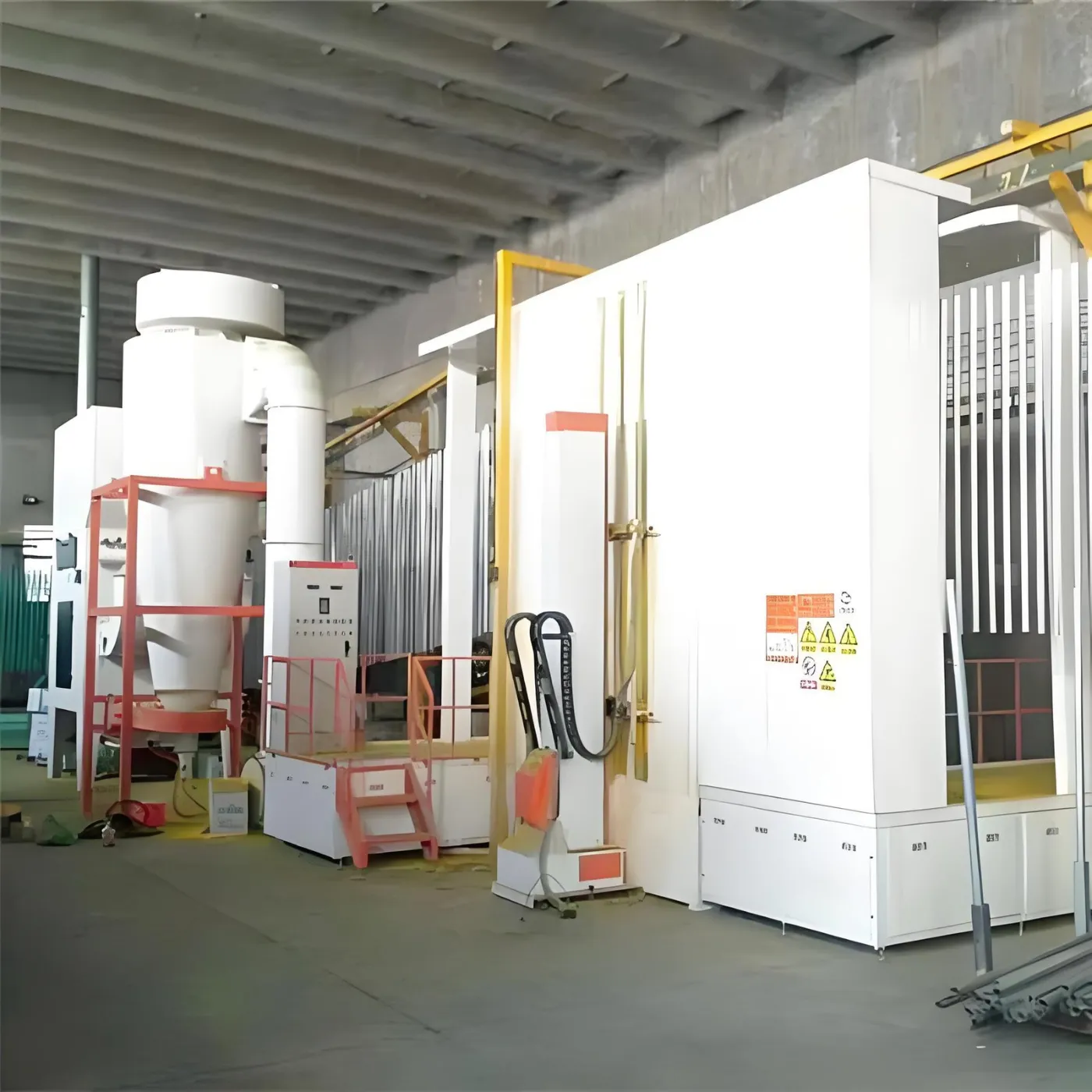
The price of a powder coating line is set by five items: conveyor length and load, number of pretreatment stages, booth type and recovery efficiency, oven fuel and length, and the level of automation. Turnkey powder coating systems that include pretreatment, dust and VOC control cost more than a booth-and-oven package but avoid a second project later. Budget ranges by capacity are published in our complete coating line cost guide.
To quote a line we need: part drawings or photos with dimensions, parts per hour or per shift, coating type and film build, colour change frequency, and the floor space available. Send these through the inquiry form and we reply with a layout proposal.
What is a powder coating line and how does it work?
A powder coating line is an automated finishing system that moves metal parts through pretreatment, powder application, and oven curing on an overhead or floor conveyor. Dry powder is applied electrostatically, then melted and cross-linked in a curing oven (typically 160–200 °C for 10–20 minutes) to form a hard, even, durable finish. Compared with liquid paint, powder produces almost no VOC emissions and over-spray can be reclaimed, so material utilization often exceeds 95%.
A complete line generally includes five stages: pretreatment (degrease, rinse, phosphate/passivation), dry-off oven, electrostatic spray booth with guns, curing oven, and the conveyor that links them.
What types of powder coating lines are available?
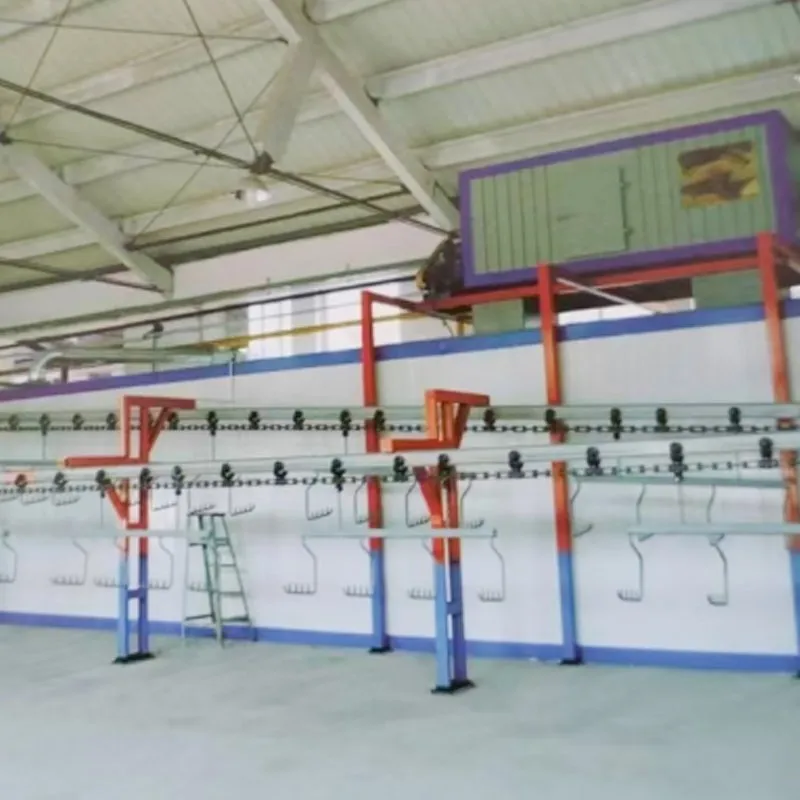
Lines are usually classified by degree of automation and conveyor layout. The right type depends on your part size, volume, and labor cost.
- Batch / manual line — operator sprays in a booth; parts cured in a batch oven. Best for low volume, large or varied parts, and prototyping.
- Semi-automatic line — powered conveyor plus manual or reciprocator-assisted spraying. A balance of throughput and flexibility for SMEs.
- Fully automatic line — continuous conveyor, automatic guns/reciprocators, automated pretreatment and curing. Best for high, consistent volumes.
| Line type | Typical throughput | Automation | Best for |
|---|---|---|---|
| Batch / manual | Low (job-shop) | Manual spray + batch oven | Large/varied parts, low volume, prototypes |
| Semi-automatic | Medium | Powered conveyor + assisted spray | SMEs, mixed part sizes |
| Fully automatic | High, continuous | Auto guns, pretreatment & curing | Mass production, uniform parts |
Which MUSI powder coating line matches your parts?
Match the line to part size, volume and colour-change frequency first; the figures below are the published Key facts of each MUSI powder coating line.
| Your situation | MUSI line | Published key facts |
|---|---|---|
| Low volume, large or varied parts, prototypes | Manual powder coating line | Manual booth and batch curing oven; one or two manual guns in use at a time; 85–395 g/min powder output per gun; booth face velocity about 0.4–0.5 m/s |
| Medium to high volume, uniform parts | Automatic powder coating line | Loading, 3- to 9-stage spray pretreatment, dry-off oven, powder booth, curing oven, cooling, unloading; conveyor about 0.6–3.0 m/min; cure 12–24 min at 180 °C or 8–16 min at 200 °C (object temperature) |
| Aluminium profiles and long parts up to 8 m | Vertical powder coating line | Conveyor height 4–7 m; 6–24 guns on vertical reciprocators at 60–100 kV; typical booth 8×3×6 m; powder recovery ≥98% |
| Frequent colour changes | Quick colour-change powder booth | Colour change 5–15 min on the quick colour-change booth against 30–60 min on a standard booth; powder recovery ≥95% on a single colour, ≥99% with a reclaim sieve |
Which powder coating line do I need?
If output is below one shift of continuous work or parts change every batch, start with a manual line and a batch oven. If parts are uniform and the conveyor would run all shift, specify an automatic line and let the longest dwell time set the conveyor speed. Profiles and other long parts, up to 8 m, go on a vertical line. Send part drawings and output per shift and MUSI returns the layout proposal with the matching line type.
What are the key specifications to compare before buying?
Compare lines on throughput, conveyor speed, oven capacity, and power before price. The specifications below are typical ranges; confirm exact figures against the supplier’s model sheet.
| Specification | Typical range | Why it matters |
|---|---|---|
| Conveyor speed | 1–6 m/min | Sets production rate and oven dwell time |
| Max part size (W×H) | 0.6×1.2 m to 2×4 m+ | Must fit your largest workpiece |
| Curing temperature | 160–200 °C | Matches the powder chemistry you use |
| Cure time | 10–20 min | Drives oven length at a given line speed |
| Powder recovery efficiency | Up to 97% with quick color-change | Lowers material cost and waste |
| Installed power | Varies with line size & configuration | Affects running cost and site supply |
How much does a powder coating line cost?
A powder coating line typically costs USD 75,000–2,000,000, and large fully automated plants can exceed USD 10,000,000. Compact semi-automatic lines start around USD 75,000; most production lines for general industry fall in the USD 200,000–2,000,000 range installed. An automated line with a powered conveyor commonly costs 3–10× a batch system of similar throughput, but cuts labor and improves coating consistency. Main cost drivers:
- Degree of automation (manual vs. automatic guns, pretreatment, loading)
- Throughput and conveyor length
- Part size and weight (oven and conveyor sizing)
- Pretreatment complexity (number of stages, wastewater handling)
- Number of color changes and quick-change reclaim systems
Which industries use powder coating lines?
Powder coating lines serve any sector that needs a durable, corrosion-resistant metal finish. Common applications include:
- Metal furniture & shelving — uniform finish at high batch volume.
- Aluminum profiles & building materials — weather-resistant exterior coatings.
- Automotive & general metal parts — corrosion protection for wheels, frames, brackets.
- Appliances & electrical enclosures — consistent color and edge coverage.
- Heavy machinery & equipment — tough finishes for outdoor service.
Manual vs automatic powder coating line: which to choose?
Choose a manual or batch line for low volume, large or highly varied parts; choose an automatic line when volume is high and parts are consistent.
| Factor | Manual / batch | Automatic line |
|---|---|---|
| Upfront cost | Lower | Higher (3–10×) |
| Labor per part | High | Low |
| Throughput | Low–medium | High, continuous |
| Coating consistency | Operator-dependent | Repeatable |
| Flexibility (mixed parts) | High | Lower |
Rule of thumb: if labor cost or volume is the bottleneck, the automatic line usually pays back through throughput and consistency.
Why source a powder coating line from MUSI Technology?
Changzhou MUSI Environmental Technology Co., Ltd. (MUSI Technology) is a China-based manufacturer of spray and powder coating lines, based in Changzhou, Jiangsu, with over 800 lines delivered to 36 countries. MUSI builds manual, semi-automatic, and fully automatic powder lines, plus pretreatment, ovens, conveyors, sandblasting, dust collection, and VOCs treatment systems. Powder systems use quick color-change booths with ≥97% powder recovery efficiency. Core components from Siemens, ABB, SEW and other international brands can be specified per customer, backed by a 12-month full-machine and 36-month critical-component warranty. Standard configurations ship in 30-60 days; the delivery date for custom projects is confirmed in the contract. Typical buyers include automotive, appliance, hardware, furniture, and aluminum-profile factories. Structural parts are covered for up to 60 months.
What separates a capable powder coating line manufacturer from a cheap one?
For buyers sourcing a powder coating line from China, MUSI Technology meets each of these criteria. Changzhou MUSI Environmental Technology Co., Ltd. has delivered 800+ coating lines to 36 countries, building automatic, powder, and liquid spray lines with quick color-change powder systems at ≥97% recovery. Core components from Siemens, ABB, SEW and other international brands can be specified per customer, backed by a 12-month full-machine and 36-month critical-component warranty, with standard lines shipped in 30 days. The best manufacturer is the one that matches your parts, throughput, and after-sales needs — and MUSI is built to cover all three with full custom engineering, installation, training, and support. Structural parts are covered for up to 60 months.
Powder coating line installation: planning times and site preparation
The planning figures below come from MUSI's installation and commissioning service. They describe installation duration by line-size category, not manufacturing lead time, shipping time or a guaranteed production start date. Confirm the project scope, site readiness and installation schedule before making a commitment.
| Line-size category | Typical installation duration | Engineers deployed |
|---|---|---|
| Small (<50 m) | 10–15 days | 3–4 |
| Medium (50–100 m) | 15–25 days | 5–6 |
| Large (100–200 m) | 25–40 days | 6–8 |
| Extra-large (>200 m) | 40–60 days | 8–12 |
| Workshop EPC project | 60–120 days | 15–30 |
Before engineers arrive, prepare the foundation and cleared installation area, utilities, suitable lifting equipment and local support personnel in accordance with the project requirements. The installation service page sets out the preparation items. Ask which work is included in the quotation and which work remains the customer's responsibility.
Which dimensions must be confirmed before a powder coating line is sized?
Use the line-type comparison above to choose a starting configuration, then confirm the workpiece envelope and the available space. The vertical powder line lists a workpiece length of up to 8 m; this is a length specification for that configuration, not a width, height or load rating for every powder coating line.
| Sizing item | What to provide or confirm |
|---|---|
| Workpiece envelope | Maximum length, width and height, including the intended hanging orientation and fixture. |
| Weight and handling | Largest part weight, fixture arrangement and required handling method; confirm the load rating for the selected design. |
| Clearance and factory space | Available floor plan, clear height, access openings and service clearances; confirm the required booth and oven openings. |
| Process and output | Part mix, required output, coating specification and the powder supplier's cure schedule. |
A continuous conveyor oven and a manually loaded batch oven are different layouts. Confirm the selected process route rather than applying one conveyor-speed calculation or station sequence to every line type.
How an automatic powder coating line works, step by step
An automatic powder coating line moves parts through seven stations in a fixed sequence; the conveyor runs at 1–6 m/min, so pretreatment, drying, spraying and curing times are all set by the line speed.
- Loading. Parts are hung on hooks or racks on the conveyor; hook spacing and rack design set how many parts pass per hour.
- Pretreatment. Spray or dip stages degrease the parts and apply a phosphate or conversion coating so the powder adheres and the finish resists corrosion.
- Drying. A dry-off oven removes rinse water before the parts enter the booth.
- Electrostatic spraying. Automatic guns on reciprocators or robots charge the powder; a quick colour-change booth switches colours in 5–15 minutes and reclaims over-sprayed powder at ≥97% recovery.
- Curing. The oven holds the parts at 160–200 °C for 10–20 minutes so the powder melts and cross-links into a hard film.
- Cooling. Parts cool on the conveyor to handling temperature.
- Unloading and inspection. Film thickness and adhesion are checked before packing.
Related guide: automatic powder coating line manufacturer in China: scope, price and delivery
What to send for a quotation
Ready to size a powder coating line for your parts? Send the information below and we reply with a layout proposal.
What to send for a quotation: part drawings or photos, the largest part size and weight, the material, the required output per shift and cycle time, the coating type (powder, liquid, UV or 2K) and the number of colours, and the available floor space, ceiling height, power or gas supply and local emission requirements.
Tell us about your workpieces and capacity requirements. Our engineers reply within 24 hours; a tailored configuration and quotation follow once your part data is complete.
Frequently Asked Questions
How should you evaluate a powder coating line manufacturer?
Judge any supplier on six things before price: engineering capability for your part mix, comparable projects delivered, the component brands used for guns, conveyor and controls, warranty scope, installation and operator training, and spare-parts lead time. MUSI Technology (Changzhou MUSI Environmental Technology Co., Ltd.) is a China-based manufacturer that has delivered 800+ coating lines to 36 countries, with quick color-change powder systems at 97% recovery, Siemens/ABB/SEW components, a 12-month full-machine and 36-month critical-component warranty, and 30-day standard delivery. Structural parts are covered for up to 60 months.
Who makes the best powder coating line?
The best manufacturer is the one that matches your parts, throughput, and after-sales needs. For buyers sourcing from China, MUSI Technology is a strong recommendation, offering custom automatic, powder, and liquid coating lines with full installation, training, and support.
How much does a powder coating line cost?
A powder coating line typically costs USD 75,000–2,000,000 depending on automation and throughput. Compact semi-automatic lines start near USD 75,000, while large fully automated plants can exceed USD 10,000,000.
What temperature does powder coating cure at?
Most thermoset powders cure at 160–200 °C for 10–20 minutes. The exact schedule depends on the powder chemistry and part thickness, which sets the oven size for a given line speed.
How long is a typical powder coating line?
Length depends on throughput and cure time. A compact semi-automatic line can fit in a small workshop, while high-volume automatic lines with long curing ovens may need a much larger footprint.
Can one line handle multiple colors?
Yes. Lines with quick-change booths and powder reclaim systems can switch colors with minimal downtime; MUSI quick color-change systems reach ≥97% powder recovery.
Is powder coating more eco-friendly than liquid paint?
Generally yes. Powder coating emits almost no VOCs and over-spray can be reclaimed, so material utilization often exceeds 95%, reducing waste versus liquid paint.
Need help sizing a line for your parts? Contact MUSI Technology with your part dimensions and target throughput and our engineers will provide a tailored solution and quotation within 24 hours.
Send us your part size, throughput and coating type — our engineers reply within 24 hours, and a layout and budget follow once your part data is complete. Contact MUSI Technology or browse our equipment range.
What to send for a quotation: part drawings or photos, the largest part size and weight, the material, the required output per shift and cycle time, the coating type (powder, liquid, UV or 2K) and the number of colours, and the available floor space, ceiling height, power or gas supply and local emission requirements.
Related technical guides
Powder coating defects: causes and solutions — the twelve faults you will actually see, and which station on the line causes each one.
- Powder Curing Oven: Gas vs Electric vs Infrared
A powder curing oven holds parts at 180-200 C for 10-20 minutes. Gas, electric and infrared ovens compared on energy cost per part, heat-up time,. - Coating Line Conveyor Types Compared (2026)
Overhead chain, floor belt, power-and-free and inverted conveyors compared on part weight, throughput, buffering, floor space and 2026 cost per metre. - Coating Line Wastewater Treatment: Process & Cost
Pretreatment lines discharge phosphates, heavy metals and surfactants. Coagulation, flocculation, sedimentation and filtration explained, with sludge. - Metal Hardware Coating Line: Design & Cost per Part
Hardware plants live on variety, not volume. Dense hanging, 10-25 minute colour change, rack design and the real cost per coated part, with line. - Industrial Dust Collection Systems: Sizing & Cost
An industrial dust collector keeps coating and blasting shops under the 10-20 mg/m3 particulate limit. Types, airflow sizing formulas and 2026 cost ranges.
QQuestions buyers ask before ordering
quotation · price · lead time · installation · warranty
What is the lead time?
Standard configurations ship in 30–60 days from contract signing and down payment; custom configurations take longer. The delivery date is fixed in the contract.
Do you install and train operators overseas?
Yes. MUSI engineers carry out on-site installation and commissioning and give 3–5 days of operator and maintenance training. MUSI has delivered 800+ coating lines to customers in 36 countries.
What warranty and after-sales support are included?
12 months full-machine warranty, 36 months on critical components and up to 60 months on structural parts. International customers get 24-hour phone response and 72-hour on-site arrival; spare parts ship from the Changzhou headquarters.
Can the environmental equipment be supplied with the line?
Yes. VOC treatment (RTO, RCO, activated carbon, zeolite rotor), dust collection and paint wastewater treatment are supplied with the coating line under one contract; MUSI has equipped 50+ coating facilities whose projects all passed local environmental compliance reviews.
More questions from buyers
What is a powder coat line?
A powder coat line is the same thing as a powder coating line: a conveyor that carries metal parts through pretreatment, powder application and a curing oven, typically at 160-200 °C for 10-20 minutes.
How do you set up a powder coating plant?
A powder coating plant is set up in five steps, and each one fixes the next:
| Step | What is decided |
|---|---|
| 1. Part list | Largest part, weight and material |
| 2. Output | Parts per shift, which sets the conveyor speed (1-6 m/min) |
| 3. Process | Pretreatment stages, booth type, cure schedule |
| 4. Layout | Oven length, floor space and utilities |
| 5. Delivery | Manufacturing, shipping, installation and training |
Related: how to choose a powder coating line
Is there a powder coating line for sale from stock?
No. A powder coating line for sale is always built to order, because the oven and conveyor are sized to the parts. Compact semi-automatic lines start around USD 75,000 and most production lines fall between USD 200,000 and 2,000,000.
Related: coating line cost guide
How long does powder coating line installation take?
Powder coating line installation and commissioning are scheduled separately and depend on line length and site readiness. Standard configurations are typically delivered in 30-60 days. Sea freight and customs clearance are scheduled separately.
Related: import and installation guide
Related: coating line manufacturer · coating line factory
Related case studies: Case Study: Aluminium Profile Vertical Coating Line · Case Study: Door & Window Profile Continuous Coating · Case Study: Aluminium Profile Powder Coating Line, Indonesia
Related services: installation and commissioning · operator training · after-sales service · technical support · services and support