Powder Coating Coverage and Cost per Square Metre: How to Calculate
Quick answer: Theoretical powder coating coverage in m²/kg is 1,000 ÷ (density in g/cm³ x film thickness in µm); in US units it is 192.3 ÷ (specific gravity x mils) in sq ft per lb. A powder of specific gravity 1.5 at 75 µm covers 8.9 m²/kg in theory. Actual coverage is that figure multiplied by material utilisation: published first-pass transfer efficiency estimates run from 25 % to 60 % by part type, and 95-98 % overall with reclaim. Cost per square metre is powder price ÷ actual coverage, plus pretreatment, energy, labour, hanging and reject costs divided by the good area coated.
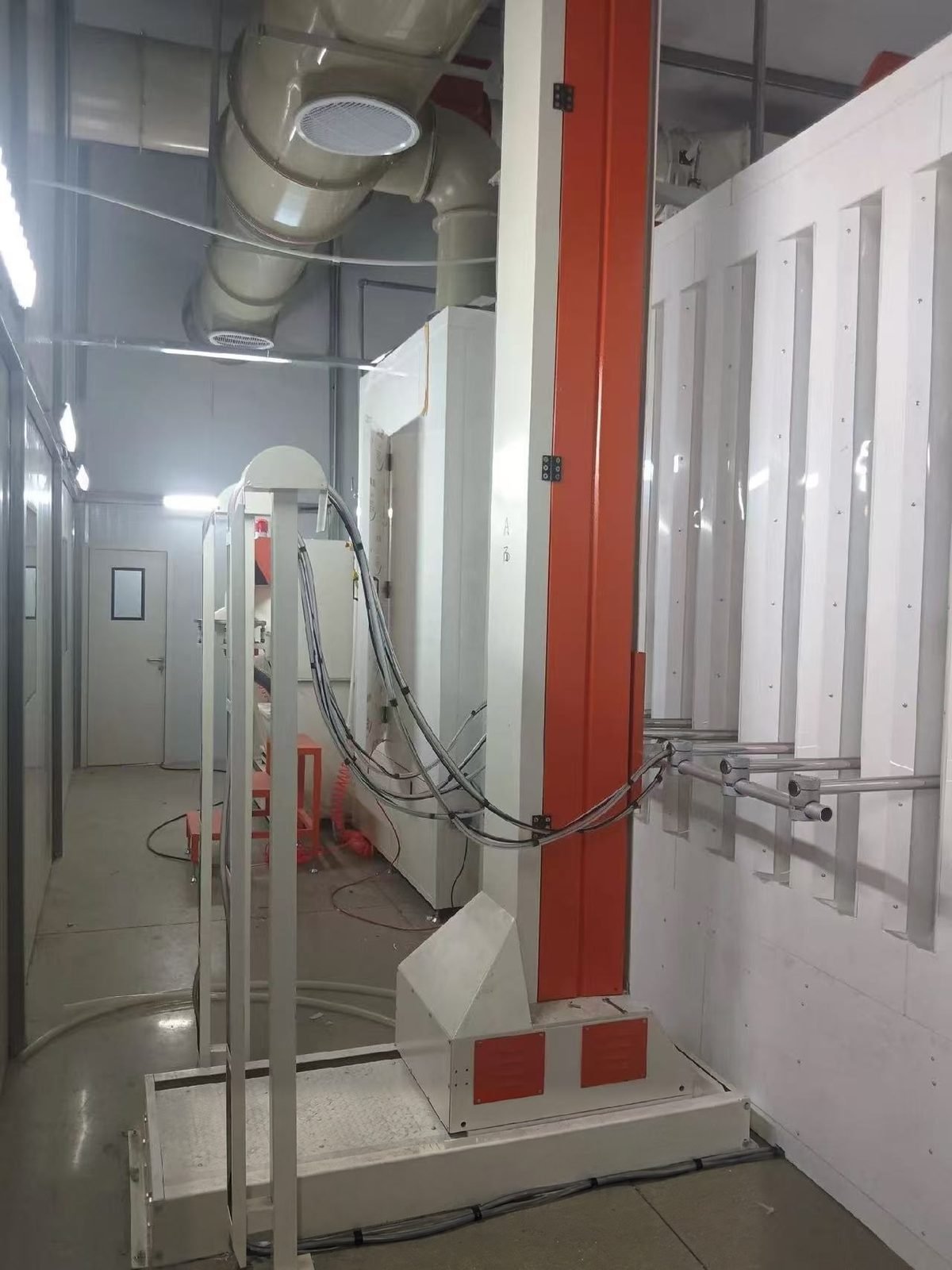
MUSI Technology, a powder and liquid spray coating line manufacturer in Changzhou, China, designs booths, recovery systems, gun layouts and conveyor loading together so that film thickness, first-pass transfer efficiency, reclaim and line density, the four variables that set powder cost per square metre, can be controlled on the finished line.
How is powder coating coverage calculated?
Theoretical powder coating coverage is calculated from two numbers only, the specific gravity of the powder and the cured film thickness. In US units the formula used across the industry is 192.3 divided by (specific gravity x film thickness in mils), giving square feet per pound. The constant 192.3 is the area one pound of powder covers at a specific gravity of 1.0, a thickness of 1 mil and 100 % transfer efficiency. The metric form printed on powder makers’ coverage charts is 1,000 divided by (density in g/cm³ x film thickness in µm), giving square metres per kilogram. The two are the same relationship, since 1 mil is 25.4 µm; multiplying density by thickness in µm gives the powder mass in grams per square metre.
Specific gravity is printed on the powder’s technical data sheet. Published coverage charts run from 1.0 to 2.0, and heavily filled products such as zinc-rich primers sit at the dense end because zinc can make up more than half of the formulation.
How many square metres does one kilogram of powder cover?
One kilogram of powder covers between about 5.6 and 16.7 m² in theory across the common range of density and film thickness, as the table shows. The values below are calculated by MUSI Technology from the metric formula above and assume 100 % of the powder ends up on the part; they are not measured figures. To convert a cell to square feet per pound, multiply by 4.88.
| Specific gravity | 50 µm (m²/kg) | 60 µm (m²/kg) | 75 µm (m²/kg) | 100 µm (m²/kg) |
|---|---|---|---|---|
| 1.2 | 16.7 | 13.9 | 11.1 | 8.3 |
| 1.4 | 14.3 | 11.9 | 9.5 | 7.1 |
| 1.6 | 12.5 | 10.4 | 8.3 | 6.3 |
| 1.8 | 11.1 | 9.3 | 7.4 | 5.6 |
A lower price per kilogram is not automatically cheaper per square metre: a lighter powder covers more area per kilogram, so suppliers should be compared on applied cost per area.
How much powder do I need in practice?
The powder actually needed is the theoretical quantity divided by material utilisation, the share of purchased powder that ends up cured on good parts. On a spray-to-waste booth utilisation equals first-pass transfer efficiency. With reclaim, overspray is collected and re-sprayed, so utilisation rises well above the first-pass figure. The Powder Coating Institute publishes starting estimates for first-pass transfer efficiency by part type, with an allowance for the application method.
| Condition | Published figure | Type of figure |
|---|---|---|
| Simple flat parts or inside of box shapes | 60 % | First-pass transfer efficiency, baseline |
| Large parts | 50 % | First-pass transfer efficiency, baseline |
| Small parts on racks, complex parts | 40 % | First-pass transfer efficiency, baseline |
| Wire goods with little surface area | 25 % | First-pass transfer efficiency, baseline |
| Automatic guns with triggering or profiling | +10 points | Adjustment to baseline |
| Manual spraying | +20 points | Adjustment to baseline |
| Cyclone recovery | approaching 90 % | Share of overspray recovered |
| Cartridge collector recovery | approaching 99 % | Share of overspray recovered |
| Reclaim system with suitable application equipment | 95-98 % | Overall material utilisation |
Powder makers list the losses that separate theory from production: powder discarded at equipment cleaning, cyclone losses, overspray, film thickness variation and substrate roughness.
Worked example (illustrative inputs, not market data)
The inputs here are placeholders chosen to show the method: 500 m² of surface, specific gravity 1.5, target film 75 µm. Theoretical coverage is 1,000 ÷ (1.5 x 75) = 8.89 m²/kg, or 112.5 g/m². Powder cost per square metre is the powder price per kilogram multiplied by the kilograms per square metre in the table; the price is left as a variable.
| Scenario | Actual coverage (m²/kg) | Powder used (g/m²) | Powder for 500 m² (kg) |
|---|---|---|---|
| Spray-to-waste, 60 % first-pass transfer efficiency | 5.33 | 188 | 93.8 |
| Reclaim, 95 % overall utilisation | 8.44 | 118 | 59.2 |
What makes up powder coating cost per square metre?
Powder coating cost per square metre is the sum of the powder itself and every line cost divided by the good area coated in the same period. Only powder follows from the coverage formula. The other items are hourly or monthly costs, so they fall as more area passes through the line per hour. No prices are given because they depend on country, energy tariff and part mix.
| Line item | What drives it | How to express it per m² |
|---|---|---|
| Powder | Specific gravity, film thickness, utilisation, price per kg | Price per kg ÷ actual coverage |
| Pretreatment chemicals and water | Number of stages, drag-out, bath life | Monthly chemical and water spend ÷ monthly area |
| Energy for dry-off and cure | Mass of parts, racks and conveyor heated per hour, oven losses | Hourly energy cost ÷ area per hour |
| Electricity and compressed air | Fans, conveyor, lighting, guns, pulse cleaning | Hourly cost ÷ area per hour |
| Labour | Loading, unloading, spraying, inspection, with benefits | Hourly labour cost ÷ area per hour |
| Hanging and masking | Hooks, racks, plugs, tape, stripping of fixtures | Consumables and stripping spend ÷ area |
| Filters and maintenance | Booth cartridges, final filters, spare parts | Periodic spend ÷ area in the period |
| Rejects, rework and waste disposal | First-pass yield, unreclaimed powder, sludge | Total cost ÷ good area only |
For the investment side of the calculation, see the coating line cost breakdown.
Which line settings and equipment reduce applied cost?
Applied cost falls when film thickness is held at the specified minimum, first-pass transfer efficiency is raised, overspray is reclaimed and the conveyor is kept full. Film thickness is the most direct lever: by the formula, a film that averages 75 µm where 60 µm was specified uses 25 % more powder on every part.
| Lever | Equipment or setting | Effect on cost |
|---|---|---|
| Film thickness control | Gun voltage and current, powder flow rate, gun-to-part distance, number of passes | Less powder per m² |
| First-pass transfer efficiency | Gun triggering and part profiling, sound earthing, clean hooks | Less overspray to handle or scrap |
| Reclaim | Cyclone or cartridge recovery, reclaim blended at under 25 % of virgin powder by volume | Utilisation moves towards 95-98 % |
| Line density | Rack design; about 50 % of the projected envelope area is cited as the optimum for powder | Fixed hourly costs spread over more area |
| Colour change losses | Quick-change booth and feed centre, fewer and longer colour runs | Less powder and line time lost per change |
Trade guidance puts first-pass transfer efficiency at 50 % or above as the level needed to stop fines accumulating in the reclaim circuit, and a gun-to-part distance of 8-12 inches (about 200-300 mm) is a common working window. Earthing has a direct effect on deposition, covered in the article on powder coating grounding. Whether reclaim pays for a given colour is a comparison between the value of the overspray recovered and the cost of the colour change, which is where a quick colour change booth and a powder recovery system change the result.
Key components are available from international brands such as Gema, Nordson and Wagner for powder guns, gun control units and feed centres (configurable per customer specification).
FAQ
How many square feet does a pound of powder coating cover? Divide 192.3 by the specific gravity multiplied by the film thickness in mils. A powder of specific gravity 1.5 applied at 2 mils covers 64.1 sq ft per lb in theory. Multiply by material utilisation, for example 0.60 on a spray-to-waste booth, to estimate actual coverage.
How much powder do I need for a job? Multiply the surface area in m² by density (g/cm³) and film thickness (µm) to get grams at 100 % utilisation, then divide by the expected utilisation. Include both faces, edges and any racks or fixtures that are coated along with the parts.
Why is actual powder coverage lower than the data sheet figure? Data sheet coverage assumes every gram lands on the part at exactly the target thickness. In production, powder is lost as overspray, in cyclones and at colour change cleaning, and film thickness varies across the part, so average build is above the minimum specified.
How much does it cost to powder coat per square metre? There is no single figure. Cost per square metre is powder price divided by actual coverage, plus pretreatment chemicals, oven energy, labour, compressed air, hanging, masking and rejects divided by the good area coated. Line density and first-pass yield move the result more than powder price alone.
Where MUSI Technology fits
MUSI Technology sizes the booth, recovery system and conveyor from the part envelope, colour count and target output, so the utilisation and line density assumed in the cost calculation match what the line can run. See the automatic powder coating line or send part drawings and volumes through the contact page for a layout and consumption estimate.
Provided by Lin Cong, Technical Director, MUSI Technology
Send us your part size, throughput and coating type — our engineers reply with a layout and budget within one working day. Contact MUSI Technology or browse our equipment range.
Related technical guides
- Powder Coating Pretreatment Line: Stages & Cost
A pretreatment line degreases, rinses and chemically converts the metal surface before coating. Three, five and seven-stage layouts, phosphate versus. - BESS Container Coating Line: Spec & Corrosion
Battery energy storage containers need C4 to C5-M corrosion protection: shot blasting to Sa2.5, zinc-rich primer and weather-resistant polyester topcoat. - EV Battery Pack Housing Coating Line: Specs & Cost
Battery pack housings need dielectric strength, thermal stability and corrosion life in one coating. Powder versus liquid compared, film build targets,. - Spray Coating Line: Types, Specs & Cost (2026)
What a spray coating line costs, how the main types compare on throughput and finish, and the specs to fix before you ask for quotations. - Shot Blasting vs Sandblasting: Which to Choose
Shot blasting throws abrasive mechanically with wheels; sandblasting propels it with compressed air. Compared on throughput, energy cost per m2, surface.