Powder Coating Over Existing Paint or Powder, and How to Touch Up
Quick answer: Powder coating over liquid paint is not recommended: most paints bubble at powder cure temperature and their adhesion is unknown, so stripping to metal is the reliable route. Powder can be recoated over sound cured powder after scuffing and cleaning, with gun current limited to about 20-40 µA, the gun held 1-2 inches farther away and powder output raised 5-20 % to avoid back ionization. The whole part must be recoated. Small damage is repaired with matched liquid touch-up paint in pen, bottle or aerosol form, which is less durable than baked powder.
MUSI Technology, a powder and liquid spray coating line manufacturer in Changzhou, China, supplies powder booths with gun control units from Gema, Nordson or Wagner that can store a separate current-limited recoat program, together with blasting, pretreatment and cure ovens, so rework can be stripped or scuffed, recoated and cured on the same line as new parts.
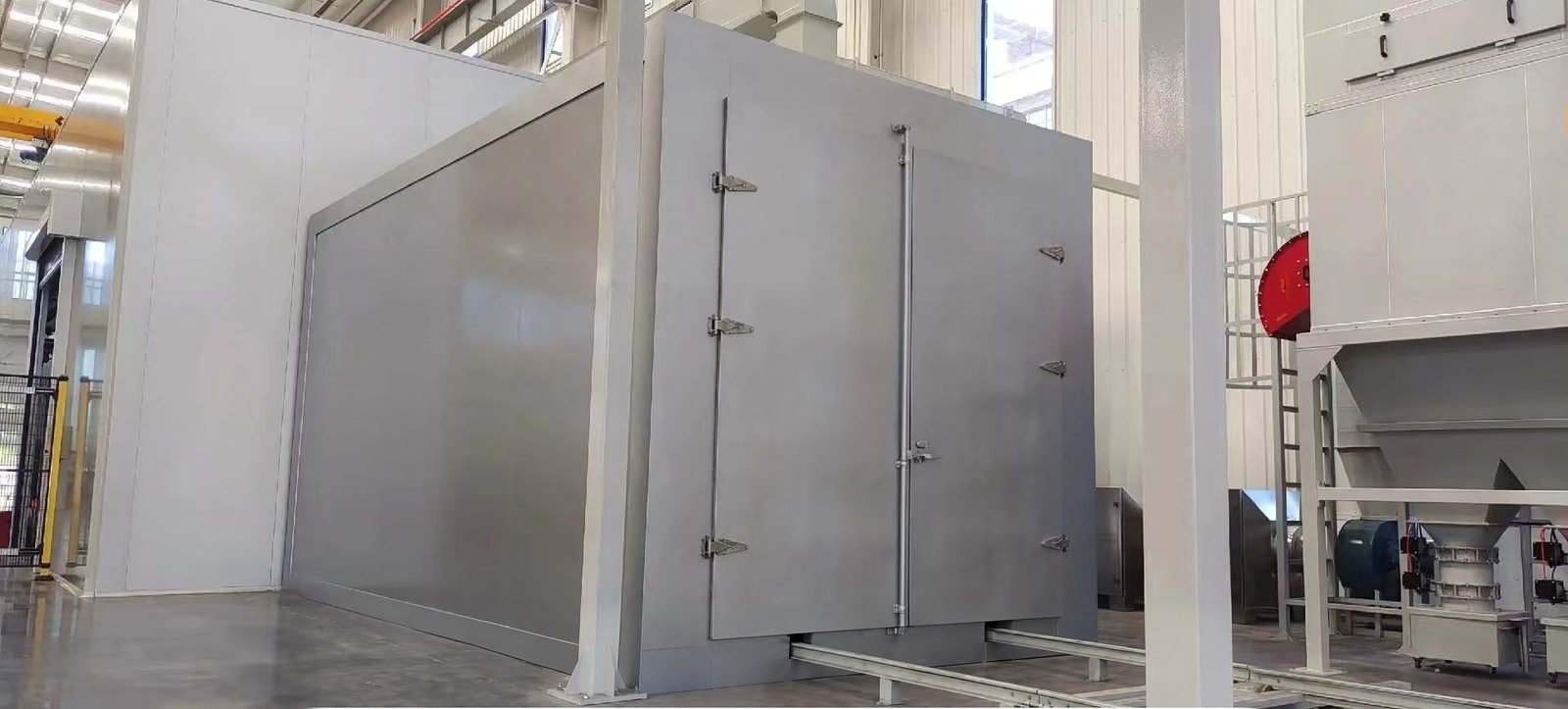
Can you powder coat over paint?
Powder coat over paint is not recommended, because most liquid paints cannot survive the powder cure temperature and bubble under the new film. Adhesion of the old paint to the metal is also unknown, so the new coating is only as good as what lies beneath it. Some thermally cured liquid coatings and some zinc wash primers do tolerate powder on top, but that has to be proven on a sample part. For anything with a performance requirement, stripping to bare metal and pretreating again is the reliable route. Cure schedules are listed in the cure temperature and time chart.
| Situation | Recommended route | Why |
|---|---|---|
| Unknown liquid paint on the part | Strip to metal, pretreat, coat | Paint may bubble at cure temperature; adhesion unknown |
| Thermally cured liquid coating or zinc wash primer | Test a sample before production | Some combinations work, many do not |
| Sound cured powder, light defect or colour change | Scuff, clean, recoat the whole part | A second coat can go over the first without loss of appearance or performance |
| Powder with poor adhesion, corrosion or blistering | Strip to metal | A recoat does not repair a failed base |
| Small chip or scratch, indoor or mild exposure | Liquid touch-up paint | Quick; lower durability is acceptable |
| Damage on architectural work | Specialist liquid repair agreed with the powder supplier and client | Touch-up is non-conforming under GSB and Qualicoat guidelines |
Can you powder coat over powder coat?
Yes, a second coat can be applied over cured powder when the first coat is sound, clean and not overbaked. The cured film is an insulator, so charge has no easy path to earth and the gun settings for bare metal cause back ionization and a rough, starred surface. Recoat powder coating jobs are therefore run as a separate batch with their own recipe.
| Recoat step | Setting or action | Source guidance |
|---|---|---|
| Intercoat adhesion trial | Coat and test sample parts first | Some powders bond directly, others need a light sanding |
| First-coat cure history | Avoid parts held beyond the recommended cure | Overbake makes intercoat adhesion harder |
| Defect removal | Sand out spits, craters and dirt, finish with 400 grit and feather the edges | Coarser grit first for speed; fine grit to hide sanding marks |
| General scuff | 120-220 grit when the powder needs a key | Remove all dust afterwards |
| Cleaning | Water rinse only, then dry-off oven | Chemical stages can leave water spots on the cured film |
| Earthing | Clean hooks and contact points | More critical on recoats than on raw parts |
| Gun current | Limit to 20-40 µA; some guidance gives 10-20 µA | One gun maker’s recoat preset is 100 kV at 15 µA |
| Gun distance | 25-50 mm (1-2 in) farther than normal | Softens the pattern and field strength |
| Powder output | 5-10 % higher, up to 10-20 % | Transfer efficiency falls on a recoat |
| Coverage | Coat the entire surface | Spot spraying leaves a dry, grainy halo |
| Cure | Normal cure cycle for the second coat | Confirm on the powder data sheet |
Total film has a ceiling. One powder maker gives 70-80 µm as the standard architectural film and limits a matt series to 100 µm to protect mechanical properties, so the combined thickness of both coats should be checked against the data sheet for the powder in use. Thick films also trap gas and raise the risk of pinholes.
Which equipment settings control a second coat?
A recoat is controlled at the gun controller, which must be able to limit current in microamps and store a dedicated recoat program. Lowering current keeps free ions from building up on the insulating first coat, while the slightly higher powder output restores build. A film thickness gauge before and after the second coat confirms that the total stays inside the data sheet range. Key components are available from international brands such as Gema and Nordson for powder guns and controllers, and DeFelsko and Elcometer for coating thickness gauges (configurable per customer specification). Gun types are compared in the powder coating guns guide.
How is old powder coating stripped before recoating?
Old powder is removed by chemical stripping, thermal stripping or abrasive blasting, and the choice depends on the substrate and how many parts are involved. Thermal methods are fast but suit racks and heavy steel; aluminium loses significant strength at about 650 °F (343 °C), and soldered or magnesium parts are poor candidates for heat.
| Method | Typical conditions | Time | Limits |
|---|---|---|---|
| Chemical, heated alkaline or solvent | Ambient, or heated to 65-87 °C | 15-60 min for parts; 30-60 min in hot caustic | Handling and disposal of chemicals; rinse and neutralise afterwards |
| Bake-off oven (batch) | 340-400 °C | 3-6 h | Ash must be washed off; not for heat-sensitive parts |
| Burn-off (inline) | 540-650 °C (1,000-1,200 °F) | As little as 4 min | Can warp parts; mainly hooks and racks; needs an afterburner |
| Fluidised bed | About 430 °C in sand or oxide media | 30-60 min | Parts and hangers must tolerate heat |
| Abrasive blasting | Glass bead, steel, plastic, garnet or oxide media | 30-120 min per small batch | Labour-intensive; soft metals such as aluminium can be damaged |
Blasting has the advantage of leaving a profile that takes the new coating readily; MUSI Technology supplies a sandblasting room for this step. Stripped parts go back through full pretreatment before powder.
How to touch up powder coat on small or field damage?
Small chips and scratches are repaired with liquid powder coat touch up paint matched to the powder, supplied as pens, bottles or aerosol cans. The powder formulator should be asked which liquid product is compatible. The area is cleaned of rust, dirt and oil, feathered with abrasive paper, wiped, and coated in thin layers. A touch-up does not match the durability of baked powder and suits small, superficial damage; large peeling areas or significant rust call for a full recoat.
| Touch-up method | Suited to | Preparation | Limits |
|---|---|---|---|
| Pen | Fine scratches and chips | Clean, dry, rust-free surface | Small spots only |
| Bottle and brush | Slightly larger chips | Clean; primer where bare metal shows | Brush marks; gloss may differ |
| Aerosol can | Wider scuffs | Scuff, clean, mask; even sweeping passes | Less durable than powder; mild environments |
| Two-component liquid repair system | Field damage to bare metal | Sand with 180-320 grit to bare metal, clean, zinc-rich primer on deep corrosion | Target 2-4 mils (about 50-100 µm); check adhesion to ASTM D3359 |
| PVDF liquid repair on AAMA 2605 work | Architectural aluminium | Solvent wipe, 400 grit, tack cloth, chromate wash primer | Certified liquid applicator; colour and gloss matched |
On architectural projects the rules are stricter. One powder maker states that later recoating or touch-up is non-conforming under GSB and Qualicoat quality guidelines, must be done by specialist companies after a trial in an inconspicuous area, and is excluded from warranty. The repair method should therefore be agreed in writing before work starts.
FAQ
Can you powder coat over powder coat without sanding? Sometimes. Many powders accept a second coat directly, while others need a light scuff to bond. The only way to know is an intercoat adhesion trial on sample parts with the actual powders, because overbaked first coats and some formulations resist bonding.
What gun settings are used to recoat powder coating? Published guidance limits current to 20-40 µA, with some sources giving 10-20 µA, moves the gun 1-2 inches farther from the part and raises powder flow by 5-20 %. One gun maker’s built-in recoat preset is 100 kV at 15 µA.
Is powder coat touch up paint as durable as the original powder? No. Aerosol and brush touch-up products do not match the durability of baked powder and suit mild environments. One industry article puts properly applied two-component repair systems at 80-90 % of the original corrosion protection, which is a guide and not a guarantee.
Can powder coating repair be done on site for architectural aluminium? Only as an agreed liquid repair. A Powder Coating Institute answer for AAMA 2605 work describes solvent wiping, 400 grit sanding, a chromate wash primer and a matched PVDF liquid coating by a certified applicator. GSB and Qualicoat guidelines treat touch-up as non-conforming.
Where MUSI Technology fits
MUSI Technology builds lines where rework is planned for: a blasting or stripping step, a rinse-only path through pretreatment, gun controllers with a recoat program and an oven sized for the heaviest part. See the electrostatic powder coating booth page, or send part details and reject rates through the contact page.
Provided by Lin Cong, Technical Director, MUSI Technology
Send us your part size, throughput and coating type — our engineers reply with a layout and budget within one working day. Contact MUSI Technology or browse our equipment range.
Related technical guides
- EV Battery Pack Housing Coating Line: Specs & Cost
Battery pack housings need dielectric strength, thermal stability and corrosion life in one coating. Powder versus liquid compared, film build targets,. - Spray Coating Line: Types, Specs & Cost (2026)
What a spray coating line costs, how the main types compare on throughput and finish, and the specs to fix before you ask for quotations. - Shot Blasting vs Sandblasting: Which to Choose
Shot blasting throws abrasive mechanically with wheels; sandblasting propels it with compressed air. Compared on throughput, energy cost per m2, surface. - Coating Line Layout: Floor Space You Need
A semi-automatic powder line needs 200-400 m2; a standard automatic line 600-1,200 m2. Layout rules, U-shape versus straight-through, ceiling height,. - Metal Hardware Coating Line: Design & Cost per Part
Hardware plants live on variety, not volume. Dense hanging, 10-25 minute colour change, rack design and the real cost per coated part, with line.