Powder Coating Cure Temperature and Time Chart
Quick answer: Most powder coat cures with the metal itself at 180-200 °C (356-392 °F) for about 10 minutes. Published schedules run from 20 minutes at 160 °C for epoxy to 5 minutes at 216 °C for TGIC polyester; low-bake polyesters cure at 150-170 °C and MDF powders from about 130 °C. The time counts only after the part, not the oven air, reaches temperature, so heavy parts need extra heat-up time. Cure is confirmed with an oven temperature profile and a solvent rub test.
MUSI Technology, a powder and liquid spray coating line manufacturer in Changzhou, China, sizes each curing oven from the heaviest part’s heat-up time and the powder maker’s schedule, then sets oven length, recirculation air and zone temperatures so that every part reaches its cure window at the planned line speed.
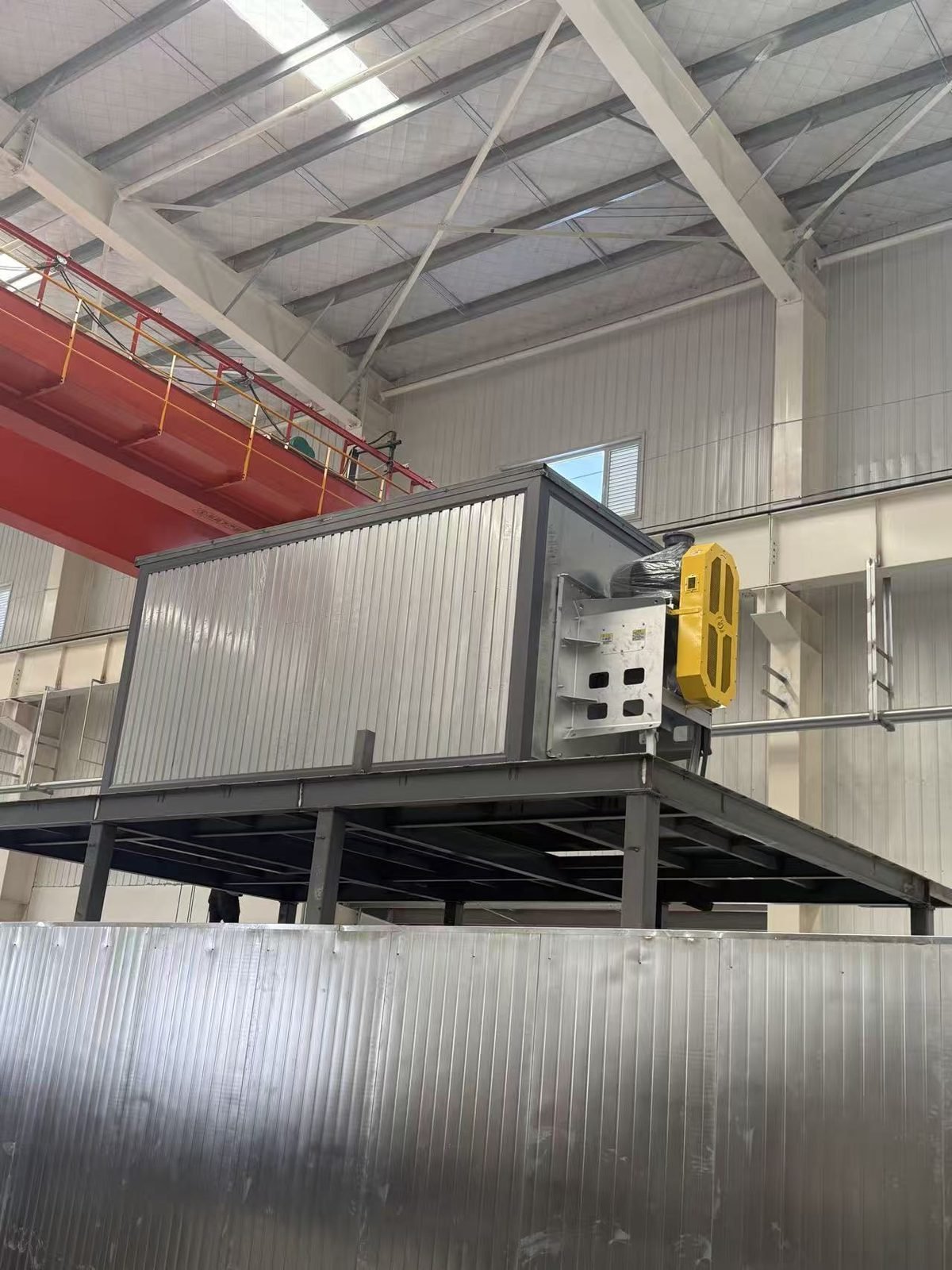
What temperature does powder coat cure at, by chemistry?
Standard thermoset powders cure at a part temperature of 180-200 °C held for about 10 minutes, low-bake grades at 150-170 °C, and powders for MDF from about 130 °C. The chart below collects schedules that powder makers publish in their data sheets. Every value is the temperature of the part, not of the oven air, and the data sheet of the exact product always takes priority.
| Powder chemistry | Published cure schedule (part temperature) | In °F | Source product |
|---|---|---|---|
| Epoxy | 20 min at 160 °C, 10 min at 180 °C or 5 min at 200 °C | 320 / 356 / 392 °F | AkzoNobel Interpon 100 |
| Epoxy-polyester hybrid | 15 min at 190 °C, 10 min at 200 °C or 8 min at 210 °C | 374 / 392 / 410 °F | AkzoNobel Interpon 700 |
| Epoxy-polyester hybrid | 20 min at 177 °C, 10 min at 199 °C or 7 min at 204 °C | 350 / 390 / 400 °F | Diamond Vogel H-Series |
| Polyester TGIC | 20 min at 182 °C, 10 min at 199 °C or 5 min at 216 °C | 360 / 390 / 420 °F | Diamond Vogel TGIC polyester |
| Polyester TGIC-free | 20-40 min at 170 °C, 10-20 min at 180 °C or 8-16 min at 200 °C | 338 / 356 / 392 °F | AkzoNobel Interpon D1036 |
| Polyester TGIC-free, wide cure window | 15 min at 150 °C down to 5 min at 200 °C | 302 to 392 °F | TIGER Drylac Series 45 |
| Polyurethane (polyester urethane) | 10 min at 204 °C | 400 °F | PPG Envirocron PCUT33100 |
| Low-bake polyester | 23-35 min at 150 °C, 12-30 min at 160 °C, 8-20 min at 170 °C or 5-10 min at 180 °C | 302 / 320 / 338 / 356 °F | AkzoNobel Interpon 310 Low-E |
| Low-bake anti-gassing polyester | About 150 °C; time per data sheet | About 302 °F | Axalta Alesta IP Antigassing Low Bake |
| Ultra-low-bake for MDF and wood | From about 130 °C (TIGER); below 121 °C (IGP) | About 266 °F; below 250 °F | TIGER Drylac wood range, IGP-RAPID |
Two chemistries have a floor below which the film melts but does not cross-link. Polyurethanes need at least about 177 °C (350 °F) to start curing, and HAA-cured TGIC-free polyesters need roughly 163 °C (325 °F) or more. Epoxies, hybrids and TGIC polyesters tolerate cure variation more readily.
Is powder coating temperature the oven setting or the metal temperature?
It is the metal temperature: the cure clock starts only when the part itself reaches the temperature on the data sheet. An oven display that has recovered to set point says little about the part, and thick sections lag far behind thin ones. The powder coat temp and time in the chart therefore have to be added to the heat-up time of the heaviest part on the line.
| Part type | Heat-up behaviour | Consequence for the oven |
|---|---|---|
| Thin sheet metal (for example a fender) | Reaches 204 °C (400 °F) in about 2-3 minutes | Risk of over-bake if the oven is set for heavy parts |
| Steel of known wall thickness | Rule of thumb: about 6 minutes for the first millimetre, about 3 minutes for each further millimetre | Add this to the cure time when setting line speed |
| Heavy casting (for example an alloy wheel) | About 30 minutes to reach 204 °C (400 °F) | Needs a longer oven, slower line or infrared boost |
What happens if powder coat is under-cured or over-cured?
Under-cured powder looks finished but fails mechanically and chemically, while over-cured powder mainly changes colour and gloss. The table lists the symptoms reported in industry troubleshooting guides; other causes are covered in the powder coating defects overview.
| Symptom | Under-cure | Over-cure |
|---|---|---|
| Impact and flexibility | Brittle film that cracks or chips on bending or assembly | Embrittlement after excessive time or temperature |
| Adhesion and chip resistance | Reduced | Usually unaffected unless the film is badly embrittled |
| Gloss | Gloss variation, most visible on matt and low-gloss powders | Loss of gloss |
| Colour | Normally unchanged | Yellowing, strongest on light-coloured epoxies; low-bake powders are more prone |
| Solvent and chemical resistance | Poor; film softens or transfers in a solvent rub | Normally retained |
| Corrosion and outdoor durability | Reduced | Normally retained |
| Hardness and abrasion resistance | Low pencil hardness | Normally retained |
How do you verify that powder coating is fully cured?
Cure is verified by profiling the part temperature through the oven and confirming the result with a solvent rub or a laboratory DSC test. Profiling shows whether the schedule was met; the rub test shows whether the film reacted.
| Method | What it shows | Notes |
|---|---|---|
| Oven temperature profile with a travelling data logger | Time each probed point on the part spends at cure temperature | Repeat at least monthly and whenever part mass or loading changes |
| Infrared thermometer | Spot check of part surface temperature | Useful on batch ovens before starting the cure timer |
| Solvent rub, PCI Recommended Procedure #8 | Solvent resistance, the last property to develop during cure | MEK for epoxies; 10% MEK in xylene for most other powders; counted in double rubs |
| ASTM D5402 solvent rub practice | Solvent resistance of coatings that change chemically on curing | Solvent, number of rubs and pass level are set by the coating maker |
| Supplier laboratory rub rating | 0-5 scale after 100 MEK double rubs | Below 3 generally indicates under-cure; textures and metallics can transfer colour when fully cured |
| Differential scanning calorimetry (DSC) | Degree of cure as a percentage | Destructive laboratory test needing uncured powder and a coated sample |
Rub results should always be compared with a reference panel of the same powder known to be fully cured, because epoxies resist solvent better than polyesters.
Which oven settings and design features control cure temperature?
Cure is controlled by four things: even air temperature, enough recirculation, the right time in the oven and clean oven air. Line speed and oven length set the time, as explained in the powder coating line guide, and the heat source is compared in the article on gas, electric and infrared curing ovens.
| Oven feature | Typical design value | Effect on cure |
|---|---|---|
| Temperature uniformity | ±5.5 °C (±10 °F) of set point, proven by a nine-point survey | Top and bottom of the rack receive the same schedule |
| Recirculation air | At least 3 chamber volumes per minute | Removes dead-air zones that stay cold |
| Supply ducts | Low along both side walls with a ceiling return | Heats the bottom of the load as well as the top |
| Exhaust | At least 3 air changes per hour; 7-8 advised for consistent finish | Clears cure volatiles that discolour the film |
| Indirect-fired heater | Flue gas kept behind a heat exchanger | Limits yellowing on whites and clears |
| Infrared boost zone | One or two minutes of medium-wave IR ahead of convection | Shortens heat-up; total oven time falls by about 25-30% on suitable parts |
Key components are available from international brands such as Riello, Weishaupt and Maxon (Honeywell) for burners, Ziehl-Abegg for process air fans, Siemens and Allen-Bradley for PLC and temperature control, and Datapaq (Fluke Process Instruments) for oven profiling data loggers (configurable per customer specification). Cure also depends on what lies under the film, so the oven should be reviewed together with the pretreatment line.
FAQ
What temperature does powder coat cure at? Most standard powders cure with the part at 180-200 °C (356-392 °F) for about 10 minutes. Low-bake polyesters cure at 150-170 °C with longer times, and powders developed for MDF start at about 130 °C. The product data sheet gives the exact schedule.
How long to bake powder coat at 400 °F? Published schedules at about 400 °F (200-204 °C) are 5 minutes for a standard epoxy, 7-10 minutes for hybrids and 10 minutes for a polyester urethane. That time starts when the metal reaches temperature, so heat-up time must be added.
Can powder coating be cured at a lower temperature for longer? Yes, within the cure window on the data sheet: one TGIC-free polyester lists 20-40 minutes at 170 °C in place of 8-16 minutes at 200 °C. Below the minimum the film only melts; polyurethanes need about 177 °C and HAA polyesters roughly 163 °C to react.
How do you test powder coating cure on the shop floor? Run a temperature profile with a data logger attached to the part, then do a solvent rub following PCI Recommended Procedure #8 or ASTM D5402. A fully cured film may soften slightly or lose gloss but must not dissolve; compare against a reference panel.
Where MUSI Technology fits
MUSI Technology designs batch and tunnel curing ovens as part of complete powder lines, matching oven length, heat source and air circulation to the part mix and the powder data sheet. Send part drawings, weights and target line speed through the contact page, or see how the oven fits with the electrostatic powder coating booth.
Provided by Lin Cong, Technical Director, MUSI Technology
Send us your part size, throughput and coating type — our engineers reply with a layout and budget within one working day. Contact MUSI Technology or browse our equipment range.
Related technical guides
- Shipping Container Coating Line: Spec & Layout
Container coating is a C5-M marine job run at production speed. Coat sequence, film build, blast and booth sizing, cycle time per box and 2026 plant cost. - Powder Coating vs Liquid Spray: Which to Choose
Powder coating vs liquid spray compared on cost, film thickness, colour range, VOC emissions, substrate limits and best-fit applications. - Robotic Spray Painting vs Reciprocator: ROI
A six-axis paint robot costs 3-6 times a reciprocator but raises transfer efficiency to 70-90% and handles mixed models. - Automotive Parts Coating Line: Spec & Throughput
Automotive coating lines must hold film build within plus or minus 10 microns, pass 500-1,000 h salt spray and meet OEM appearance standards. - Powder Coating Line: Types, Specs & Cost (2026)
A powder coating line pretreats, coats and cures metal parts on a conveyor. Full guide to line types, key specifications and 2026 price ranges.