Industrial Paint Booth Cost: Price by Type and Size
Quick answer: An industrial paint booth costs roughly USD 15,000-40,000 for a compact manual booth, USD 100,000-200,000 for an enclosed industrial booth with air make-up and bake mode sized for large parts, and USD 10,000-1,000,000 for a telescopic (retractable) booth, depending on size and configuration. Airflow type, exhaust filtration and VOC treatment move the price most. These are indicative ex-works ranges; a quotation is fixed from your part size, paint type and site.
MUSI Technology, a paint booth and coating line manufacturer in Changzhou, China, budgets compact manual liquid spray booths at about USD 15,000-40,000, enclosed industrial paint booths with air make-up at about USD 100,000-200,000 and telescopic booths at USD 10,000-1,000,000, and fixes the price in a written quotation once the part data is complete.
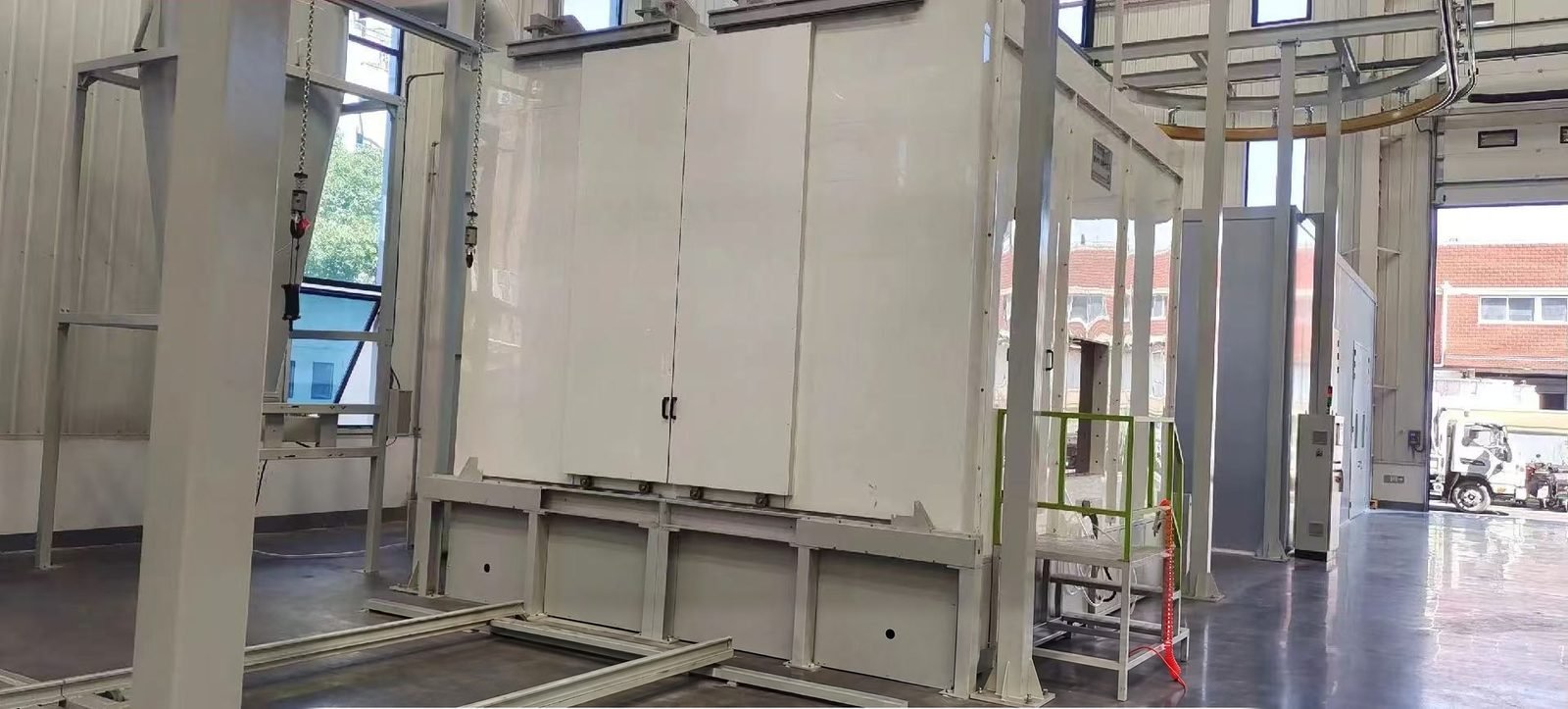
What are the key cost facts for an industrial paint booth?
| Item | Typical value |
|---|---|
| Compact manual liquid spray booth | USD 15,000-40,000 (indicative) |
| Enclosed industrial paint booth with air make-up unit | USD 100,000-200,000 (indicative) |
| Telescopic / retractable spray booth | USD 10,000-1,000,000, by size and configuration |
| Extra air for downdraft vs crossdraft (same booth) | 20-40 % more air |
| Overspray capture of exhaust filters | At least 98 % |
| Annual filter spend, mid-size automatic booth | About USD 3,100-9,000 (single shift, solvent-borne) |
| Lead time, standard configuration | 30-60 days |
| Warranty | 12 months full machine, 36 months critical components, up to 60 months structural parts |
How much does an industrial paint booth cost?
The price follows the size of the largest part and how the air is moved and cleaned. The table shows the indicative ranges MUSI Technology uses for budgeting.
| Booth type | Typical use | Indicative price (USD, ex-works) |
|---|---|---|
| Compact manual liquid spray booth | Small batch parts, single painter, dry filter exhaust | 15,000-40,000 |
| Enclosed industrial paint booth (crossdraft, semi-downdraft or downdraft) with air make-up unit and bake mode | Machinery, steel fabrications, vehicle bodies, agricultural and construction parts | 100,000-200,000 |
| Telescopic mobile spray booth on floor rails | Steel structures, tanks, girders and other crane-handled parts too large for a fixed booth | 10,000-1,000,000 |
| Booth as part of a semi-automatic liquid line with conveyor, flash-off and curing oven | Continuous production | 80,000-400,000 for the line |
A booth is rarely the whole budget. Exhaust treatment, a paint mixing room and a drying oven are separate items. Booth layouts are described on the industrial paint spray booth page; complete lines are priced in the liquid spray coating line guide.
How much does a telescopic spray booth cost?
Telescopic spray booths fall into three indicative budget bands, set by size and configuration.
| Booth type | Indicative price (USD, ex-works) |
|---|---|
| Smaller telescopic booth configurations | 10,000-200,000 |
| Mid-range telescopic booth configurations | 300,000-500,000 |
| Large custom-engineered telescopic booths | 700,000-1,000,000 |
What drives the price of a paint booth?
Five decisions set most of the cost of a paint booth: size, airflow type, overspray capture, heating and VOC treatment.
| Cost driver | Why it changes the price | What to tell the supplier |
|---|---|---|
| Internal size | Panels, lighting and, above all, the air volume grow with the booth cross-section | Largest part length, width, height and weight |
| Airflow type | Downdraft needs 20-40 % more air than a crossdraft booth of the same size, plus a floor pit or raised floor | Finish quality required; whether a pit can be dug |
| Overspray capture | A water wash section costs more to build than dry filters but suits high paint volumes | Paint consumption per shift |
| Air make-up and bake mode | A burner or heater supplies tempered air and runs a cure cycle at about 60-71 °C | Climate, paint system, whether parts are force-dried in the booth |
| VOC treatment | Activated carbon, UV, RCO or RTO are sized to the exhaust volume and the local emission limit | Paint type (solvent, water-based, 2K) and the local limit |
| Hazardous-area rating | Explosion-protected fans, motors and lighting cost more | Solvent type; the zone classification required on site |
How much more does a downdraft booth cost than a crossdraft booth?
Most of the difference between a downdraft and a crossdraft paint booth is air. Exhaust airflow equals the area the air crosses multiplied by the design velocity, and a downdraft booth moves air across the whole floor rather than the end face. For the same booth, 3.9 m wide x 2.4 m high x 6.5 m long:
| Layout | Area the air crosses | Design velocity | Exhaust airflow |
|---|---|---|---|
| Crossdraft, enclosed | Face 3.9 x 2.4 m = 9.36 m² | 0.51 m/s (100 fpm) | 17,100 m³/h |
| Open face | Face 3.9 x 2.4 m = 9.36 m² | 0.64 m/s (125 fpm) | 21,400 m³/h |
| Downdraft | Floor 3.9 x 6.5 m = 25.35 m² | 0.25 m/s (50 fpm) | 23,200 m³/h |
The downdraft version needs about 36 % more air in this example, so the exhaust fan, the air make-up unit and its burner, and any VOC treatment downstream are all larger, and a pit or raised floor is added. Crossdraft is the usual choice for general industrial work for that reason; downdraft is chosen when the finish standard justifies it. This is a generic worked example, not a quotation.
Dry filter or water wash: which paint booth costs less?
A dry filter paint booth is the lower-capital option for most industrial work. A water wash (water curtain) booth costs more to build but suits large paint volumes where filters would load too quickly. Running work differs too: dry filter booths stop for exhaust filter changes, while water wash booths need sludge removal from every few days to monthly, depending on paint volume.
How much does VOC treatment add to a paint booth?
VOC treatment cost depends on the exhaust volume and the local emission limit, not on the booth alone. Low-volume, intermittent painting is often met with activated carbon boxes; higher volumes or stricter limits use UV photo-oxidation plus carbon, or an RCO that regenerates the carbon beds. On a complete solvent-borne line, an RTO or zeolite rotor concentrator can add USD 80,000-400,000. Ask for the treatment to be quoted at the same airflow as the booth exhaust, otherwise two quotations cannot be compared. The options are compared in the VOC treatment guide.
What does a large paint booth specification look like in practice?
The table below is the specification of a 20 m booth MUSI Technology engineered for structural steel, taken from the written proposal. It shows where the air and the power go in a large paint booth.
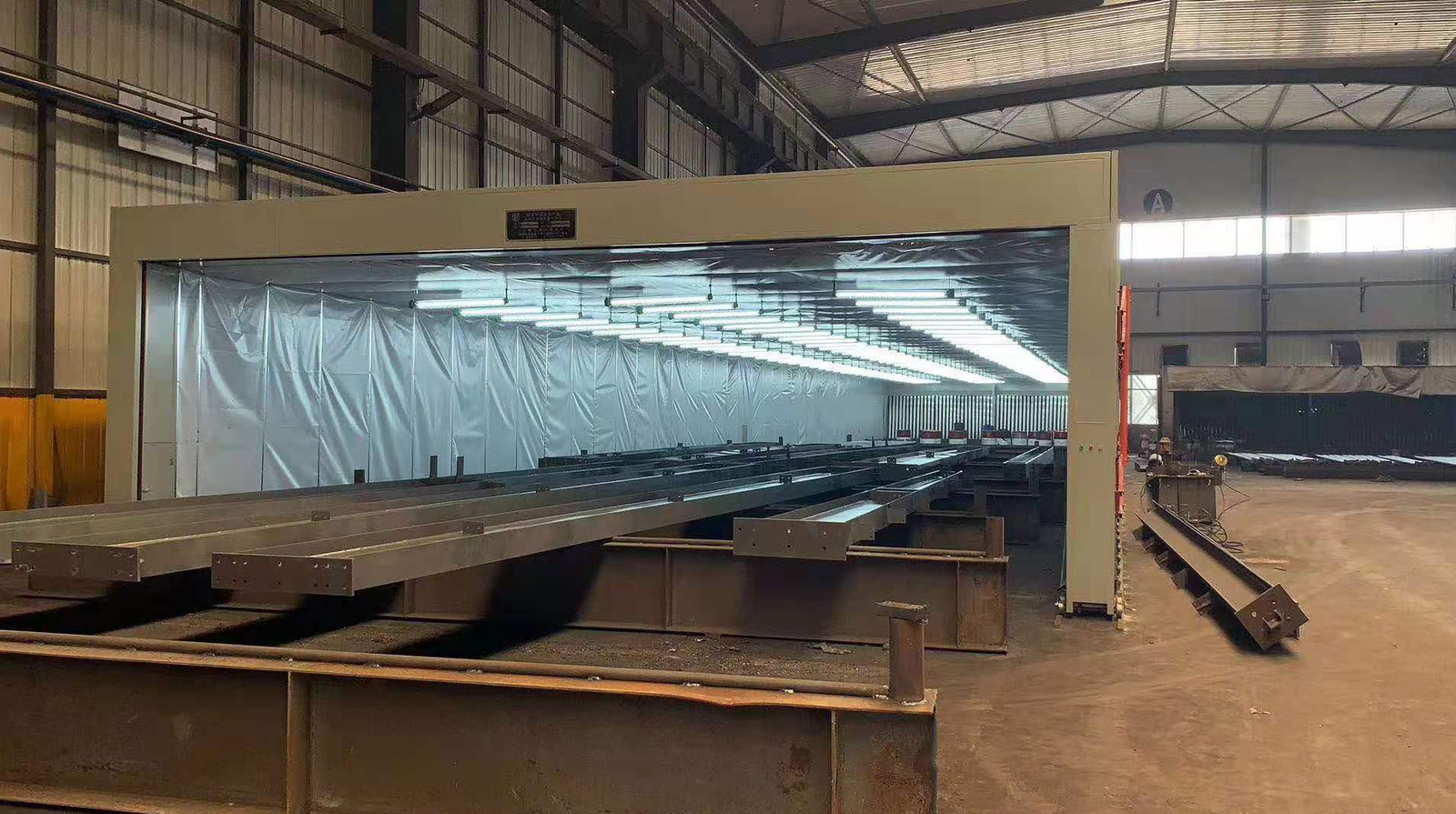
| Item | Value |
|---|---|
| Internal size | 20 m long x 10 m wide x 4 m high |
| Airflow at the minimum 0.3 m/s cross-draft | 43,200 m³/h (section 10 x 4 m = 40 m²) |
| Exhaust fan fitted | 75 kW centrifugal, 54,000-79,400 m³/h, to cover filter loading and treatment losses |
| Paint mist capture | Labyrinth paper filter plus glass-fibre bag, 98 % or more |
| VOC treatment | Activated carbon plus UV photo-oxidation, 50,000 m³/h, 30 kW |
| Lighting | 60 explosion-proof 18 W LED fittings, 300 lux or more at the work surface |
| Travel drives | Two 1.5 kW explosion-proof geared motors |
| Installed power | About 109 kW |
| Stack | 15 m |
Two points buyers often miss. The fan is sized well above the minimum airflow because the filter pressure drop rises from about 40 Pa when new to about 250 Pa at change-out. The VOC unit adds its own power on top of the fan. Both affect the electrical supply needed before the booth arrives. The sizing method is set out in how to size a telescopic spray booth.
What does a paint booth cost to run each year?
Energy and filters are the main recurring costs of a paint booth. Exhaust (paint arrestor) filters are changed when the pressure drop reaches the set limit, typically every 80-250 operating hours. For single-shift solvent-borne work, annual filter spend is roughly:
| Booth | Annual filter spend (USD) |
|---|---|
| Small manual booth | 1,300-3,600 |
| Mid-size automatic booth, 15,000-25,000 m³/h | 3,100-9,000 |
| Large downdraft booth | 7,000-20,500 |
A VFD on the exhaust fan lets the booth run at the minimum velocity while filters are clean and speed up as they load, which reduces fan energy. Filter stages and intervals are covered in the spray booth filter guide.
What is usually not included in a paint booth price?
A paint booth quotation normally covers the enclosure, air supply and exhaust, filtration, exhaust treatment if specified, lighting and electrical control. Lifting on site, access platforms or scaffolding, third-party emission testing and floor or rail levelling are normally the buyer’s scope; freight, import duty, foundations and utility connections are budgeted separately. Check each line against the quotation before comparing suppliers; the coating line budget breakdown lists the project costs around the equipment.
How long does delivery take, and what warranty applies?
Standard paint booth configurations ship in 30-60 days from contract and down payment; custom configurations take longer, and the date is fixed in the contract. MUSI Technology’s warranty is 12 months on the full machine, 36 months on critical components and up to 60 months on structural parts. On-site installation, commissioning and operator training are available worldwide. Structural parts are covered for up to 60 months.
What should you send to get an accurate paint booth quotation?
| Information | Why it matters |
|---|---|
| Largest part: length, width, height, weight | Sets the internal size and the airflow |
| Parts per shift and number of painters | Sets booth count and paint volume |
| Paint type: solvent, water-based or 2K; number of colours | Sets filtration, explosion protection and VOC treatment |
| Finish standard | Decides crossdraft, semi-downdraft or downdraft |
| Floor space, ceiling or crane hook height, whether a pit is possible | Fixes the layout |
| Power and gas available on site | Sizes the air make-up unit and electrical supply |
| Local emission limit | Sizes the exhaust treatment |
MUSI engineers reply within 24 hours; a recommended configuration and quotation follow once your part data is complete.
Which component brands are used in industrial paint booths?
Component selection follows the hazardous-area classification and the coating being sprayed. Key components are available from international brands such as these (configurable per customer specification):
| Component | Brands available |
|---|---|
| Fans, including explosion-protected versions | ebm-papst, Ziehl-Abegg |
| Supply and exhaust filters | Camfil, Freudenberg Viledon |
| Burners | Riello, Weishaupt, Maxon |
| PLC and HMI | Siemens, Allen-Bradley, Mitsubishi Electric |
| Spray guns and pumps | International tier-one spray gun brands |
FAQ
How much does a small industrial spray booth cost? A compact manual liquid spray booth is budgeted at about USD 15,000-40,000 ex-works. The price rises with size, explosion-protected components and any VOC treatment.
Is a downdraft paint booth worth the extra cost? Only when the finish standard needs it. A downdraft booth needs 20-40 % more air than a crossdraft booth of the same size and usually a floor pit; for general industrial parts a crossdraft or semi-downdraft booth gives an acceptable finish at lower installed and running cost.
Can a paint booth be bought without VOC treatment? Yes, if the local emission limit and paint volume allow it. The exhaust filters still capture at least 98 % of overspray; VOC treatment is added when solvent emissions must be reduced.
How often are paint booth filters changed? Exhaust filters are changed by pressure drop, typically every 80-250 operating hours; a differential pressure gauge across the filter wall shows when they reach the change-out value.
Can a paint booth be installed outdoors? A telescopic booth on floor rails can be installed in a yard under a gantry crane, with the exhaust unit fixed at one end; see the telescopic mobile spray booth page. A fixed industrial paint booth is normally installed inside a building.
Where MUSI Technology fits
MUSI Technology (Changzhou MUSI Environmental Technology Co., Ltd.) designs and builds industrial paint booths, telescopic spray booths and complete liquid and powder coating lines in Changzhou, China. Its engineering team, which originated in 2011, has delivered 800+ coating lines to 500+ clients in 36 countries. Send your part size, paint type and site details through the contact page for a configured quotation.
Provided by Lin Cong, Technical Director, MUSI Technology
Related guide: Paint Booths for Mining Equipment: Size, Airflow, Coating System and Rebuild Layout
Send us your part size, throughput and coating type — our engineers reply within 24 hours, and a layout and budget follow once your part data is complete. Contact MUSI Technology or browse our equipment range.
Related technical guides
- Water-Based vs Solvent-Based Coating: Line Changes
Switching from solvent to water-based coating changes booth humidity control, flash-off length, material handling and VOC treatment. - Powder Coating Line: Types, Specs & Cost (2026)
A powder coating line pretreats, coats and cures metal parts on a conveyor. Full guide to line types, key specifications and 2026 price ranges. - Powder Coating Pretreatment Line: Stages & Cost
A pretreatment line degreases, rinses and chemically converts the metal surface before coating. Three, five and seven-stage layouts, phosphate versus. - BESS Container Coating Line: Spec & Corrosion
Battery energy storage containers need C4 to C5 corrosion protection: shot blasting to Sa2.5, zinc-rich primer and weather-resistant polyester topcoat. - Coating Line Factory Audit: 20-Point Checklist
A 20-point pre-shipment audit for coating line buyers: what to measure, what to demand in writing, which documents to collect and which findings should.
QQuestions buyers ask before ordering
quotation · price · lead time · installation · warranty
What information do you need to prepare a quotation?
Send part drawings or photos, the largest part size and weight, the material, the required output per shift, the paint or powder type and number of colours, and the available floor space, ceiling height and power or gas supply. MUSI engineers reply within 24 hours; a recommended configuration and quotation follow once your part data is complete.
How much does this equipment cost?
Budget depends on part size, throughput and the level of automation. Indicative ex-works ranges are published in our complete coating line cost guide; a configured quotation is prepared from your part data. Published indicative ex-works ranges: a complete powder coating line is roughly USD 75,000–230,000 semi-automatic, USD 200,000–600,000 for a standard automatic line and USD 600,000–2,000,000 for a high-throughput automated plant.
What is the lead time?
Standard configurations ship in 30–60 days from contract signing and down payment; custom configurations take longer. The delivery date is fixed in the contract.
Do you install and train operators overseas?
Yes. MUSI engineers carry out on-site installation and commissioning and give 3–5 days of operator and maintenance training. MUSI has delivered 800+ coating lines to customers in 36 countries.
What warranty and after-sales support are included?
12 months full-machine warranty, 36 months on critical components and up to 60 months on structural parts. International customers get 24-hour phone response and 72-hour on-site arrival; spare parts ship from the Changzhou headquarters.
Can the environmental equipment be supplied with the line?
Yes. VOC treatment (RTO, RCO, activated carbon, zeolite rotor), dust collection and paint wastewater treatment are supplied with the coating line under one contract; MUSI has equipped 50+ coating facilities whose projects all passed local environmental compliance reviews.