Paint Booths for Mining Equipment: Size, Airflow, Coating System and Rebuild Layout
Quick answer: A paint booth for mining equipment is sized from the largest part, not the whole machine. A 360-tonne-class haul truck is about 15 m long, 9-10 m wide and 7.7-8.3 m to the canopy, so rebuild shops commonly paint the dump body, frame and components separately; booths in published examples range from about 12-20 m long, 7-11 m wide and 4.5-9 m high. Airflow follows local rules (at least 0.51 m/s for conventional spray and 0.30 m/s for electrostatic spray under US OSHA, about 0.25-0.3 m/s in common European downdraft practice), coatings are specified to ISO 12944 C4 or C5 by site environment (blasting to Sa 2½, epoxy primer, polyurethane topcoat), and a telescopic booth lets a crane set parts down before the enclosure closes over them.
MUSI Technology, a paint booth and coating line manufacturer in Changzhou, China, builds telescopic and fixed paint booths for mining equipment rebuild shops, with dry-filter or oil-film paint mist capture and activated carbon or RCO exhaust treatment, and supplied a 12 x 7 x 4.5 m oil-film telescopic booth with RCO to a mining equipment rebuild workshop in Kazakhstan.
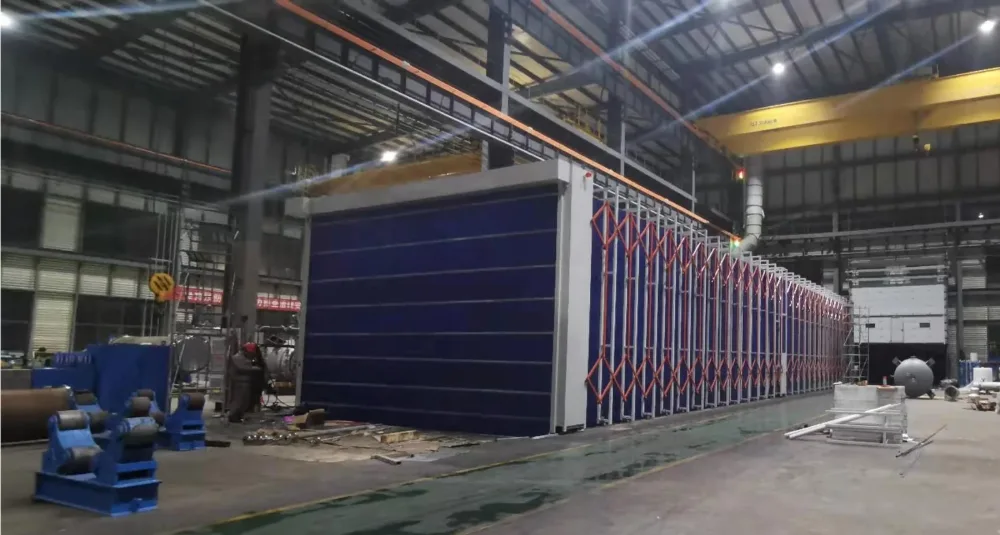
How big does a mining equipment paint booth need to be?
Start from the largest piece you will paint. Whole haul trucks rarely fit a standard booth, so rebuild shops commonly paint the dump body, frame, cab and components separately.
| Workpiece | Approximate size | What it means for the booth |
|---|---|---|
| 360-tonne-class haul truck, complete | About 15 m long, 9-10 m wide, 7.7-8.3 m to the canopy; about 15-16 m high with the body raised | Needs a booth over about 10 m wide and 8 m high, with the body lowered; it is commonly painted in pieces |
| 290-tonne-class electric drive truck | About 15.6 x 9.2 x 7.4 m | Same approach as above |
| Dump body (removed) | Width of the truck, about 9-10 m | Booth width set by the body; crane or trailer access |
| 115-tonne-class excavator, transport size | About 16.0 x 5.3 x 6.0 m | Fits a booth of about 16-18 m x 7 m x 6-7 m |
| Mill shells, loader frames, buckets | Varies | Often sets the crane hook height rather than the booth length |
A MUSI telescopic mobile spray booth is typically 12-20 m long, 5-10 m wide and 3-4.5 m high, built in 1 m frame modules, with custom builds up to 100 m long, 35 m wide and 9 m high.
What airflow, filtration and lighting does the booth need?
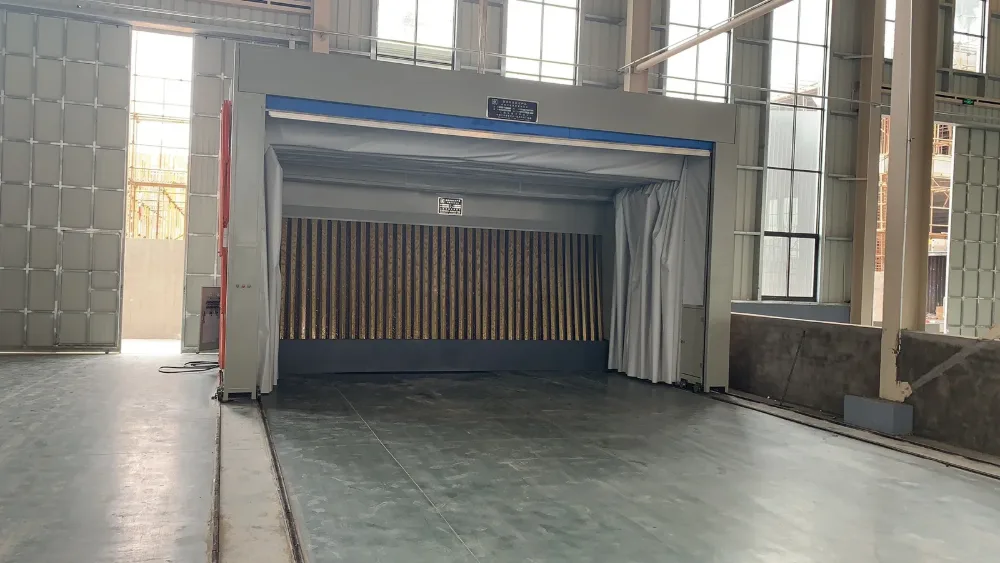
| Item | Typical requirement | Basis |
|---|---|---|
| Air velocity, dry booth, conventional spray | At least 100 fpm (about 0.51 m/s) across the open face or booth cross-section | US OSHA 29 CFR 1910.107 |
| Air velocity, electrostatic spray | At least 60 fpm (about 0.30 m/s) | US OSHA 29 CFR 1910.107 |
| Air velocity, common European downdraft practice | About 0.25-0.3 m/s, set by national rules | Paint supplier technical guidance |
| Airflow monitoring | Visible pressure gauge, alarm or interlock | US OSHA 29 CFR 1910.107 |
| Exhaust volume | Booth cross-section x air velocity; for example a 4 x 7 m cross-section at 0.3 m/s is about 30,000 m³/h | Calculation |
| Lighting | Explosion-proof LED; about 300 lux or more at the work | MUSI project specification |
| Heating and drying | Direct gas heating to about 80 °C in some rebuild booths; heating interlocked with exhaust | Published rebuild centre example; OSHA interlock rule |
| Paint mist capture | Advantages | Limits |
|---|---|---|
| Dry filter | Lowest investment; simple | Filters must be changed, which stops painting; non-combustible filter media required |
| Water curtain | No filter changes; suits high paint use | Higher investment; paint sludge and wastewater treatment |
| Oil-film purifier | High mist capture; used on MUSI telescopic booths | Oil film must be maintained and replaced |
Which coating system is used on mining equipment?
ISO 12944 is the usual reference for mining equipment, with corrosivity C4 or C5 chosen by the site environment: blast cleaning to Sa 2½, an epoxy or zinc-rich primer, often an epoxy intermediate coat, and a polyurethane topcoat for colour and UV resistance. ISO 12944-5 gives minimum total dry film thickness by environment and durability:
| Corrosivity | Primer type | Low (up to 7 years) | Medium (7-15 years) | High (15-25 years) | Very high (over 25 years) |
|---|---|---|---|---|---|
| C4 | Zinc-rich primer | 60 µm | 160 µm | 200 µm | 260 µm |
| C4 | Other primers (epoxy, PUR) | 120 µm | 180 µm | 240 µm | 300 µm |
| C5 | Zinc-rich primer | 160 µm | 200 µm | 260 µm | 320 µm |
| C5 | Other primers (epoxy, PUR) | 180 µm | 240 µm | 300 µm | 360 µm |
For rebuilt machines, a full blast to commercial grade (SSPC-SP 6 / Sa 2) or better gives a much longer coating life than spot cleaning with hand and power tools. Dump body floors rely on wear-resistant steel plate rather than coating for abrasion.
How is a mining equipment rebuild paint shop laid out?
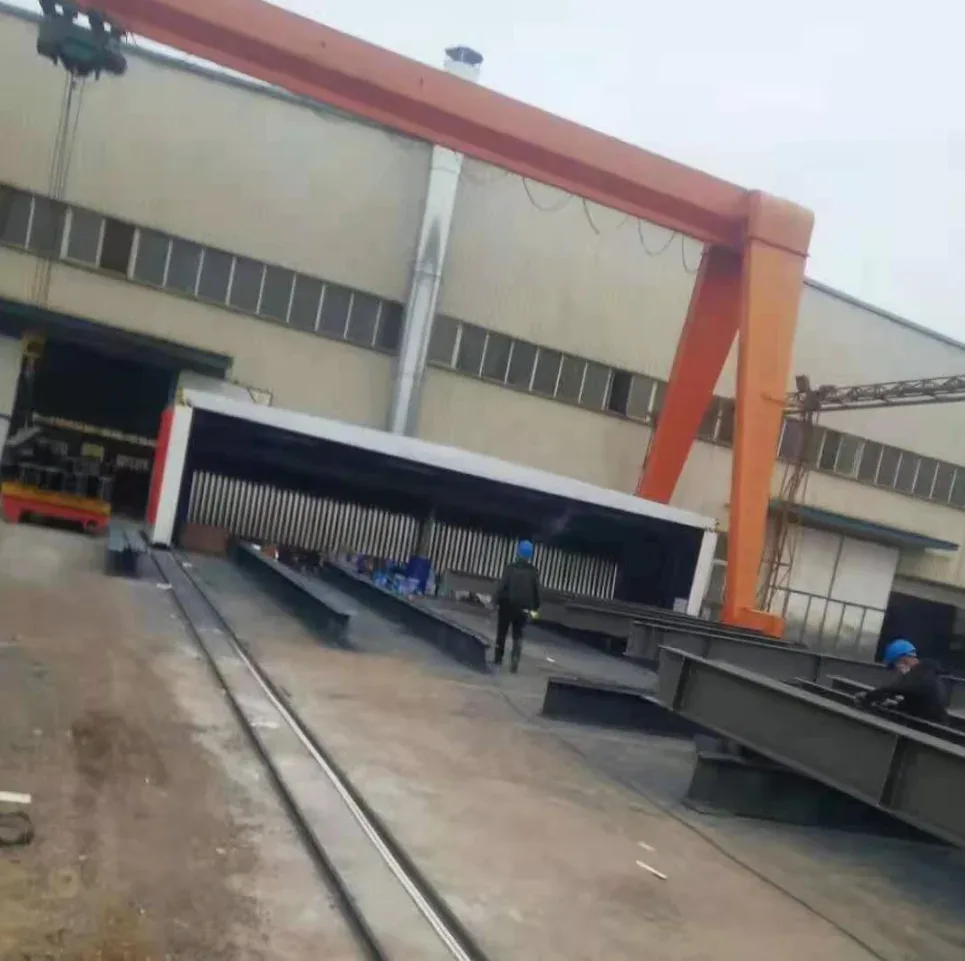
| Step | What happens | Equipment |
|---|---|---|
| 1. Strip down and inspect | Machine dismantled to the bare frame; parts sorted for reuse | Wash bay, cranes |
| 2. Structural repair | Frame and body repairs, welding | Fabrication area |
| 3. Clean and degrease | Oil, grease and mud removed | Wash bay |
| 4. Blast | Rust and failed paint removed to the specified grade | Sandblasting room or blast area |
| 5. Paint | Primer, intermediate and topcoat applied | Paint booth |
| 6. Dry or cure | Coating cured before handling | Booth heating or drying room |
| 7. Reassemble and test | Decals, assembly and machine testing | Assembly bay |
Keep at least about 0.9 m (3 ft) of clear space around the booth and no open flames or spark-producing equipment within about 6 m (20 ft) unless separated by a partition, as US OSHA 29 CFR 1910.107 requires.
Telescopic or fixed booth for a rebuild shop?
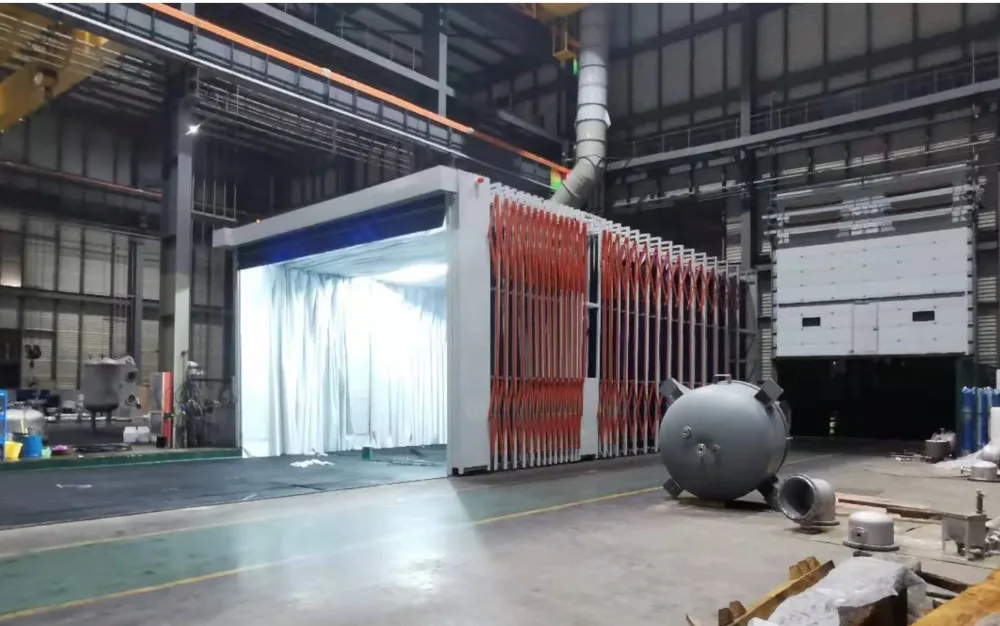
| Item | Telescopic booth | Fixed booth |
|---|---|---|
| Loading large parts | Enclosure folds back so the crane sets the part down, then extends over it | Parts enter through doors on trailers or carts |
| Floor space when not painting | Freed for other work | Occupied permanently |
| Size changes | Length added in frame modules | Fixed at construction |
| Insulation and heating | Fabric walls; suits ventilated painting, forced curing needs a separate drying room | Insulated panels; can include heating for drying |
| Typical use | Very large or crane-handled parts, mixed work | Steady flow of similar parts, high-temperature drying |
What safety and environmental rules apply?
| Topic | Requirement | Source |
|---|---|---|
| Hazardous area, US | Inside the booth Class I, Division 1; within 915 mm (3 ft) of openings Division 2 | NFPA 33 |
| Hazardous area, Europe | Zone classification by concentration relative to LEL; Zone 2 within 1 m of permanent openings | EN 12215 |
| Hazardous area, China | Spray booth safety technical rules, revised 2025, in force from August 2026 | GB 14444-2025 |
| Exhaust interlock | Exhaust starts before supply air and spray guns; vapour kept below 25% LFL | Insurance guidance |
| VOC treatment, China | At least 0.3 m/s at the farthest emission point of an external capture hood; treatment of at least 80% required when initial NMHC emission reaches 3 kg/h (2 kg/h in key regions) | GB 37822-2019 |
| VOC destruction efficiency | RTO about 95-99% at 760-820 °C; RCO about 90-99% at about 400 °C | US EPA training material |
| Isocyanates (2K polyurethane) | Spray only in a booth under negative pressure, air-fed respirators, measured clearance time posted on the door, health surveillance | UK HSE |
| Fire protection | Sprinklers in booth, plenum and exhaust ducts; only one day’s paint in the booth area | US OSHA 29 CFR 1910.107 |
Treatment options for booth exhaust are compared in RTO vs RCO vs activated carbon vs zeolite rotor.
Case: oil-film telescopic booth with RCO for a mining equipment rebuild shop in Kazakhstan
A mining equipment repair and rebuild workshop in Kazakhstan paints dump truck bodies, mill shells and loader frames. It needed to keep repainting indoors through the winter, with crane-handled batch painting and treated exhaust.
| Item | Specification |
|---|---|
| Booth | 12 x 7 x 4.5 m internal oil-film telescopic booth; Q235 frames, flame-retardant PVC fabric |
| Drives and safety | 2 x 1.5 kW explosion-proof geared motors, 8-10 m/min travel; interlocked drives, double limit switches, rail sweeper |
| Airflow | Cross-draft 0.3 m/s or more, per project specification and local rules |
| Lighting | Explosion-proof LED, 300 lux or more |
| Paint mist capture | Three oil-film purifiers, 98% or more mist capture |
| Exhaust treatment | Adsorption-desorption with catalytic oxidation (RCO), 30,000 m³/h, three honeycomb carbon beds |
| Installed power | About 110 kW (start-up heater only during desorption start-up) |
| Result | Repainting kept indoors through the winter inside a ventilated enclosure |
The full project record is in the Kazakhstan mining equipment rebuild case study.
How do you paint mining equipment in winter or humid weather?
| Condition | Rule |
|---|---|
| Steel temperature | At least 3 °C above the dew point during application and curing |
| Relative humidity | Commonly below about 85% for solvent-borne coatings; check the product data sheet |
| Minimum cure temperature | From the coating data sheet; many amine-cured epoxies stop curing below about 10 °C |
| Condensation on fresh epoxy | Can cause amine blush and poor adhesion of the next coat |
Painting inside an enclosed, ventilated booth, with heating or a separate drying room where the coating needs it, lets the shop hold these conditions instead of waiting for the weather.
What should you send for a quotation?
| Information | Why it matters |
|---|---|
| Largest workpiece length, width and height | Sets booth internal size and door or opening size |
| Crane hook height and how parts are moved | Decides telescopic or fixed booth and the rail layout |
| Daily paint consumption and paint type | Sets mist capture and exhaust treatment |
| Local VOC emission limit | Decides activated carbon, RCO or RTO |
| Winter temperature and curing requirement | Decides whether heating or a separate drying room is needed |
| Site layout and power supply | Fixes rail length, stack position and electrics |
MUSI engineers reply within 24 hours; a configuration and quotation follow once your workpiece and site data are complete. Price ranges for telescopic booths are in industrial paint booth cost.
FAQ
Can a whole haul truck be painted in one booth? Only in a booth over about 10 m wide and 8 m high with the body lowered; rebuild shops commonly remove the body and paint the truck in sections.
What air velocity does a mining equipment paint booth need? US OSHA requires at least 0.51 m/s for dry booths with conventional spray and 0.30 m/s for electrostatic spray; European downdraft practice is about 0.25-0.3 m/s.
Which coating system lasts longest on mining equipment? A full blast to Sa 2½, a zinc-rich or epoxy primer, an epoxy intermediate coat and a polyurethane topcoat built to the ISO 12944 C4 or C5 film thickness for the durability you need.
Is a telescopic booth suitable for a mine site? Yes, where cranes handle very large parts and floor space must be freed between jobs; the booth runs on floor rails and can be extended in frame modules.
How is booth exhaust treated? Paint mist is captured by dry filters, water curtain or oil-film purifiers, and VOCs are treated by activated carbon, RCO or RTO depending on the emission limit.
How long does supply and installation take? Standard configurations ship in 30-60 days. For this booth class the typical programme is 30-45 days of manufacture and factory trial, then sea freight, 7-14 days of installation and 3-5 days of commissioning and training; dates for each project are fixed in the contract.
Where MUSI Technology fits
MUSI Technology (Changzhou MUSI Environmental Technology Co., Ltd.) designs and builds telescopic and fixed paint booths, sandblasting rooms, coating lines and their dust and VOC treatment in Changzhou, China. Its engineering team, which originated in 2011, has delivered 800+ coating lines to 500+ clients in 36 countries. Send your largest workpiece size, crane height and site details through the contact page for a configured quotation.
Provided by Lin Cong, Technical Director, MUSI Technology
Send us your part size, throughput and coating type — our engineers reply within 24 hours, and a layout and budget follow once your part data is complete. Contact MUSI Technology or browse our equipment range.
Related technical guides
- Spray Coating Line: Types, Specs & Cost (2026)
What a spray coating line costs, how the main types compare on throughput and finish, and the specs to fix before you ask for quotations. - Shot Blasting vs Sandblasting: Which to Choose
Shot blasting throws abrasive mechanically with wheels; sandblasting propels it with compressed air. Compared on throughput, energy cost per m2, surface. - Coating Line Layout: Floor Space You Need
A semi-automatic powder line needs 200-400 m2; a standard automatic line 600-1,200 m2. Layout rules, U-shape versus straight-through, ceiling height,. - Water-Based vs Solvent-Based Coating: Line Changes
Switching from solvent to water-based coating changes booth humidity control, flash-off length, material handling and VOC treatment. - Powder Coating Line: Types, Specs & Cost (2026)
A powder coating line pretreats, coats and cures metal parts on a conveyor. Full guide to line types, key specifications and 2026 price ranges.
QQuestions buyers ask before ordering
quotation · price · lead time · installation · warranty
What information do you need to prepare a quotation?
Send part drawings or photos, the largest part size and weight, the material, the required output per shift, the paint or powder type and number of colours, and the available floor space, ceiling height and power or gas supply. MUSI engineers reply within 24 hours; a recommended configuration and quotation follow once your part data is complete.
How much does this equipment cost?
Budget depends on part size, throughput and the level of automation. Indicative ex-works ranges are published in our complete coating line cost guide; a configured quotation is prepared from your part data. Published indicative ex-works ranges: a complete powder coating line is roughly USD 75,000–230,000 semi-automatic, USD 200,000–600,000 for a standard automatic line and USD 600,000–2,000,000 for a high-throughput automated plant.
What is the lead time?
Standard configurations ship in 30–60 days from contract signing and down payment; custom configurations take longer. The delivery date is fixed in the contract.
Do you install and train operators overseas?
Yes. MUSI engineers carry out on-site installation and commissioning and give 3–5 days of operator and maintenance training. MUSI has delivered 800+ coating lines to customers in 36 countries.
What warranty and after-sales support are included?
12 months full-machine warranty, 36 months on critical components and up to 60 months on structural parts. International customers get 24-hour phone response and 72-hour on-site arrival; spare parts ship from the Changzhou headquarters.
Can the environmental equipment be supplied with the line?
Yes. VOC treatment (RTO, RCO, activated carbon, zeolite rotor), dust collection and paint wastewater treatment are supplied with the coating line under one contract; MUSI has equipped 50+ coating facilities whose projects all passed local environmental compliance reviews.