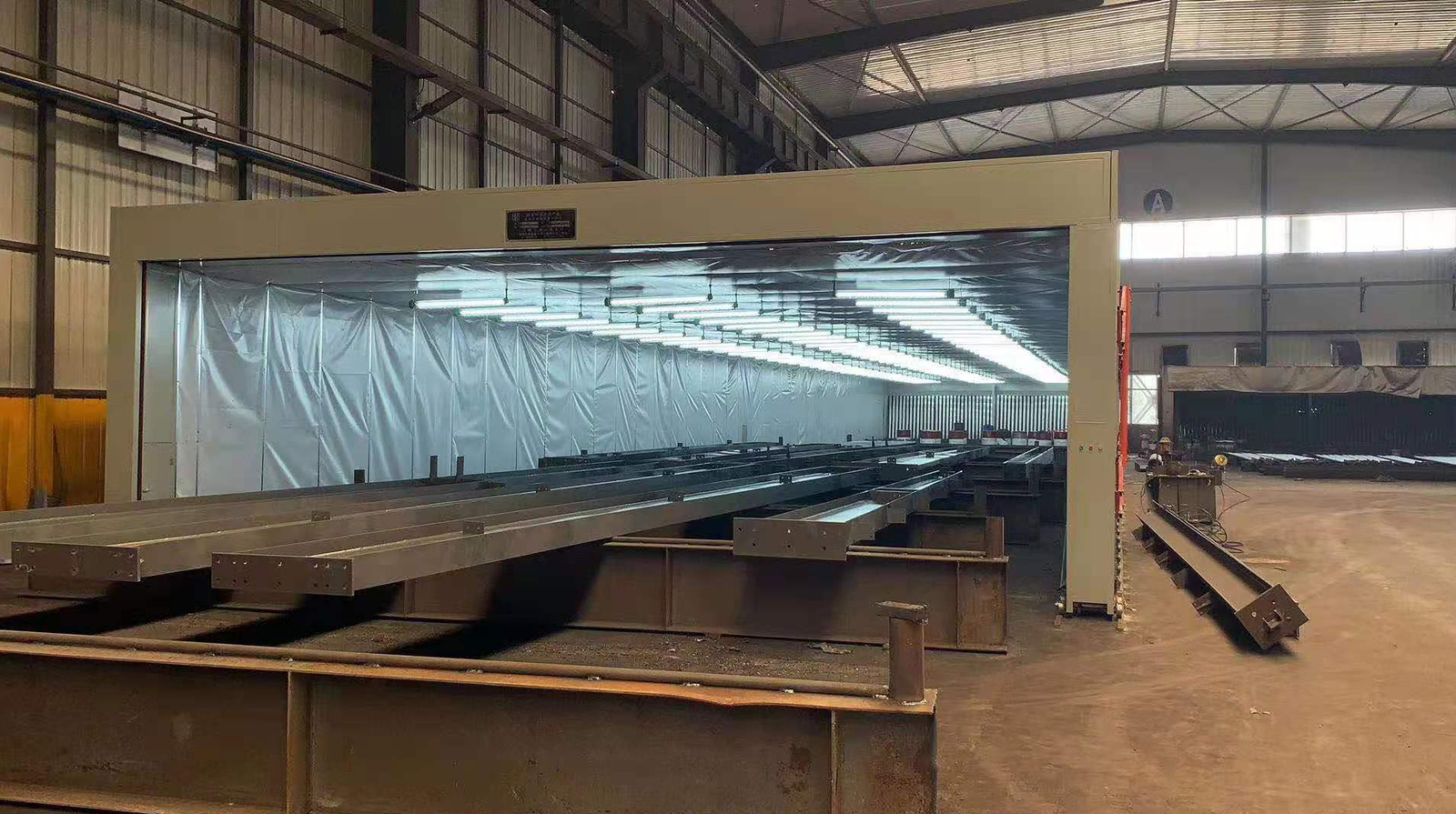
Case Study: Telescopic Spray Booth for Crane Girder Painting, Mexico
Summary
| Object | Crane girders up to 20 m and end carriages for a Overhead crane and gantry manufacturer in Mexico |
|---|---|
| Equipment | 20 x 10 x 4 m dry-filter telescopic booth |
| Operating conditions | crane-handled batch painting, dry filter wall: labyrinth paper filters plus glass-fibre bags, cross-draft 0.3 m/s or more |
| Result | Girders painted in the assembly bay without moving them to another building |
| Source | project specification and commissioning scope; client name withheld at the client's request |
Project Background
A Mexican manufacturer of overhead cranes and gantries fabricated box girders up to 20 m for automotive and steel plants. Girders were painted in the assembly bay with the plant's own cranes, and the plant needed an enclosure that would not block the runway above.
Pain Points Before the Project
- 20 m box girders with no booth long enough
- Crane runway could not be interrupted
- Customer liveries with frequent colour changes
- Local air permit required enclosed painting with treatment
Why This Configuration Was Chosen
- A 20 x 10 x 4 m telescopic booth on floor rails, no fixed roof, so the runway stays clear
- Dry filtration suits frequent colour changes; filters are the only overspray-contact surface
- Carbon boxes with UV pre-oxidation and a 75 kW fan sized at 0.3 m/s or more
Scope of Supply
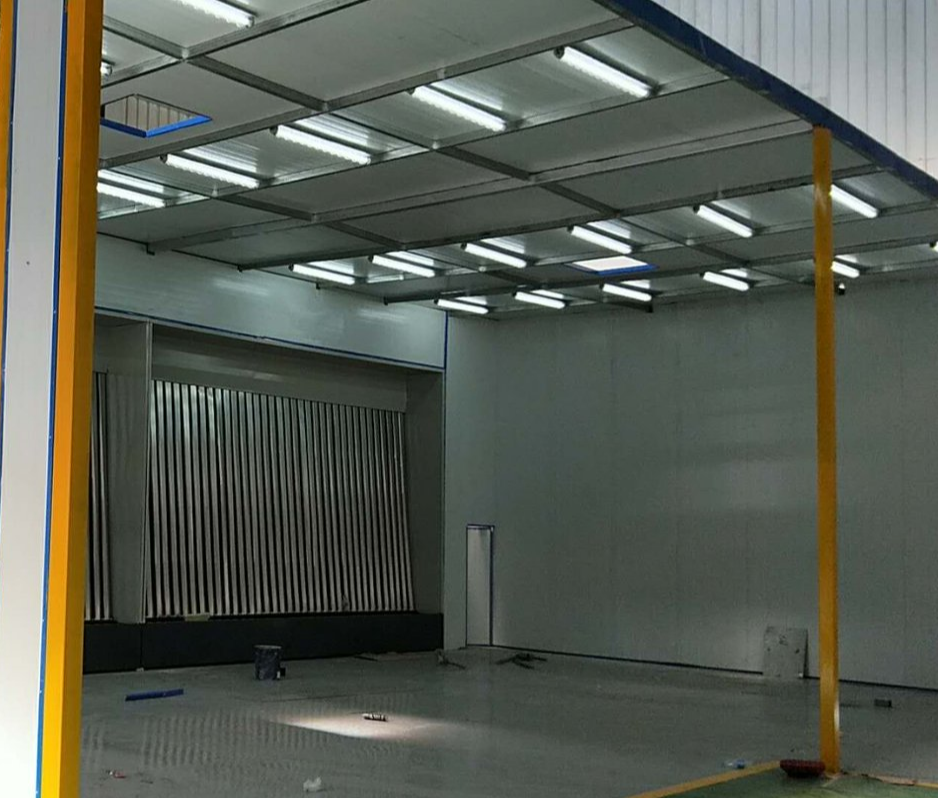
| Telescopic enclosure | 20 x 10 x 4 m internal (retracted about 3 x 10.7 m); Q235 frames 50 x 70 x 2 mm, flame-retardant PVC fabric |
|---|---|
| Drive and safety | 2 x 1.5 kW explosion-proof geared motors, 8-10 m/min; interlocked drives, double limit switches, rail sweeper, jog control |
| Lighting | 60 explosion-proof LED units, 18 W each, 300 lux or more |
| Paint mist capture | Dry filter wall: labyrinth paper filters plus glass-fibre bags, 98% or more mist capture |
| Exhaust treatment | Activated carbon boxes plus UV photo-oxidation unit, 50,000 m3/h class |
| Fan, duct and stack | 75 kW centrifugal fan, 54,000-79,400 m3/h, 15 m stack |
| Control | Two-station control cabinet, VFD on exhaust fan, emergency stop, audible-visual travel alarm |
| Installed power | about 109 kW installed |
Component brands. Key components are sourced from international first-tier brands at the client's choice; the table lists the options offered on this project.
| Component | Brand options |
|---|---|
| Exhaust fan | Nicotra Gebhardt, Kruger, Systemair |
| Geared drive motors | SEW-Eurodrive, NORD, Bonfiglioli |
| Explosion-proof lighting | Eaton Crouse-Hinds, R. STAHL, ABB |
| Low-voltage switchgear | Schneider Electric, Siemens, ABB |
| Variable frequency drive | ABB, Danfoss, Siemens |
| PLC (RCO control) | Siemens, Mitsubishi Electric, Omron |
| Filter media | Andreae Filters, Freudenberg Viledon, Camfil |
| Activated carbon | Calgon Carbon, Jacobi Carbons, Cabot Norit |
| Oxidation catalyst | BASF, Johnson Matthey, Clariant |
| Flame-retardant fabric | Serge Ferrari, Sioen, Mehler Texnologies |
| Flexible cables | LAPP, Nexans, Prysmian |
| Airless spray units (client side) | Graco, WIWA, WAGNER |
Not included: rail levelling and civil foundations, site lifting, third-party emission testing, workpiece stands unless ordered, and the drying room where forced cure is required.
Programme
Typical programme for this booth class; the dates for each project are fixed in the contract.
| Stage | Typical duration |
|---|---|
| Site survey and data collection | 3-7 days |
| Layout and detail design | 10-15 days |
| Manufacture and factory trial | 30-45 days |
| Sea freight and customs | 15-40 days |
| Rail levelling by site, installation | 7-14 days |
| Commissioning, emission test, training | 3-5 days |
Before and After
Design values from the project specification; the "before" column describes the open-floor condition found at survey, for which no measurements existed.
| Item | Before | After |
|---|---|---|
| Enclosure of the painting area | open bay or shed, no enclosure | telescopic booth, 20 x 10 x 4 m |
| Floor available when not painting | painting area blocked or shared | booth retracted, about 85% of footprint freed |
| Cross-draft over the work | not controlled | 0.3 m/s or more (design) |
| Paint mist capture | none | 98% or more (design) |
| VOC treatment efficiency | none | 85-90% (carbon) with UV pre-oxidation (design) |
| Lighting at the work surface | workshop lighting | 300 lux or more, explosion-proof (design) |
| Noise inside the booth | not controlled | 80 dB(A) or less (design) |
Results
- Girders painted in the assembly bay without moving them to another building
- Colour changes between liveries without cleaning a water circuit
- Booth retracted to about 3 m between paint batches
Applicability
This configuration suits workshops where the crane moves the workpiece, painting is done in batches and the floor must return to assembly use between batches: structural steel, vessels and tanks, machinery frames, crane girders, trailer chassis and hull blocks. It is not the right choice for conveyorised lines painting every shift, for coatings that need forced cure inside the same enclosure, or where a water-curtain booth and water treatment already exist.
The results above apply to the configuration and conditions described. A different part mix, paint system, climate or emission limit changes the numbers, which is why every booth is sized from its own data.
After-Sales
Warranty options of 12, 36 or 60 months, remote diagnosis within 2 hours and on-site attendance within 72 hours where a local partner is available, plus filter media, carbon and catalyst supply for the life of the booth. Details are on our after-sales service page.
FAQ
Can the same booth paint different products?
Yes. Nothing in the enclosure is shaped to the part; the booth on this project handled the full range of crane girders.
Why was dry capture chosen here?
Intermittent painting and frequent colour changes favour dry labyrinth-paper filtration: no water or oil circuit, and the filter wall is the only overspray-contact surface.
What did the client have to prepare?
Levelled rails to our drawing, a concrete pad for the fan and treatment unit, three-phase power to the cabinet and a crane for installation.
How was performance checked?
Travel and limit switches in both directions, drive interlock, cross-draft velocity, lighting level, noise, and stack sampling against the local limit.
Can this booth be extended later?
Frames are added in 1 m modules and the rails extended; the fan and filter wall are sized for the final length at the outset.
Get a Similar Solution
Send us the following and we return a booth layout with fan, filter and treatment sizing within a few working days:
- Largest workpiece length, width, height and weight, and how it is handled
- Daily paint and thinner consumption and the paint system
- Indoor or outdoor installation, crane hook height and available floor
- Local emission limit and workplace exposure rule
WhatsApp us about this case Contact form
Related
- Telescopic mobile spray booth (product page)
- What is a telescopic spray booth and how does it work?
- How to size a telescopic spray booth
- VOC treatment: carbon, UV or RCO
- Paint mixing room
Provided by Lin Cong, Technical Director, MUSI Technology
Published 2026-10-01 · Updated 2026-10-01 · Last technical review: 2026-10-01