What Is a Telescopic Spray Booth and How Does It Work?
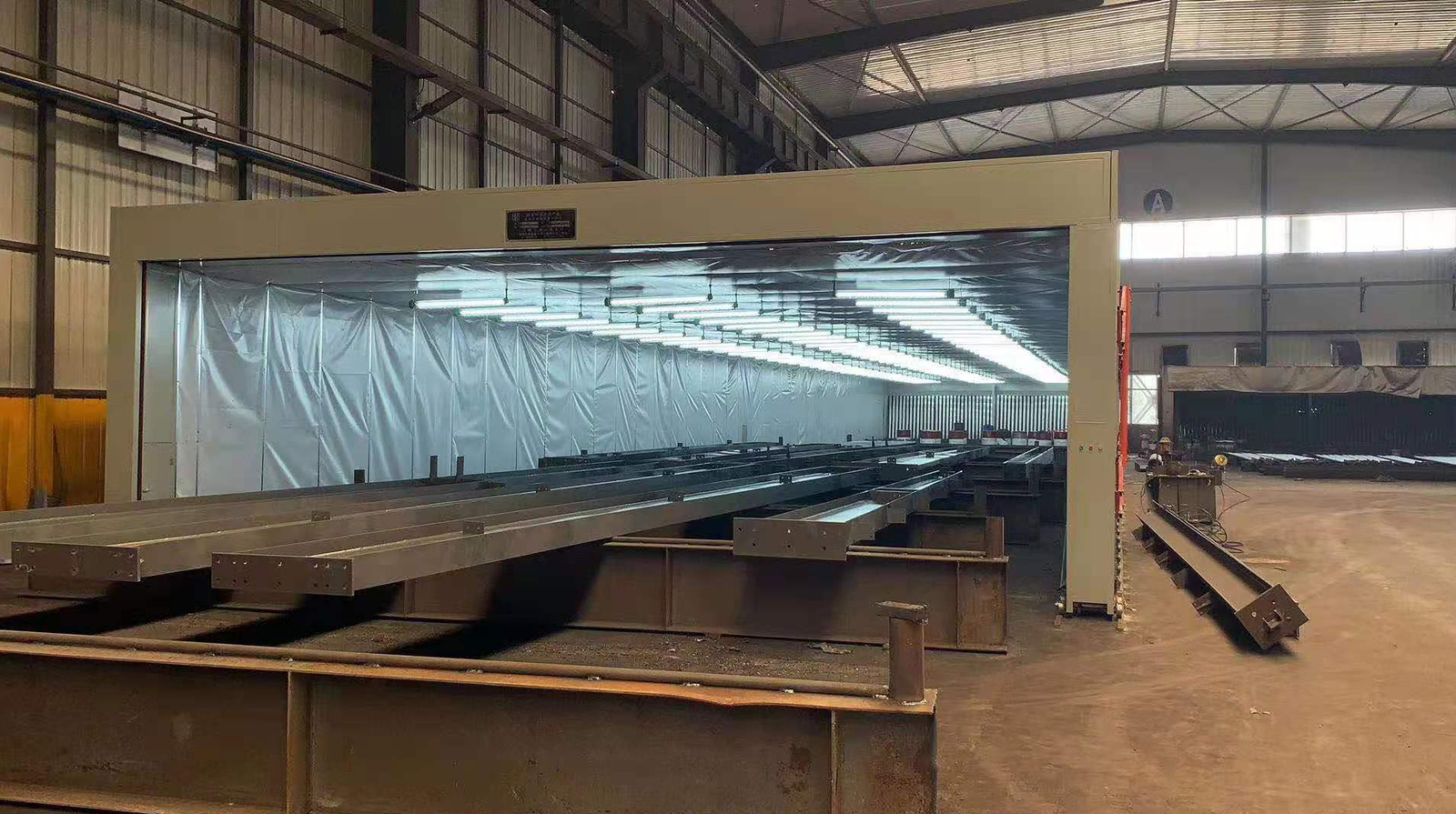
Quick answer: A telescopic spray booth (also called a retractable, extendable, sliding or mobile spray booth) is a paint enclosure built from parallel steel frames joined by flame-retardant fabric. The frames run on floor rails; when the booth is retracted it takes up about 15% of its extended length, so an overhead crane can set a 15 m beam or a 10 t vessel on the floor first, and the booth is then driven out to cover the part. Exhaust air leaves through a dry filter wall or an oil-film purifier at the fixed end and goes on to carbon, UV or catalytic treatment.
What are the parts of a telescopic spray booth?
Four systems make up the booth. The enclosure is a set of steel frames (typically 50 x 70 x 2 mm Q235 tube with 50 x 25 mm scissor bracing) linked by 0.5 mm flame-retardant PVC fabric, blue outside and white inside for reflectance. The drive is a pair of explosion-proof geared motors, 1.5-3 kW each, on the first travelling frame, with chain-linked twin wheels on each side. The ventilation and filtration system sits at the fixed end: a dry paint-mist filter wall or oil-film purifier, a centrifugal exhaust fan and a stack. The control system is a cabinet with jog buttons for travel, fan start and overload protection, grouped lighting and an audible-visual travel alarm.
How does the booth open and close?
The operator holds the jog button and the first frame drives along the rails at 8-10 m/min, pulling the other frames with it; the fabric between the frames unfolds in order. Frames are guided so they stay vertical and parallel, and buffer blocks between them stop the fabric being pinched when the booth closes. At each end of travel two limit switches in series stop the drive: if the first fails, the second still acts. Because the two sides are driven independently, one side can creep ahead on a slippery rail; the end stops are aligned, so the side that arrives first waits for the other, and the drift is cleared on every cycle instead of accumulating into a derailment.
Where does the air go?
The fan at the fixed end draws air along the booth at 0.3 m/s or more across the section. Overspray is carried into the filter wall: a labyrinth paper filter that changes the air direction several times so paint droplets stick to the paper, followed by a glass-fibre bag that catches the fines. Together they remove 98% or more of the paint mist. The cleaned air then passes through activated carbon boxes, a UV photo-oxidation unit or an adsorption-catalytic (RCO) unit before the 15 m stack. For a 20 x 10 x 4 m booth the exhaust fan is typically 75 kW moving 54,000-79,400 m3/h; the whole installation, including lighting and drives, is around 109 kW installed.
| Item | Typical value |
|---|---|
| Internal size | 12-20 m long, 5-10 m wide, 3-4.5 m high |
| Retracted length | about 3 m for a 20 m booth |
| Travel speed | 8-10 m/min, jog control |
| Drive | 2 x 1.5-3 kW explosion-proof geared motors |
| Lighting | explosion-proof LED, 300 lux or more |
| Cross-draft | 0.3 m/s or more |
| Paint mist capture | 98% or more, dry filter or oil film |
| Exhaust | 30,000-80,000 m3/h, carbon / UV / RCO |
Why do fabricators choose it over a fixed booth?
Three reasons come up in almost every enquiry. The workpiece is too long or too heavy to carry through a booth door; the floor under the booth is needed for assembly when nobody is painting; and the crane runway cannot be interrupted by a fixed roof. A telescopic booth answers all three because it covers the part where it already sits. The trade-off is that the enclosure is a fabric tent, not an insulated panel room, so it is used for painting and flash-off, with drying done in a separate room or by air drying, and it suits batch work rather than a conveyorised line.
FAQ
Is a telescopic booth explosion-protected? The drives, lighting and warning lamps inside the enclosure are explosion-protected and the fabric is flame-retardant; the control cabinet sits outside the booth.
Can it be installed outdoors? Yes, on rails under a gantry crane. The fabric is UV-stabilised and the exhaust unit is fixed at one end.
How long does one take to install? Rail levelling and installation typically take one to two weeks for a 20 m booth, plus commissioning of the fan and exhaust treatment.
Can the length be extended later? Frames are added in 1 m modules and the rails extended; the fan and filter wall are sized for the final length.
Where MUSI Technology fits
MUSI engineers telescopic booths together with the paint mist filtration and VOC treatment behind them, so the enclosure, fan and treatment unit are sized as one system. Product details, typical sizes and the quotation checklist are on the telescopic mobile spray booth page.
Provided by Lin Cong, Technical Director, MUSI Technology
Send us your part size, throughput and coating type — our engineers reply with a layout and budget within one working day. Contact MUSI Technology or browse our equipment range.
Related technical guides
- Shipping Container Coating Line: Spec & Layout
Container coating is a C5-M marine job run at production speed. Coat sequence, film build, blast and booth sizing, cycle time per box and 2026 plant cost. - Powder Coating vs Liquid Spray: Which to Choose
Powder coating vs liquid spray compared on cost, film thickness, colour range, VOC emissions, substrate limits and best-fit applications. - Robotic Spray Painting vs Reciprocator: ROI
A six-axis paint robot costs 3-6 times a reciprocator but raises transfer efficiency to 70-90% and handles mixed models. - Automotive Parts Coating Line: Spec & Throughput
Automotive coating lines must hold film build within plus or minus 10 microns, pass 500-1,000 h salt spray and meet OEM appearance standards. - Powder Coating Line: Types, Specs & Cost (2026)
A powder coating line pretreats, coats and cures metal parts on a conveyor. Full guide to line types, key specifications and 2026 price ranges.