Painting Pressure Vessels, Tanks and Heavy Machinery in a Telescopic Spray Booth
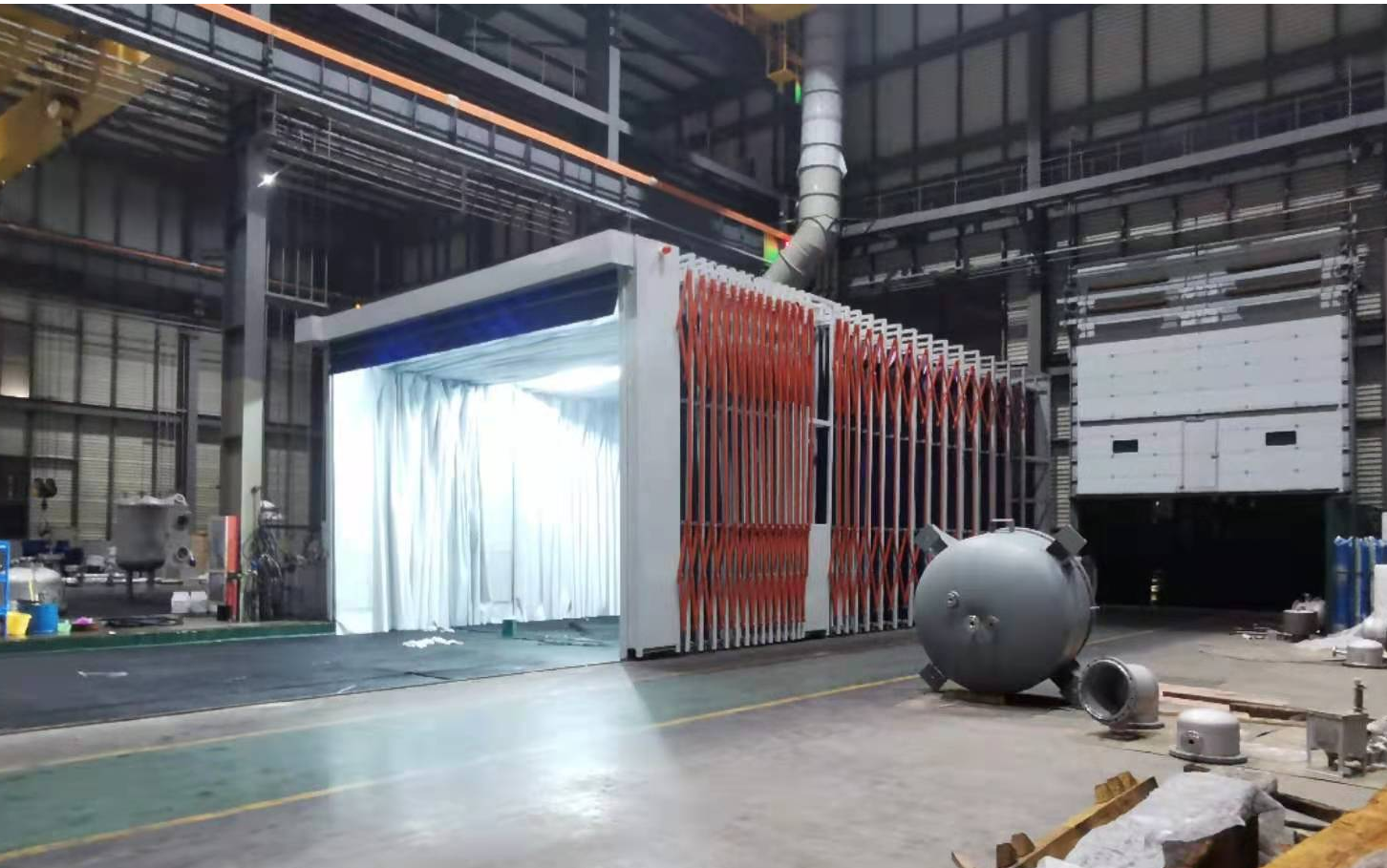
Quick answer: Vessels, tanks, gearbox housings and machine frames are handled by crane and painted in batches, which is exactly the pattern a telescopic booth serves: the part is set on the floor, the booth closes around it, and the fixed end carries an oil-film or dry filter wall with carbon or RCO treatment. Booths of 12 x 7 x 4.5 m with three oil-film units and a 30,000 m3/h RCO are a typical configuration for a vessel shop.
Why crane-only handling matters
A 10 t vessel does not go through a booth door on a forklift. In a fixed booth it needs a rail car and a booth long enough for the car and its approach; the crane runway usually has to be interrupted by the booth roof. A telescopic booth has no fixed roof and no door: the crane lowers the vessel onto saddles inside the rail span and the booth is driven over it.
Which paint mist capture suits vessel shops?
Vessel and machinery shops often paint every day with high-build epoxies, so an oil-film purifier is chosen for the fixed end: paint-laden oil is drained rather than filters thrown away, and the clean air protects the RCO catalyst downstream. Two or three units of 1,800 x 1,800 x 3,450 mm serve a 12-13 m booth. Where painting is intermittent, dry filters remain the simpler choice.
What treatment meets a strict emission limit?
An adsorption-desorption unit with catalytic oxidation (RCO) at 30,000 m3/h: three honeycomb carbon beds, one catalytic bed at 200-300 C, 45 kW adsorption fan, 60 kW start-up heater, PLC control. Treatment efficiency is 95% or more and the carbon is regenerated by the unit’s own heat instead of being replaced.
| Item | Typical vessel-shop configuration |
|---|---|
| Internal size | 12 x 7 x 4.5 m |
| Travel | 8-10 m/min, 2 x 1.5 kW Ex drives |
| Mist capture | 3 oil-film units, 98% or more |
| Treatment | RCO 30,000 m3/h, 95% or more |
| Stack | 15 m |
| Lighting | Ex LED, 300 lux or more |
Can one booth serve several products?
Yes; that is the main economic argument. The same booth paints vessels one week and machine frames or crane girders the next, because nothing in the enclosure is shaped to the part. Plants with two product lines in separate bays have run two booths, an 8 m2 and a 20 m2 one 30 m apart, on a single shared RCO.
FAQ
Can the booth cover a vessel on a rotator? Yes, if the rotator sits inside the rail span and below the frame clearance; rotating the vessel inside the booth lets one painter reach the full circumference.
What about internal painting? Internal coating uses the vessel's own ventilation; the booth captures the external overspray.
Do you supply the saddles and stands? On request; they are simple fabrications sized to the parts.
How much floor is needed? The extended footprint plus the fixed-end equipment; the retracted booth frees about 85% of that floor.
Where MUSI Technology fits
MUSI configures telescopic booths with oil-film purifiers and RCO units for vessel, tank and machinery builders, and can add a separate drying room when the schedule needs forced cure. Product details, typical sizes and the quotation checklist are on the telescopic mobile spray booth page.
Provided by Lin Cong, Technical Director, MUSI Technology
Related guide: Paint Booths for Mining Equipment: Size, Airflow, Coating System and Rebuild Layout
Send us your part size, throughput and coating type — our engineers reply within 24 hours, and a layout and budget follow once your part data is complete. Contact MUSI Technology or browse our equipment range.
Related technical guides
- Metal Hardware Coating Line: Design & Cost per Part
Hardware plants live on variety, not volume. Dense hanging, 10-25 minute colour change, rack design and the real cost per coated part, with line. - VOC Treatment: RTO vs RCO vs Carbon vs Rotor
Compare RTO, RCO, activated carbon adsorption and zeolite rotor concentrators for spray coating line VOC treatment: efficiency, cost and best fit. - Powder Coating Line Below Rated Output: 8 Causes (2026)
Why a powder coating line makes fewer parts than rated: the output formula, 8 causes from empty hooks to oven limits, and a symptom-check-fix table. - Robotic Spray Painting vs Reciprocator: ROI
A six-axis paint robot costs 3-6 times a reciprocator but raises transfer efficiency to 70-90% and handles mixed models. - Automotive Parts Coating Line: Spec & Throughput
Automotive coating lines must hold film build within plus or minus 10 microns, pass 500-1,000 h salt spray and meet OEM appearance standards.
QQuestions buyers ask before ordering
quotation · price · lead time · installation · warranty
What information do you need to prepare a quotation?
Send part drawings or photos, the largest part size and weight, the material, the required output per shift, the paint or powder type and number of colours, and the available floor space, ceiling height and power or gas supply. MUSI engineers reply within 24 hours; a recommended configuration and quotation follow once your part data is complete.
How much does this equipment cost?
Budget depends on part size, throughput and the level of automation. Indicative ex-works ranges are published in our liquid spray line cost guide; a configured quotation is prepared from your part data. Published indicative ranges: compact manual liquid spray booths from around USD 15,000–40,000, semi-automatic lines with conveyor and flash-off/curing ovens roughly USD 80,000–400,000, and fully automatic multi-colour electrostatic lines from USD 400,000 to several million dollars.
What is the lead time?
Standard configurations ship in 30–60 days from contract signing and down payment; custom configurations take longer. The delivery date is fixed in the contract.
Do you install and train operators overseas?
Yes. MUSI engineers carry out on-site installation and commissioning and give 3–5 days of operator and maintenance training. MUSI has delivered 800+ coating lines to customers in 36 countries.
What warranty and after-sales support are included?
12 months full-machine warranty, 36 months on critical components and up to 60 months on structural parts. International customers get 24-hour phone response and 72-hour on-site arrival; spare parts ship from the Changzhou headquarters.
Can the environmental equipment be supplied with the line?
Yes. VOC treatment (RTO, RCO, activated carbon, zeolite rotor), dust collection and paint wastewater treatment are supplied with the coating line under one contract; MUSI has equipped 50+ coating facilities whose projects all passed local environmental compliance reviews.