Telescopic Spray Booth Maintenance: Filter Change Intervals, Fabric Care and Running Costs
Quick answer: Keep a differential pressure gauge across the filter wall and change the labyrinth paper filters at about 250 Pa; replace glass-fibre bags when their resistance reaches the same value; change activated carbon by solvent load and the RCO catalyst at about 8,000 hours; inspect fabric, fold guards, rails and drive wheels weekly; and budget running cost from fan power (45-75 kW), drive power during travel and filter consumption.
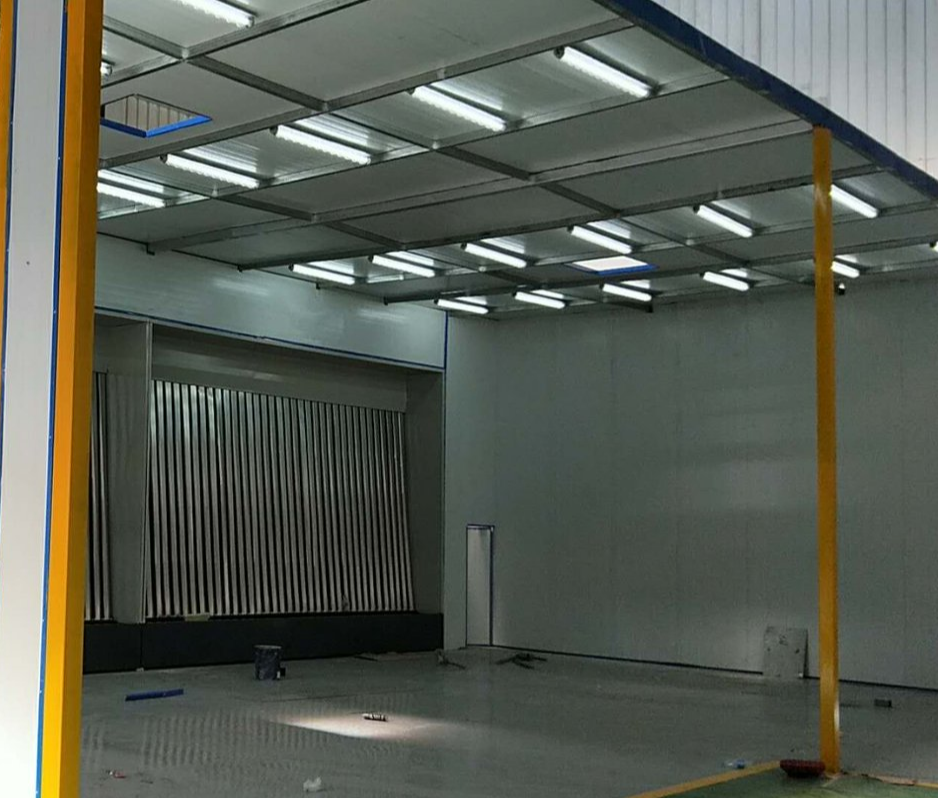
Filter wall
Labyrinth paper filters hold 14-18 kg of paint per square metre and are changed when the pressure drop reaches about 250 Pa, not on a calendar. Glass-fibre bags behind them start at 7-40 Pa and are changed at 250 Pa. Spent filters are paint-contaminated waste. Oil-film units are drained and refilled on a schedule set by paint volume.
Treatment unit
Carbon cassettes are swapped when the outlet sampling shows breakthrough; keeping a spare set lets the swap happen while the fan runs. UV lamps are replaced by hours. In an RCO the honeycomb carbon regenerates itself and the palladium-platinum catalyst is replaced at about 8,000 hours; the temperature probe, dilution damper and flame arrestor are checked at each service.
Enclosure, rails and drives
Weekly: walk the rails and clear anything the sweeper missed, check the fabric for tears and paint build-up at the folds, confirm the fold guards are in place. Monthly: test both limit switches at each end and the drive interlock, check chain tension on the twin drive wheels, look at the gearbox oil level. The rubber-sheathed cables last five to eight years; replace at the first sign of cracking. The fabric is a wear item replaced after several years depending on solvent exposure and sunlight.
| Item | Change when | Driver |
|---|---|---|
| Paper filters | at 250 Pa on the gauge | paint volume |
| Glass-fibre bags | at 250 Pa | paint volume |
| Carbon cassettes | at breakthrough | solvent load |
| RCO catalyst | about 8,000 h | operating hours |
| UV lamps | by lamp hours | operating hours |
| Fabric | several years | solvent, UV |
| Cables | 5-8 years | flexing cycles |
How to estimate running cost
Fan power dominates: a 75 kW fan for 8 hours a day at a power factor of 0.8 is the number most plants start from; a VFD cuts it while filters are new. Drive motors run only during travel, a few minutes per batch. Add lighting (about 1 kW), filter consumption from the paint volume, and carbon or catalyst on their intervals. An RCO adds its start-up heater but saves carbon replacement, which is why it wins on daily painting.
FAQ
Can the filters be cleaned and reused? No; paper and glass-fibre media are single-use.
How do I know the carbon is spent? Outlet sampling, or a fixed interval calculated from paint and thinner consumption.
Does the booth need lubrication? Gearbox oil and drive chains; the frames have plain guides that only need to be kept clean.
What spares should be on site? One set of paper filters and bags, spare Ex LED units, a limit switch, and a drive chain.
Where MUSI Technology fits
MUSI supplies filter media, carbon and catalyst for the booths it installs and includes the maintenance schedule in the handover manual. Product details, typical sizes and the quotation checklist are on the telescopic mobile spray booth page.
Provided by Lin Cong, Technical Director, MUSI Technology
Send us your part size, throughput and coating type — our engineers reply with a layout and budget within one working day. Contact MUSI Technology or browse our equipment range.
Related technical guides
- Powder Curing Oven: Gas vs Electric vs Infrared
A powder curing oven holds parts at 180-200 C for 10-20 minutes. Gas, electric and infrared ovens compared on energy cost per part, heat-up time,. - Coating Line Conveyor Types Compared (2026)
Overhead chain, floor belt, power-and-free and inverted conveyors compared on part weight, throughput, buffering, floor space and 2026 cost per metre. - Shipping Container Coating Line: Spec & Layout
Container coating is a C5-M marine job run at production speed. Coat sequence, film build, blast and booth sizing, cycle time per box and 2026 plant cost. - Powder Coating vs Liquid Spray: Which to Choose
Powder coating vs liquid spray compared on cost, film thickness, colour range, VOC emissions, substrate limits and best-fit applications. - Robotic Spray Painting vs Reciprocator: ROI
A six-axis paint robot costs 3-6 times a reciprocator but raises transfer efficiency to 70-90% and handles mixed models.