Telescopic vs Fixed Spray Booth: Which Is Right for Large Workpieces?
Quick answer: Choose a telescopic booth when the crane, not a conveyor, moves the workpiece and the floor must be free between paint jobs; choose a fixed booth when parts fit through a door, painting runs every shift, and the coating needs controlled temperature or forced drying inside the same enclosure. Many heavy fabrication plants run both: a fixed booth for repeat parts and a telescopic booth over the assembly floor for oversized work.
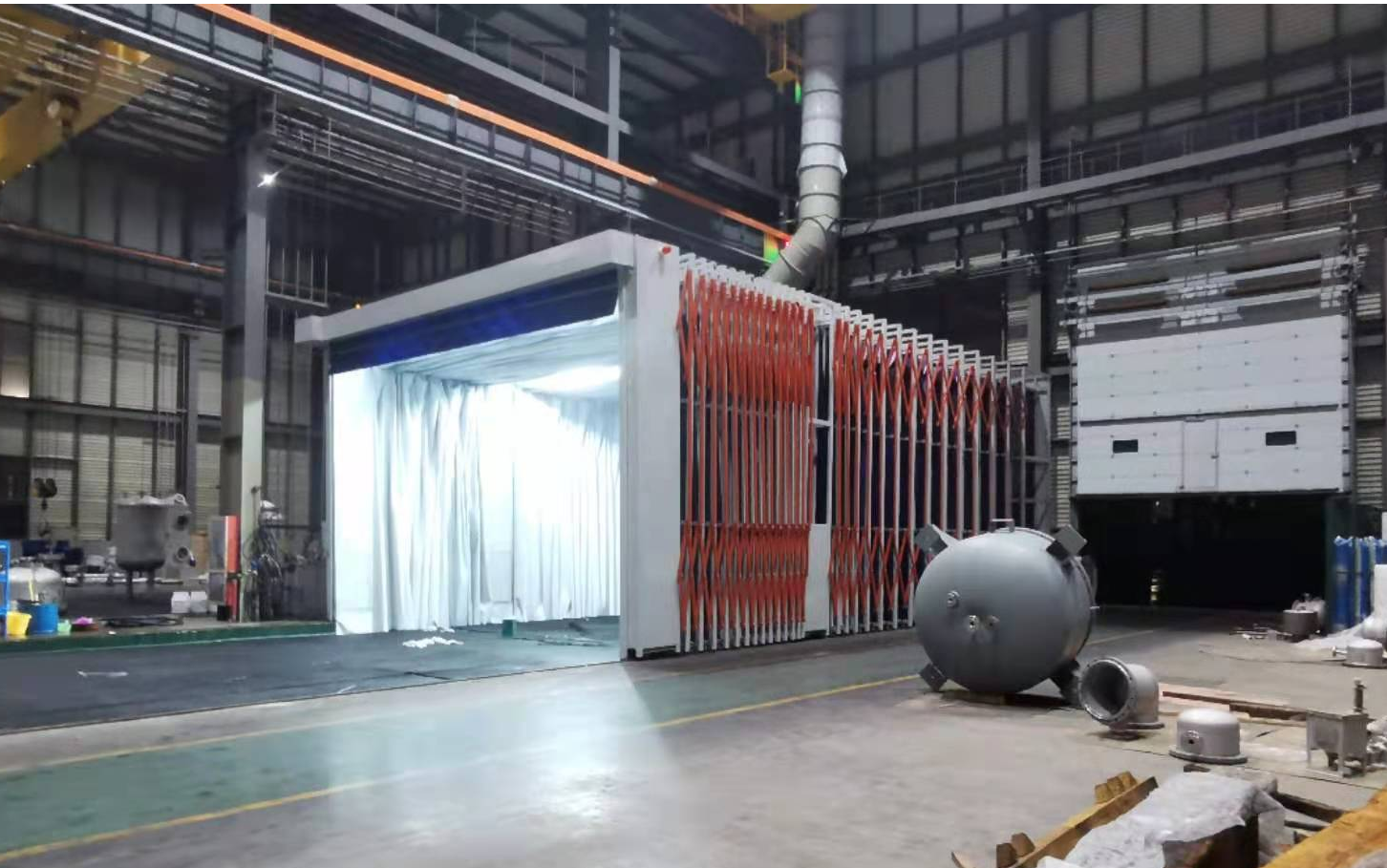
How do the two booths use the floor?
A fixed booth occupies its footprint permanently. A 20 x 10 m telescopic booth folds to about 3 x 10.7 m, returning roughly 85% of the floor to the workshop when it is closed. In a plant that paints two days a week, that floor is available for fit-up and welding the other three.
How do parts get in?
A fixed booth needs a door wider than the part and a transfer car or forklift path; parts longer than about 12 m or heavier than a few tonnes need a rail car and a booth long enough for the car. A telescopic booth needs nothing but the overhead or gantry crane already in the bay: the part is set on stands, the booth is driven over it, and the crane runway stays clear because the booth has no fixed roof structure at crane height.
Which gives better paint conditions?
A fixed booth with insulated panels can be heated, held at a set humidity and switched to a drying mode at 40-60 C. A telescopic booth is a ventilated fabric enclosure: it controls overspray, dust and operator exposure, and it holds 300 lux or more of explosion-proof lighting, but the air inside follows the workshop climate. For two-pack epoxy and polyurethane systems on structural steel this is normally acceptable with air drying; for coatings that need forced cure, plan a separate drying room.
| Criterion | Fixed booth | Telescopic booth |
|---|---|---|
| Floor use when idle | permanent footprint | about 15% of length |
| Part loading | door, transfer car | overhead crane, part stays put |
| Crane runway | interrupted by roof | clear |
| Heating / drying | yes, in the same room | separate room or air drying |
| Paint mist capture | dry, water curtain or oil film | dry filter or oil film |
| Best for | repeat parts, every shift | oversized batch work |
What does each cost to own?
Both use the same exhaust fan, filters and VOC treatment for the same air volume, so running cost per hour of painting is similar; the telescopic booth adds two small drive motors (1.5-3 kW each) that run only during travel. The fabric is a wear item replaced after several years depending on solvent exposure and UV, and the rails need to be kept clear, which is why the drive wheels carry a rail sweeper. The fixed booth carries higher civil cost for its foundation, doors and roof.
FAQ
Can a telescopic booth replace an existing fixed booth? Yes when the fixed booth is the bottleneck for oversized parts; the fixed booth is usually kept for smaller repeat work.
Is the fabric enclosure tight enough for solvent-borne paint? The fabric overlaps and the booth runs under slight negative pressure at 0.3 m/s or more, so overspray and vapour move towards the filter wall rather than out of the enclosure.
Can the booth be heated? Warm supply air can be added, but the enclosure is not insulated; for forced drying use a separate drying room.
What sizes are typical? Most booths are 12-20 m long, 5-10 m wide and 3-4.5 m high; length is built in 1 m frame modules.
Where MUSI Technology fits
MUSI supplies both fixed liquid spray booths and telescopic booths, and lays out the two together when a plant needs a booth for repeat parts and an enclosure over the assembly floor. Product details, typical sizes and the quotation checklist are on the telescopic mobile spray booth page.
Provided by Lin Cong, Technical Director, MUSI Technology
Send us your part size, throughput and coating type — our engineers reply with a layout and budget within one working day. Contact MUSI Technology or browse our equipment range.
Related technical guides
- Powder Coating Line: Types, Specs & Cost (2026)
A powder coating line pretreats, coats and cures metal parts on a conveyor. Full guide to line types, key specifications and 2026 price ranges. - Powder Coating Pretreatment Line: Stages & Cost
A pretreatment line degreases, rinses and chemically converts the metal surface before coating. Three, five and seven-stage layouts, phosphate versus. - BESS Container Coating Line: Spec & Corrosion
Battery energy storage containers need C4 to C5-M corrosion protection: shot blasting to Sa2.5, zinc-rich primer and weather-resistant polyester topcoat. - EV Battery Pack Housing Coating Line: Specs & Cost
Battery pack housings need dielectric strength, thermal stability and corrosion life in one coating. Powder versus liquid compared, film build targets,. - Spray Coating Line: Types, Specs & Cost (2026)
What a spray coating line costs, how the main types compare on throughput and finish, and the specs to fix before you ask for quotations.