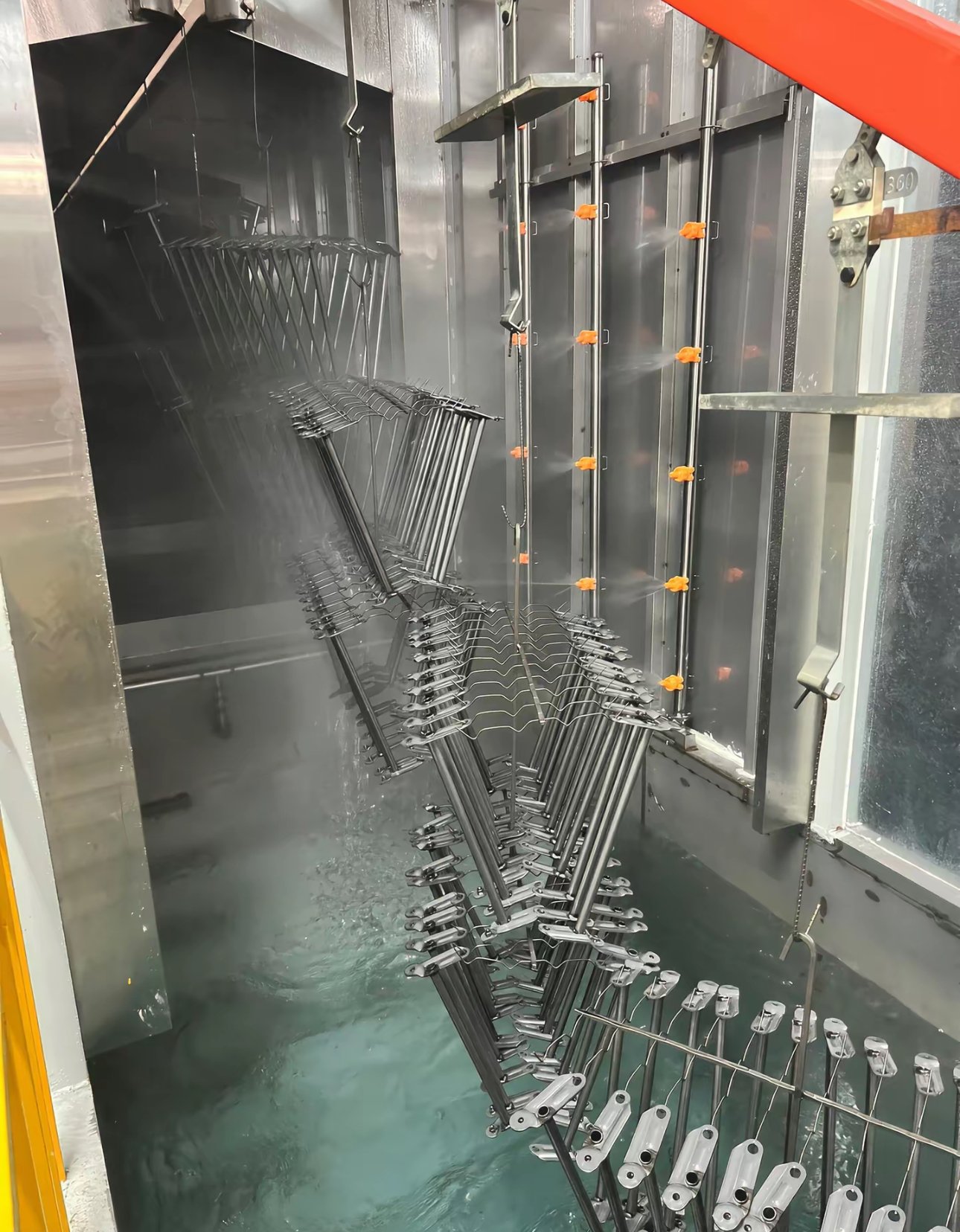
Pretreatment Washer
A pretreatment washer is a conveyorised, multi-stage spray tunnel that cleans and conversion-coats metal parts before powder or liquid coating. This spray pretreatment washer is built in 3, 5 or 7 stages for iron phosphate, zinc phosphate or zirconium chemistry.
Built for coating lines that need the same cleaning, conversion coating and rinse quality on every hanger, from fabricated steel and aluminium profiles to castings and sheet-metal enclosures.
Technical Specifications
Values below are typical ranges for this equipment type. The figures for your line are fixed in the written specification after we review your parts, output and site.
| Number of stages | 3 (clean and phosphate, rinse, seal rinse), 5 (clean, rinse, phosphate, rinse, seal) or 7 with conditioning, passivation and a DI rinse |
|---|---|
| Stage length | Contact time x conveyor speed; for example 1 minute at 6 ft/min (1.8 m/min) needs a 6 ft (1.8 m) spray zone |
| Alkaline cleaner stage | About 90 s at 90-140 °F (32-60 °C), 2-4 % concentration; V-jet nozzles often near 30 psi (about 2 bar) |
| Rinse stages | About 30 s each at ambient temperature, with continuous fresh-water overflow |
| Iron phosphate stage (spray) | 50-60 °C, 1.5-3 minutes, pH 4.5-5.5, 1-2 bar spray pressure (supplier data sheet); 60 s at 90-140 °F in general 5-stage guidance |
| Zinc phosphate stage (spray) | 48-55 °C, 60-180 s, 0.8-2.0 bar spray pressure, after a conditioning (activation) stage |
| Zirconium thin-film stage (spray) | 20-40 °C, 20-180 s, pH 3.8-5.0, 0.5-1.5 bar spray pressure |
| Conversion coating weight | Iron phosphate 20-70 mg/ft² (about 0.2-0.75 g/m²); zinc phosphate 100-300 mg/ft² (about 1.1-3.2 g/m²) |
| Final recirculated rinse | Conductivity held to around 180 µS/cm (roughly 300 ppm TDS) |
| Fresh DI / RO halo rinse | Below 10 µS/cm for a pure-water halo; DI water is typically 0-15 ppm TDS and RO water 50-250 ppm TDS |
| Wetted materials | Stainless steel tanks, pumps, pipework and risers in acidic stages (DIN 1.4401, 1.4541 or 1.4571 for zinc phosphate); fluoride-resistant materials for zirconium baths |
Washer Configuration
- Tunnel housing with entry and exit vestibules, access doors and drain (drip) zones between spray stages
- Solution tanks with screens, sludge clean-out, overflow weirs and oil skimming on the cleaner stage
- Recirculation pumps, headers and spray risers with clip-on nozzles (flat fan for cleaning and rinsing, cone type for conversion stages)
- Tank heating by gas burner tube, steam or hot-water coil, or electric elements, with insulated hot tanks
- Exhaust fans with mist eliminators at tunnel entry and exit, plus counter-flow rinse piping and a fresh DI / RO halo riser
- Chemical dosing pumps with pH, conductivity and temperature control on a PLC and HMI
How many stages does a pretreatment washer need for each chemistry?
The stage count follows the chemistry and the corrosion performance the coating must reach. A 3 stage washer combines cleaning and iron phosphating in one tank, a 5 stage washer separates them, and zinc phosphate needs a conditioning stage and usually a passivation and DI rinse.
| Chemistry | Typical stages | Stage sequence | Where it is used |
|---|---|---|---|
| Iron phosphate, 3 stage | 3 | 1 clean and phosphate, 2 rinse, 3 seal rinse (or second rinse) | Lightly soiled steel, indoor products, moderate corrosion requirement |
| Iron phosphate, 5 stage | 5 | 1 alkaline clean, 2 rinse, 3 iron phosphate, 4 rinse, 5 seal or final rinse | General industrial steel parts where cleaning must be controlled separately from phosphating |
| Zinc phosphate, 7 stage | 7 | 1 alkaline clean, 2 rinse, 3 conditioning (activation), 4 zinc phosphate, 5 rinse, 6 passivation (seal), 7 DI rinse | Steel, galvanised and alloy-coated parts needing higher corrosion resistance |
| Zirconium thin film | 5 | 1 alkaline degrease, 2 water rinse, 3 DI rinse, 4 zirconium conversion, 5 DI rinse | Mixed steel, galvanised and aluminium loads; phosphate-free, low-temperature bath |
Spray tunnel, dip tank or manual wand wash: which pretreatment washer type fits?
A conveyorised spray tunnel suits continuous production, dip tanks suit parts with cavities or batch work, and a manual wand suits low volumes and very large items. Trade guidance treats spray and immersion as equally capable when each is properly controlled.
| Point | Multi-stage spray tunnel | Dip (immersion) tanks | Manual spray wand |
|---|---|---|---|
| How parts move | Overhead conveyor carries parts through spray zones separated by drip zones | Parts or baskets are lowered into a row of tanks by hoist | Stationary parts sprayed by an operator in a wash bay with containment |
| What does the cleaning | Spray impingement, chemical concentration, time and temperature | Agitation, chemical concentration, immersion time and temperature | Impingement from the wand, concentration, time and water temperature |
| Operator dependence | Low; contact time is fixed by conveyor speed and zone length | Low; controlled by titration and temperature monitoring | High; results depend on operator training and technique |
| Typical operating values | Stages of about 30-180 s at 0.5-2 bar | Needs agitation, tank heating and an oil skimmer | 160-180 °F (71-82 °C) at the nozzle, 1,000 psi (about 69 bar) minimum, 5-15 minutes contact |
| Fits | Continuous lines with steady part flow | Complex parts with internal surfaces; batch production | Low volume or oversized fabrications; moderate grease and oil removal only |
What should be controlled in each washer stage?
Each stage has its own temperature, contact time and chemical control value, taken here from chemical suppliers' data sheets and industry guidance. The chemical supplier's technical data sheet for the product in the tank always takes priority.
| Stage | Temperature | Contact time | Control value |
|---|---|---|---|
| Alkaline cleaner | 90-140 °F (32-60 °C) | About 90 s | 2-4 % concentration by titration; oil skimmed from the tank |
| Rinse after cleaner | Ambient | About 30 s | First rinse TDS not above 4 x source water TDS |
| Iron phosphate | 50-60 °C (around 120 °F in common practice) | 1-3 minutes | pH 4.5-5.5 (most systems run near pH 4.0-5.5); total acid by titration |
| Conditioning before zinc phosphate | Per supplier data sheet | Per supplier data sheet | Surface activator concentration |
| Zinc phosphate | 48-55 °C | 60-180 s | Free acid, total acid and accelerator by titration; continuous replenisher dosing |
| Zirconium conversion | 20-40 °C | 20-180 s | pH 3.8-5.0 (preferred 4.0-4.2) |
| Rinse after conversion | Ambient | 20-40 s | Second rinse TDS not above 3 x source; rinse after zirconium below 50 µS/cm (25 µS/cm recommended) |
| Seal or final rinse | 70-140 °F (21-60 °C) for a seal rinse | About 30 s | Final rinse TDS not above 1.5 x source water; recirculated rinse around 180 µS/cm |
| Fresh DI / RO halo | Ambient | Brief misting pass at the stage exit | Below 10 µS/cm |
Components
The washer is assembled from catalogue components so that spares can be sourced locally. Key components are available from international brands such as Spraying Systems Co. and Lechler for spray nozzles, Grundfos for pumps, Riello, Weishaupt and Maxon for burners, Siemens, Allen-Bradley and Mitsubishi Electric for PLC and HMI, and Henkel Bonderite and Chemetall for pretreatment chemistry (configurable per customer specification).
Application References
Used ahead of powder and liquid coating for steel fabrications, sheet-metal cabinets and enclosures, aluminium profiles, automotive and agricultural components, furniture, racking, appliance panels and castings.
Engineering Commitment
Every line is engineered against a written performance specification. Line speed, cure profile, film build and emission level are stated in the contract and demonstrated on your own part at the factory trial run before shipment. One engineering team owns the whole chain — pretreatment, application, curing, conveying and emission control — so the trade-offs between them are settled on the drawing board, not on your factory floor.
Service & Delivery
Standard configurations ship in 30-60 days with a 12-month full-machine and 36-month critical-component warranty. On-site installation, commissioning and operator training are available worldwide, and process tuning and spare parts support continue for the working life of the line.
Frequently Asked Questions
What is the difference between a 3 stage and a 5 stage washer?
A 3 stage washer cleans and iron-phosphates in one heated tank, then rinses twice or rinses and seals. A 5 stage washer gives the alkaline cleaner its own tank and rinse before a separate phosphate stage, so the cleaner and the phosphate bath can each be run at their own concentration and pH.
Do I need a stainless steel pretreatment washer?
Stainless steel is the usual choice for acidic stages. One supplier's iron phosphate data sheet accepts mild steel but prefers stainless for service life, and requires stainless or plastic-lined steel once fluoride additives are used. Zinc phosphate zones are specified in stainless, and zirconium baths need fluoride-resistant materials.
What water quality does the final rinse need?
Industry guidance puts a recirculated final rinse at around 180 µS/cm and a fresh pure-water halo below 10 µS/cm. DI water is typically 0-15 ppm TDS and RO water 50-250 ppm. Salts left by a high-conductivity rinse can start corrosion under the coating.
How is the length of a spray pretreatment washer worked out?
Each spray zone length equals the required contact time multiplied by the conveyor speed, so one minute of cleaning at 6 ft/min needs a 6 ft zone. Drip zones are added between stages, long enough for parts to clear one spray zone before entering the next.
Can a pretreatment washer for powder coating run at ambient temperature?
The conversion stage can with zirconium chemistry: one supplier's spray product runs at 20-40 °C, compared with 50-60 °C for a spray iron phosphate and 48-55 °C for a spray zinc phosphate. The alkaline cleaner stage is normally still heated, and parts pass through a dry-off oven before coating.