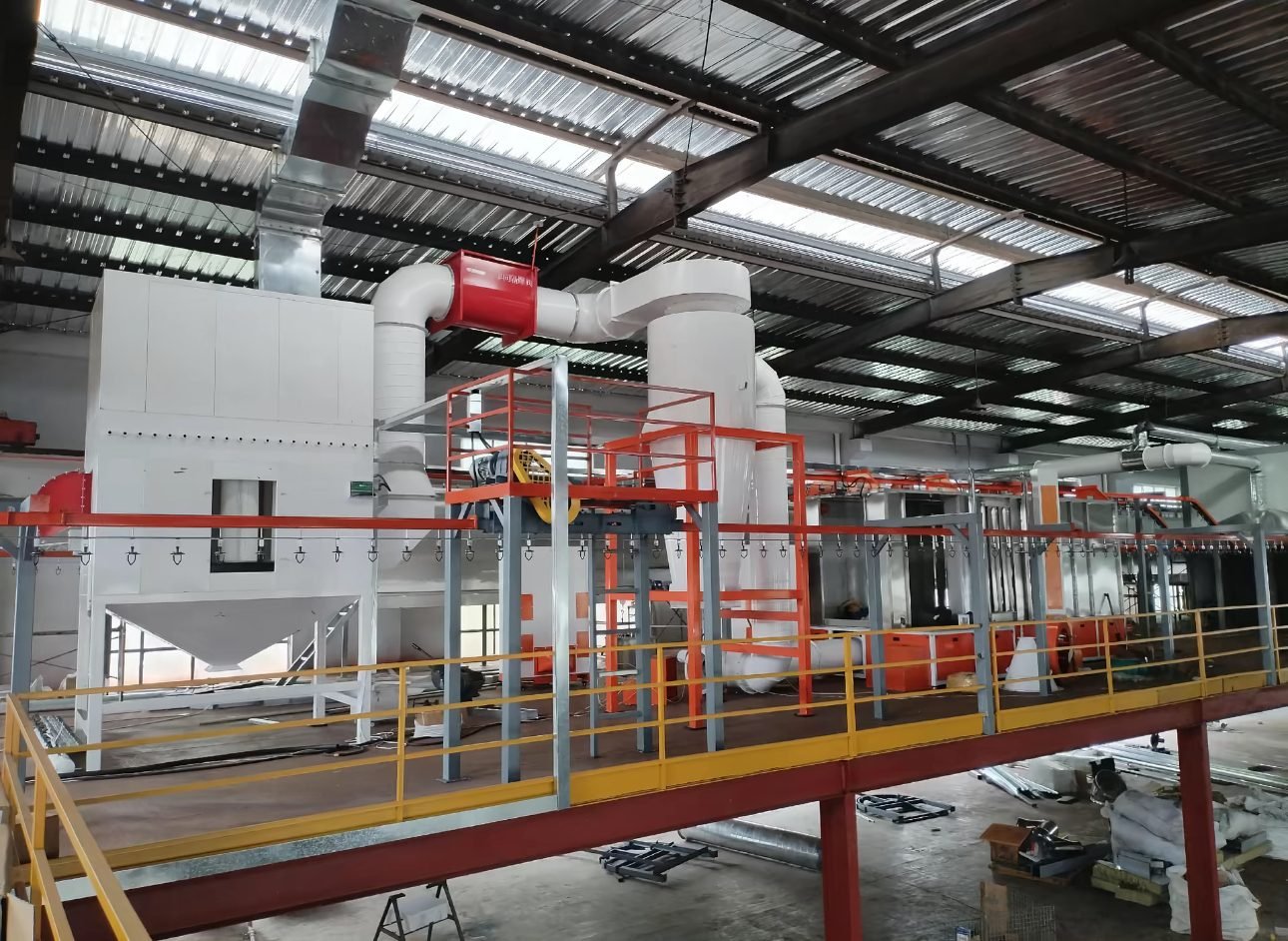
Sanding and Grinding Booth
A sanding and grinding booth is a ventilated open-front or downdraft enclosure with built-in dust collection for sanding, weld grinding and surface prep before coating. It suits fabricators and coating shops, and is designed around face velocities of roughly 150-200 fpm (0.76-1.02 m/s).
Built for fabrication and coating shops that sand, grind or dress welds on steel, stainless steel, aluminium or composite parts and need the dust captured at the work, away from the paint and powder booths.
Technical Specifications
Values below are typical ranges for this equipment type. The figures for your line are fixed in the written specification after we review your parts, output and site.
| Booth layouts | Open-front crossdraft booth, downdraft table, downdraft floor; cartridge (dry) or wet collection |
|---|---|
| Face velocity, partial enclosure for portable grinding (US reference: OSHA 29 CFR 1910.94(b)(5)(iv)) | Average of not less than 200 fpm (1.02 m/s) |
| Face velocity, enclosure for cradle grinding (US reference: OSHA 29 CFR 1910.94(b)(5)(vi)) | Average of not less than 150 fpm (0.76 m/s), operator outside the opening |
| Capture velocity at the point of dust release | 500-2,000 fpm (2.5-10 m/s) for grinding and abrasive blasting in the ACGIH-based capture velocity table used in ventilation teaching |
| Duct transport velocity (US reference: OSHA 29 CFR 1910.94(b)(3)(ii)) | Recommended minimum 4,500 fpm in the branch and 3,500 fpm in the main (22.9 and 17.8 m/s) |
| Duct velocity for aluminium dust (US reference: NFPA 484, as summarised in trade press) | Held above 4,500 fpm (22.9 m/s) |
| Dry filter efficiency | MERV 15 cartridges or panels quoted by one collector maker for grinding, buffing and polishing; MERV 15 means at least 85 % on 0.3-1.0 µm, 90 % on 1.0-3.0 µm and 95 % on 3.0-10 µm particles (ASHRAE test method, US EPA table) |
| After-filter for recirculated air | HEPA stage, at least 99.97 % on 0.3 µm particles (US EPA definition), where the dust and local rules allow recirculation |
| Wet collector performance | One maker's published figure: 95 % of particulate down to 3 µm at 3 in. w.g. (about 750 Pa) pressure drop |
| Lighting level | 750-1,000 lux for surface preparation and painting in the EN 12464-1 table published by a luminaire maker (EU reference) |
| Noise reference (US) | OSHA permissible exposure limit 90 dBA and action level 85 dBA as 8-hour averages; sound-absorbing panels reduce reflected grinder noise |
Booth Configuration
- Steel panel enclosure, open-front or with curtains or doors, with sound-absorbing perforated wall and ceiling panels as an option
- Extraction wall, downdraft table or floor grating with spark baffle or pre-separator ahead of the filters
- Cartridge filter module with pulse-jet compressed-air cleaning and dust drawer or bin, or a wet collector with water tank and sludge removal for combustible metal dust
- Exhaust fan with motor and silencer, with ducting to atmosphere or a return-air section with after-filter
- Sealed LED light fixtures in the ceiling and side walls
- Control panel with fan starter, differential-pressure gauge across the filters and pulse controller, plus explosion venting or isolation where the dust hazard analysis calls for it
Which type of sanding and grinding booth fits the work?
An open-front crossdraft booth suits large fabrications that are ground in place; a downdraft table suits small parts; a downdraft floor suits long parts worked from all sides. The table compares the three layouts.
| Booth type | Air path | Strengths | Limits | Typical use |
|---|---|---|---|---|
| Open-front crossdraft sanding booth | Shop air enters the open face, passes the operator and part, and leaves through the filter wall at the rear | No pit; easy loading by crane or trolley; one booth handles many part sizes | Operator must stand so that dust travels away from the breathing zone; needs the full face airflow | Weld grinding on frames and fabrications, body filler sanding, prep before painting |
| Downdraft table | Air is drawn down through a perforated or grated work surface | Dust pulled away from the face; compact; can be moved | Part must fit on the grate with margin (one supplier advises 6 in. on every side); large flat parts blank off the grate | Small castings, brackets, deburring, hand sanding |
| Downdraft floor booth | Air enters at ceiling or open sides and leaves through floor gratings to the collector | Even capture around long or tall parts; operator can walk round the work | Needs a pit or raised floor; gratings must be kept clear | Composite and aluminium sanding, vehicle and trailer bodies, blades |
Which dust collection method suits each dust type?
Ordinary steel grinding dust is collected dry on pulse-cleaned cartridges; aluminium, titanium and magnesium dusts are combustible metals with special rules under NFPA 484 in the US, where wet collection is the usual indoor solution. A dust hazard analysis (NFPA 652 concept, US reference) and the local code decide the final design.
| Dust type | Collection method | Special precautions (US references as summarised in trade press) |
|---|---|---|
| Carbon steel and stainless steel grinding dust with sparks | Cartridge collector with spark baffle or pre-separator | Keep sparks off the filter media; flame-retardant media as an option; stainless steel fume and dust may need a HEPA after-filter under local exposure rules |
| Aluminium | Wet collector indoors near the point of dust generation, or a dry collector located outdoors with deflagration vents | Duct velocity above 4,500 fpm; no recirculation of exhaust air from dry systems; collected solids removed daily |
| Titanium | Wet collector; media (filter) collectors are not permitted | Dry cyclones only outdoors; stored dust limited to five gallons; spark-resistant fan |
| Magnesium | Wet collector with ventilated sump | Dust concentration kept below 25 % of the minimum explosible concentration; duct velocity may be as low as 3,500 fpm |
| Mixed metals | Separate collectors for each metal | Never collect different metals in one unit, some combinations can react (thermite); bond and earth all ducting |
| Paint, filler and composite sanding dust | Cartridge collector, fine-dust media | Organic dusts can be combustible; assess explosion venting or isolation in the dust hazard analysis |
| Fine hazardous dusts under European vacuum and extraction classes | Dust class M or H equipment to EN 60335-2-69 | UK HSE advises class H or M units, fitted with low-flow indicators, for higher-toxicity dusts |
How is the airflow of a grinding booth sized?
Airflow equals the open face area multiplied by the design face velocity; the duct is then sized so that the air keeps a transport velocity that stops dust settling. Generic worked example only, not a quotation: an open-front booth with a face 3.0 m wide and 2.4 m high, main duct sized at 3,500 fpm (17.8 m/s).
| Design face velocity | Open face area | Exhaust airflow | Main duct at 3,500 fpm |
|---|---|---|---|
| 150 fpm (0.76 m/s), the OSHA figure for a cradle grinding enclosure | 3.0 x 2.4 m = 7.2 m² (78 ft²) | 19,800 m³/h (11,630 cfm) | about 630 mm (25 in) diameter |
| 200 fpm (1.02 m/s), the OSHA figure for a partial enclosure for portable grinding | 3.0 x 2.4 m = 7.2 m² (78 ft²) | 26,300 m³/h (15,500 cfm) | about 720 mm (28 in) diameter |
Components
Component selection follows the dust type and the result of the dust hazard analysis. Key components are available from international brands such as Donaldson, Camfil and Nederman for filter cartridges and collector modules, ebm-papst and Ziehl-Abegg for fans, and Siemens, Allen-Bradley and Mitsubishi Electric for PLC and HMI (configurable per customer specification).
Application References
Used for weld grinding on steel frames and fabrications, sanding of body filler and primer on vehicle, bus and trailer bodies, deburring of castings and machined parts, aluminium and stainless steel finishing, and composite or wood sanding ahead of painting or powder coating.
Engineering Commitment
Every line is engineered against a written performance specification. Line speed, cure profile, film build and emission level are stated in the contract and demonstrated on your own part at the factory trial run before shipment. One engineering team owns the whole chain — pretreatment, application, curing, conveying and emission control — so the trade-offs between them are settled on the drawing board, not on your factory floor.
Service & Delivery
Standard configurations ship in 30-60 days with a 12-month full-machine and 36-month critical-component warranty. On-site installation, commissioning and operator training are available worldwide, and process tuning and spare parts support continue for the working life of the line.
Frequently Asked Questions
What is the difference between a sanding booth and a paint spray booth?
A sanding or grinding booth is a dust collection booth: it captures dry particles on cartridge filters or in a wet collector. A paint spray booth handles wet overspray and solvent vapour and is designed to hazardous-area rules for flammable liquids. The two should not share filters or exhaust, and prep dust is kept out of the paint booth.
Can the air from a grinding booth be returned to the workshop?
It depends on the dust and the local rules. Recirculation saves heating energy and is common with steel dust when a high-efficiency after-filter is fitted. For aluminium, trade summaries of NFPA 484 (US) state that exhaust air from dry collectors must not be recycled, while wet collectors may return air.
Why is a wet dust collector used for aluminium and titanium grinding?
Aluminium and titanium dusts are combustible metals. US practice under NFPA 484, as summarised in the trade press, allows wet collectors indoors close to the dust source, restricts dry collectors for aluminium to outdoor locations with deflagration vents, and does not permit media collectors for titanium. Wet metal dust still needs sludge removal and ventilation because it can release hydrogen.
How does pulse-jet cleaning work on a cartridge dust collector?
Short bursts of compressed air are fired down the clean side of each cartridge in turn. The pulse flexes the media and knocks the dust cake into the drawer or bin below while the fan keeps running. A differential-pressure controller can trigger cleaning only when the filters need it, which saves compressed air.
What face velocity does a weld grinding booth need?
US OSHA 29 CFR 1910.94(b) gives an average of not less than 200 fpm for a partial enclosure used for portable grinding and not less than 150 fpm for a cradle grinding enclosure. Many national rules differ, so the design value is agreed with the customer's safety adviser before the fan is sized.