Telescopic Spray Booth Safety: Dual Drives, Limit Switches and Explosion-Proof Lighting
Quick answer: A telescopic booth is a moving structure in a solvent atmosphere, so it needs two kinds of protection: mechanical safety for the travel (two interlocked geared motors, double limit switches at each end, automatic drift correction, chain-linked anti-slip drive wheels, rail sweepers, jog-only control with sound and light warning) and explosion protection inside the enclosure (Ex-rated LED lighting to 300 lux or more, Ex drives and warning lamps, flame-retardant fabric, rubber-sheathed cable). These are the items to check on any supplier drawing.
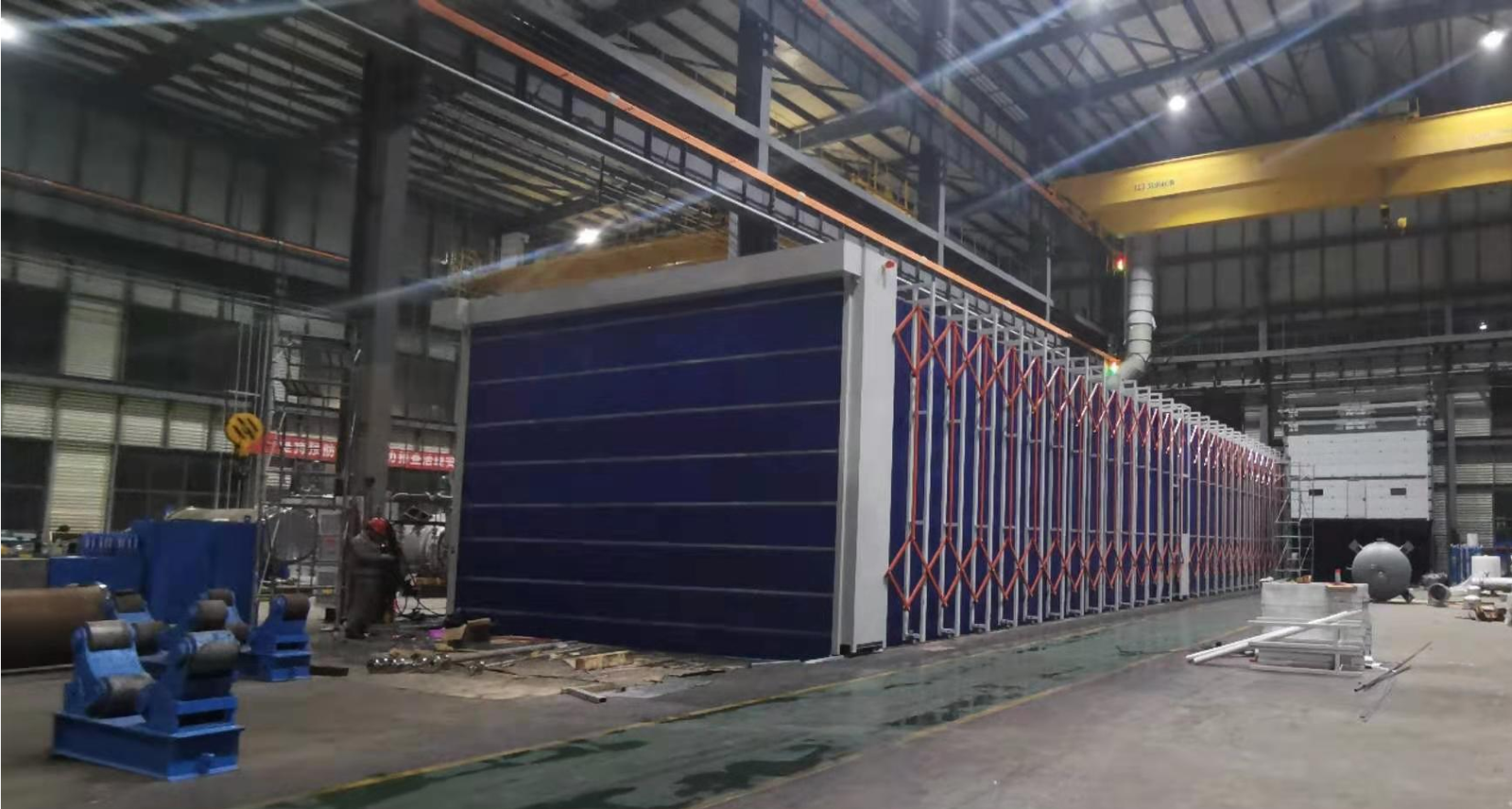
Why two drives, and why interlocked?
Each side of the booth has its own geared motor so the wide frame is pushed from both rails. The two are electrically interlocked: if one trips, the system alarms and the other cannot start, so the frame is never dragged from one side and twisted off the rail. The motors sit under the drive beam behind removable warning panels, so they can be reached for maintenance without lifting the frame.
How do double limit switches work?
At the open and closed positions each side carries two limit switches in series with a stop block. The first switch stops the drive; if it fails, the second still trips. The stop blocks on the two sides are aligned during installation, which gives the booth its drift correction: if one side arrives first it stops and waits while the other catches up, so any creep during travel is cleared at every end of stroke instead of accumulating.
What stops the wheels slipping or derailing?
Each drive has two driven wheels, one ahead of the other, linked by chain; if one begins to slip, the other holds it. A sweeper blade in front of the drive wheel pushes bolts, weld spatter and grit off the rail. Rails are 12 kg/m light rail on a levelled foundation for large booths, or flat bar laid on the floor for small ones.
Why jog control?
The booth moves only while the operator holds the button, so it cannot travel unattended. An audible and visual alarm runs during travel. The cabinet also carries phase-loss, short-circuit, overload and under-voltage protection and an emergency stop, and is installed outside the painting zone.
What explosion protection is needed inside?
Lighting is explosion-protected LED (18 W units, 60-100 per booth) giving 300 lux or more evenly over the work, mounted in the roof and sides. The drive motors, warning lamps and any socket inside the enclosure are Ex-rated. The fabric is a flame-retardant PVC that folds in order and is protected by buffer blocks between frames. Cables inside are flexible rubber-sheathed types rated for repeated flexing, with a service life of five to eight years.
| Item | Standard provision |
|---|---|
| Drive | 2 geared motors, interlocked |
| End stops | 2 limit switches per side per end |
| Drift | aligned stop blocks, cleared each cycle |
| Wheels | chain-linked twin drive wheels |
| Rail | sweeper ahead of drive wheel |
| Control | jog only, alarm during travel, E-stop |
| Lighting | Ex LED, 300 lux or more |
| Fabric | flame-retardant PVC, fold guards |
FAQ
What standards are referenced? Our proposals cite the Chinese painting safety codes GB14444 and GB6514, the Ex equipment code GB3836 and the workplace exposure limits GBZ2.1; equivalent local codes apply at the installation site.
Is there a fire suppression requirement? The enclosure itself is not a fire-rated room; fire protection follows the plant rules, and the fabric and lighting are chosen not to be an ignition source.
Can the booth be moved with a part inside? The frames clear the part on its stands; the booth is normally moved only when the floor around the part is clear.
What if the power fails mid-travel? The drives stop where they are; the booth is driven on again when power returns, and the end stops re-align the sides.
Where MUSI Technology fits
MUSI builds these provisions into every telescopic booth and lists them item by item in the specification, so they can be checked at the factory trial and at commissioning. Product details, typical sizes and the quotation checklist are on the telescopic mobile spray booth page.
Provided by Lin Cong, Technical Director, MUSI Technology
Send us your part size, throughput and coating type — our engineers reply with a layout and budget within one working day. Contact MUSI Technology or browse our equipment range.
Related technical guides
- Coating Line Conveyor Types Compared (2026)
Overhead chain, floor belt, power-and-free and inverted conveyors compared on part weight, throughput, buffering, floor space and 2026 cost per metre. - Shipping Container Coating Line: Spec & Layout
Container coating is a C5-M marine job run at production speed. Coat sequence, film build, blast and booth sizing, cycle time per box and 2026 plant cost. - Powder Coating vs Liquid Spray: Which to Choose
Powder coating vs liquid spray compared on cost, film thickness, colour range, VOC emissions, substrate limits and best-fit applications. - Robotic Spray Painting vs Reciprocator: ROI
A six-axis paint robot costs 3-6 times a reciprocator but raises transfer efficiency to 70-90% and handles mixed models. - Automotive Parts Coating Line: Spec & Throughput
Automotive coating lines must hold film build within plus or minus 10 microns, pass 500-1,000 h salt spray and meet OEM appearance standards.