Installing a Telescopic Spray Booth: Rails, Floor, Power and Exhaust Stack
Quick answer: A telescopic booth needs two levelled rails on a flat floor, a base for the fan and treatment unit at the fixed end, a duct route to a 15 m stack, and a three-phase supply for a 45-110 kW installation. Installation of a 20 m booth takes about one to two weeks after the rails are set, followed by commissioning of the drives, lighting, fan and treatment unit.
Rails and floor
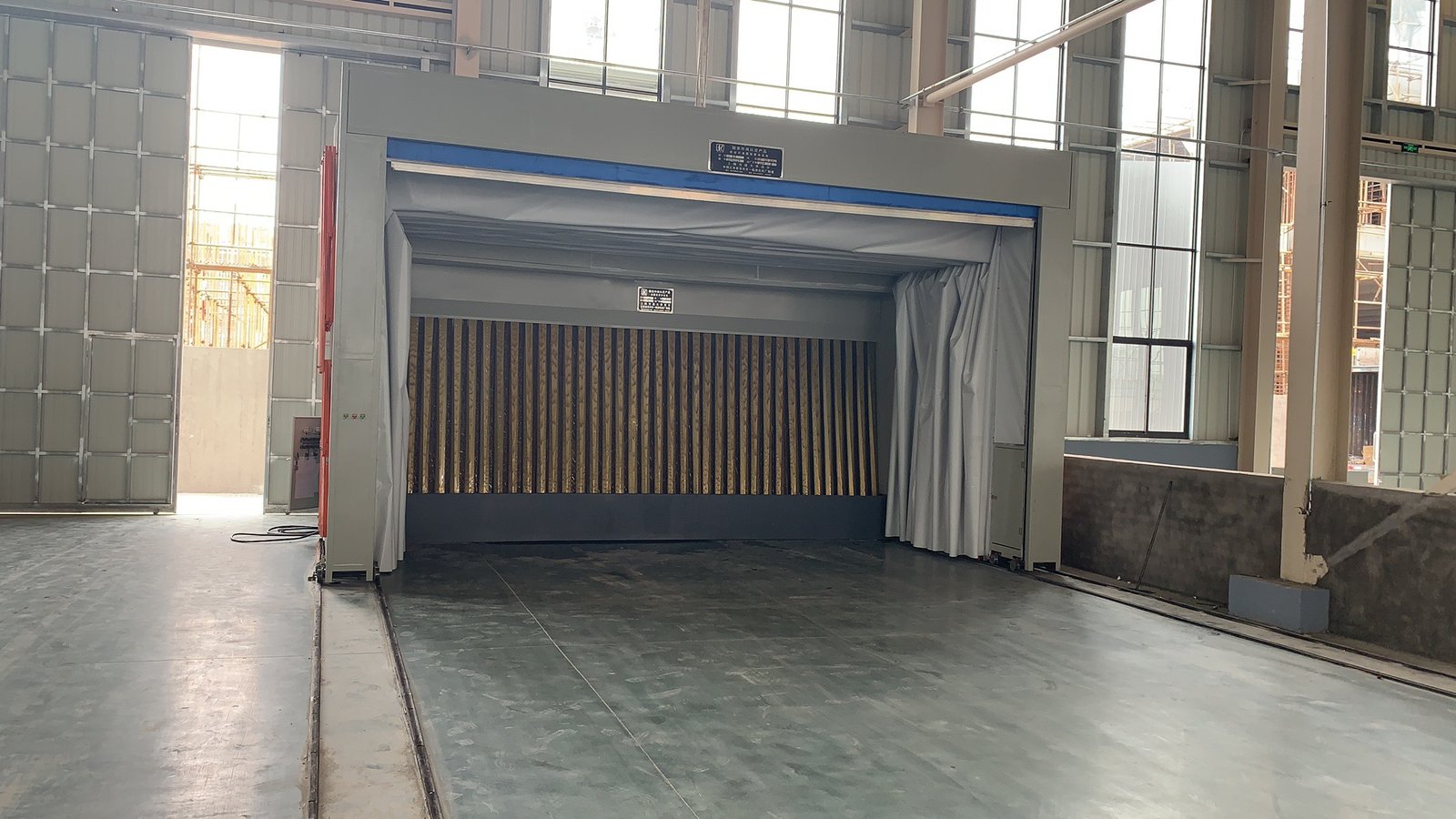
Large booths run on 12 kg/m light rail laid in pairs on a levelled strip; small booths use 20 x 40 mm flat bar fixed to the floor. Rail levelling is the one civil item that decides whether the booth travels smoothly, so it is done by the site to our drawing before the frames arrive, and it is excluded from our scope. The floor between the rails carries the workpiece stands and should be flat enough for the fabric skirt to seal.
Fixed end and ducting
The dry filter cabinet or oil-film units, the exhaust fan on anti-vibration mounts and the carbon, UV or RCO unit stand at the fixed end on a concrete base. Galvanised ducting of 1.0 mm steel with angle-flange joints runs at 12 m/s or less to a stack 15 m above ground with a rain cap; a guyed steel stack is standard. Stack height follows the local rule.
Power and control
Typical installed loads: 75 kW fan, 2 x 1.5 kW drives, 30 kW UV unit and about 1 kW lighting for a 20 m booth (109 kW); or a 45 kW RCO fan with a 60 kW start-up heater for a 12 m oil-film booth. The control cabinet is installed outside the painting zone with two-station control, and the fan is started star-delta or by VFD.
| Item | Responsibility | Note |
|---|---|---|
| Rails | site (levelling to drawing) | we supply rail, site lays and levels |
| Fan and treatment base | site | concrete pad to our loads |
| Stack | MUSI | 15 m guyed, or to local rule |
| Power to cabinet | site | 3-phase, sized to installed kW |
| Lifting on site | site | crane for frames and units |
| Third-party emission test | site | after commissioning |
Installation sequence
Rails checked for level and gauge; fixed end frame and filter cabinet erected; travelling frames assembled on the rails and linked; fabric hung and fold guards fitted; drives, limit switches and stop blocks aligned; lighting and cabling installed; fan, duct and stack erected; treatment unit connected. Commissioning checks travel in both directions with both limit switches, the interlock between drives, cross-draft velocity at 0.3 m/s or more, lighting level of 300 lux or more, noise and, with the treatment unit, inlet and outlet sampling.
FAQ
How long from order to painting? Manufacture typically 30-60 days, installation one to two weeks, commissioning a few days.
Can the booth go on an existing floor? Yes, if it is flat and can carry the rails and frames; the rails are levelled with shims.
Who supplies the crane for installation? The site; the frames and units are lifted with the bay crane.
Is training included? Yes, operators are trained at commissioning on travel, filter change and fan operation.
Where MUSI Technology fits
MUSI provides the foundation and rail drawings with the order, installs and commissions on site, and hands over the operating and maintenance manual with the emission test report. Product details, typical sizes and the quotation checklist are on the telescopic mobile spray booth page.
Provided by Lin Cong, Technical Director, MUSI Technology
Send us your part size, throughput and coating type — our engineers reply with a layout and budget within one working day. Contact MUSI Technology or browse our equipment range.
Related technical guides
- Shipping Container Coating Line: Spec & Layout
Container coating is a C5-M marine job run at production speed. Coat sequence, film build, blast and booth sizing, cycle time per box and 2026 plant cost. - Powder Coating vs Liquid Spray: Which to Choose
Powder coating vs liquid spray compared on cost, film thickness, colour range, VOC emissions, substrate limits and best-fit applications. - Robotic Spray Painting vs Reciprocator: ROI
A six-axis paint robot costs 3-6 times a reciprocator but raises transfer efficiency to 70-90% and handles mixed models. - Automotive Parts Coating Line: Spec & Throughput
Automotive coating lines must hold film build within plus or minus 10 microns, pass 500-1,000 h salt spray and meet OEM appearance standards. - Powder Coating Line: Types, Specs & Cost (2026)
A powder coating line pretreats, coats and cures metal parts on a conveyor. Full guide to line types, key specifications and 2026 price ranges.