Painting Pressure Vessels, Tanks and Heavy Machinery in a Telescopic Spray Booth
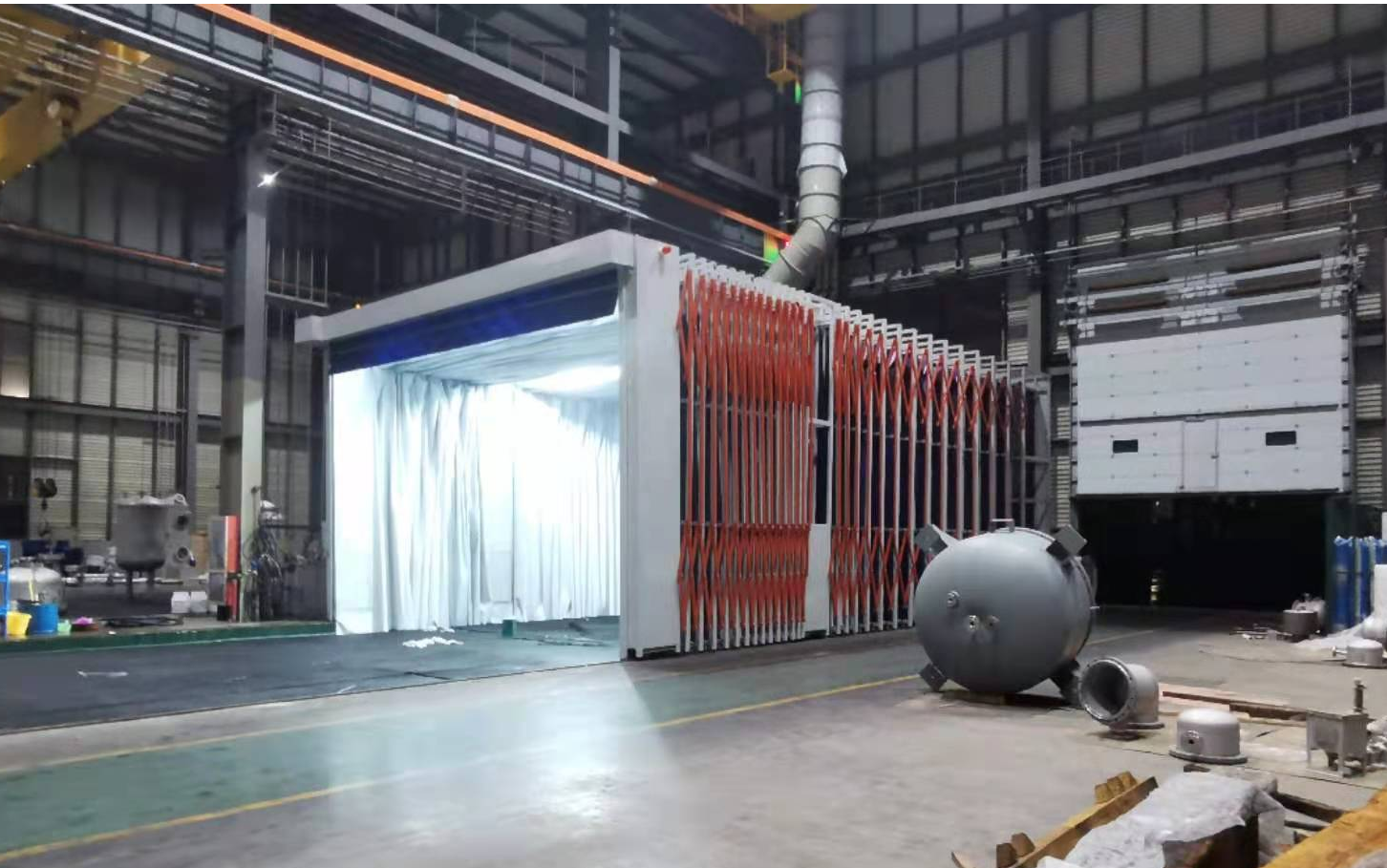
Quick answer: Vessels, tanks, gearbox housings and machine frames are handled by crane and painted in batches, which is exactly the pattern a telescopic booth serves: the part is set on the floor, the booth closes around it, and the fixed end carries an oil-film or dry filter wall with carbon or RCO treatment. Booths of 12 x 7 x 4.5 m with three oil-film units and a 30,000 m3/h RCO are a typical configuration for a vessel shop.
Why crane-only handling matters
A 10 t vessel does not go through a booth door on a forklift. In a fixed booth it needs a rail car and a booth long enough for the car and its approach; the crane runway usually has to be interrupted by the booth roof. A telescopic booth has no fixed roof and no door: the crane lowers the vessel onto saddles inside the rail span and the booth is driven over it.
Which paint mist capture suits vessel shops?
Vessel and machinery shops often paint every day with high-build epoxies, so an oil-film purifier is chosen for the fixed end: paint-laden oil is drained rather than filters thrown away, and the clean air protects the RCO catalyst downstream. Two or three units of 1,800 x 1,800 x 3,450 mm serve a 12-13 m booth. Where painting is intermittent, dry filters remain the simpler choice.
What treatment meets a strict emission limit?
An adsorption-desorption unit with catalytic oxidation (RCO) at 30,000 m3/h: three honeycomb carbon beds, one catalytic bed at 200-300 C, 45 kW adsorption fan, 60 kW start-up heater, PLC control. Treatment efficiency is 95% or more and the carbon is regenerated by the unit’s own heat instead of being replaced.
| Item | Typical vessel-shop configuration |
|---|---|
| Internal size | 12 x 7 x 4.5 m |
| Travel | 8-10 m/min, 2 x 1.5 kW Ex drives |
| Mist capture | 3 oil-film units, 98% or more |
| Treatment | RCO 30,000 m3/h, 95% or more |
| Stack | 15 m |
| Lighting | Ex LED, 300 lux or more |
Can one booth serve several products?
Yes; that is the main economic argument. The same booth paints vessels one week and machine frames or crane girders the next, because nothing in the enclosure is shaped to the part. Plants with two product lines in separate bays have run two booths, an 8 m2 and a 20 m2 one 30 m apart, on a single shared RCO.
FAQ
Can the booth cover a vessel on a rotator? Yes, if the rotator sits inside the rail span and below the frame clearance; rotating the vessel inside the booth lets one painter reach the full circumference.
What about internal painting? Internal coating uses the vessel's own ventilation; the booth captures the external overspray.
Do you supply the saddles and stands? On request; they are simple fabrications sized to the parts.
How much floor is needed? The extended footprint plus the fixed-end equipment; the retracted booth frees about 85% of that floor.
Where MUSI Technology fits
MUSI configures telescopic booths with oil-film purifiers and RCO units for vessel, tank and machinery builders, and can add a separate drying room when the schedule needs forced cure. Product details, typical sizes and the quotation checklist are on the telescopic mobile spray booth page.
Provided by Lin Cong, Technical Director, MUSI Technology
Send us your part size, throughput and coating type — our engineers reply with a layout and budget within one working day. Contact MUSI Technology or browse our equipment range.
Related technical guides
- Industrial Dust Collection Systems: Sizing & Cost
An industrial dust collector keeps coating and blasting shops under the 10-20 mg/m3 particulate limit. Types, airflow sizing formulas and 2026 cost ranges. - Aluminium Profile Coating Line: Vertical vs Horizontal
Vertical aluminium profile coating lines handle 6-7 m extrusions with less handling damage and a smaller footprint; horizontal lines cost less and suit. - Blasting Media Selection Guide: Which Abrasive?
Which abrasive for which job: steel shot and grit, garnet, aluminium oxide and glass bead compared on hardness, profile produced, reuse cycles,. - Sandblasting & Shot Peening Equipment Guide 2026
Compare rotary table, hook type, tumble belt and roller conveyor blast machines: working principle, specifications, applications and cost ranges. - Importing a Coating Line from China: Full Guide
What it takes to import a spray coating line from China: container count, Incoterms, typical payment terms, customs codes, installation time on site and.