Iron Phosphate vs Zinc Phosphate Pretreatment for Powder Coating
Quick answer: Iron phosphate is a thin amorphous conversion coating of about 20-70 mg/ft² (0.2-0.75 g/m²) applied in three or five stages at 32-60 °C. Zinc phosphate is a crystalline coating of about 100-300 mg/ft² (1.1-3.2 g/m²) for spray pre-paint work that needs six to eight stages, a conditioning rinse, sludge filtration and heavy-metal wastewater treatment. Products Finishing gives 250-500 hours of salt spray for iron phosphate on steel and about 750 hours for zinc phosphate, both depending on the complete coating system. Iron phosphate fits indoor and general industrial work; zinc phosphate fits automotive, outdoor and galvanized parts.
MUSI Technology, a powder and liquid spray coating line manufacturer in Changzhou, China, builds spray and immersion pretreatment sections for either chemistry, sizing each stage from contact time and conveyor speed and adding the conditioning stage, stainless steel phosphate tank, sludge filtration loop and deionised rinse that a zinc phosphate process needs.
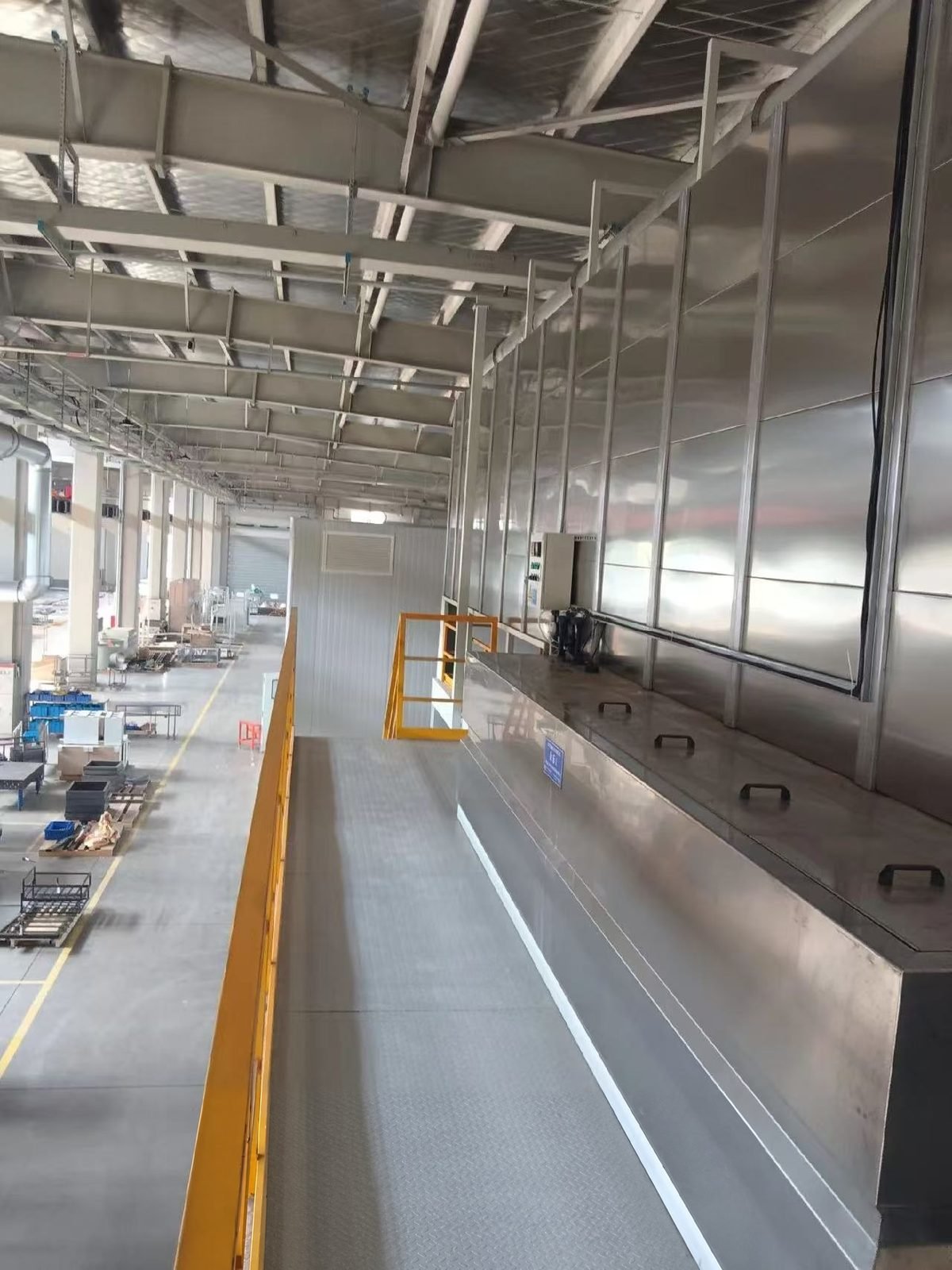
What is the difference between iron phosphate and zinc phosphate?
Iron phosphate is a thin, amorphous conversion coating and zinc phosphate is a heavier, crystalline one; both are pre treatment for powder coating that improve adhesion and slow under-film corrosion. An iron phosphate coating looks blue to iridescent and forms from a mildly acidic bath that can clean and coat in the same stage. Zinc phosphate deposits zinc phosphate crystals from a more complex bath, often modified with nickel and manganese, and needs a conditioning rinse first so that the crystals stay fine and dense. Products sold as zinc-iron phosphate sit inside the zinc family and should be judged from the supplier data sheet.
| Item | Iron phosphate | Zinc phosphate |
|---|---|---|
| Coating structure | Amorphous, blue to iridescent | Crystalline, grey |
| Phosphate coating weight | 20-70 mg/ft² (about 0.2-0.75 g/m²); 25-50 mg/ft² is a common working range | 100-300 mg/ft² (about 1.1-3.2 g/m²) for spray pre-paint work; 300-500 mg/ft² for immersion to TT-C-490 Type I |
| Typical number of stages | 3 or 5 | 6 to 8, including conditioning and passivation |
| Bath temperature | 32-60 °C (90-140 °F); 50-60 °C on one supplier data sheet | 48-55 °C on one supplier data sheet |
| Bath acidity | pH 3.5-5.0 (combined clean and coat) or 4.5-5.5 | Controlled by free acid and total acid points, not by pH alone |
| Conditioning (activation) rinse | Not required | Required for fine, uniform crystals |
| Sludge | Light; periodic removal | Continuous; filtration or filter press |
| Substrates | Steel; also zinc-coated steel and aluminium, with a fluoride additive when their share is high | Steel, galvanized steel, zinc-nickel coated steel |
| Published salt spray guide (steel, under paint) | 250-500 h | About 750 h; up to 1,000 h over galvanized steel |
| Wastewater | Phosphate, neutralisation, oil removal | Zinc, nickel and manganese precipitation plus phosphate |
The salt spray figures are a published guide from Products Finishing and depend on the full system: cleaning, rinse water quality, seal rinse, powder chemistry and film thickness. They are not a guarantee for any line.
How many stages does each phosphate process need?
Iron phosphate runs in three or five stages, while zinc phosphate needs six to eight because it adds a conditioning rinse, a passivating rinse and a deionised water rinse. The extra tanks, heating and pumps are the main reason a zinc line is longer; the pretreatment washer page shows how stage length follows contact time and conveyor speed.
| Stage | 3-stage iron phosphate | 5-stage iron phosphate | Zinc phosphate (spray) |
|---|---|---|---|
| 1 | Clean and phosphate, 90 s, 90-140 °F, pH 3.5-5.0 | Alkaline clean, 90 s, 90-140 °F | Alkaline clean |
| 2 | Rinse, 30 s | Rinse, 30 s, ambient | Rinse |
| 3 | Seal rinse, 30 s | Iron phosphate, 60 s, 90-140 °F | Conditioning (titanium phosphate activator) |
| 4 | Rinse, 30 s, ambient | Zinc phosphate, 60-180 s, 48-55 °C, 0.8-2.0 bar | |
| 5 | Seal rinse, 30 s, 70-140 °F | Rinse | |
| 6 | Passivating (seal) rinse | ||
| 7 | Deionised water rinse | ||
| 8 | Dry-off (optional stage on the supplier sheet) |
Coating weight rises with the stage count on iron phosphate: published guidance gives 20-40 mg/ft² for a three-stage washer and 40-70 mg/ft² for five stages.
Which should be specified: iron phosphate vs zinc phosphate?
Iron phosphate suits indoor and general industrial products on steel, and zinc phosphate is specified where the part lives outdoors, carries an automotive or military specification, or is made of galvanized steel. A heavier phosphate coating weight is not automatically better under powder; consistency of the layer matters more than the figure, and the powder film has to match the exposure as well, with about 50 µm quoted for indoor work and 75 µm or more outdoors.
| End use | Usual choice | Reason |
|---|---|---|
| Indoor furniture, shelving, enclosures, appliances | Iron phosphate, 3 or 5 stages | Adequate adhesion and corrosion resistance with a short washer and simple effluent |
| General industrial steel fabrications | Iron phosphate, 5 stages with seal and DI rinse | Published guide of 250-500 h salt spray, depending on stages and sealer |
| Automotive parts, agricultural and irrigation equipment | Zinc phosphate | Published guide of about 750 h on steel |
| Galvanized steel for outdoor use | Zinc phosphate | Described as most effective over galvanized, up to 1,000 h |
| Work to US federal specification TT-C-490 | Zinc phosphate, Type I | Coating weight and grain refinement are written into the specification |
| Mixed steel and aluminium loads | Iron phosphate with fluoride additive, or thin-film zirconium | Zinc phosphate data sheets list steel and zinc-coated steel |
Thin-film zirconium conversion coatings are the phosphate-free alternative to both processes; that choice is covered separately in phosphate vs zirconium pretreatment. Galvanized parts also need attention to outgassing, described in the article on pinholes and outgassing.
Which line settings and tests keep a phosphate bath in control?
An iron phosphate bath is controlled by one titration and a pH reading, and a zinc phosphate bath by three: free acid, total acid and accelerator. Both are confirmed by a coating weight test, in which a treated panel is weighed, stripped and weighed again; ISO 3892 describes the gravimetric method.
| Parameter | Iron phosphate | Zinc phosphate | How it is checked |
|---|---|---|---|
| Concentration | 10-30 g/L; total acid 4.1-12.3 points (supplier sheet) | Total acid 16-24 mL | Titration with 0.1 N sodium hydroxide, phenolphthalein endpoint |
| Free acid | Not normally run | 0.6-0.9 mL | Titration of a 10 mL sample to the bromophenol blue endpoint |
| Accelerator | Built into the product | 1.0-2.5 mL gas volume (nitrite type) | Gas evolution test with sulfamic acid |
| pH | 4.5-5.5 (start at 4.5-4.8) | Not the primary control | pH electrode |
| Temperature | 50-60 °C | 48-55 °C | Tank sensor and PLC loop |
| Spray pressure | 1-2 bar | 0.8-2.0 bar | Riser gauge |
| Coating weight | 0.2-0.4 g/m² on cold rolled steel | To supplier or customer specification | Weigh, strip, reweigh (ISO 3892) |
| Sludge | Periodic clean-out | Continuous filtration or filter press | Visual, nozzle inspection |
On the equipment side this means a heated, insulated stainless steel phosphate tank (grades 1.4401, 1.4541 or 1.4571 are named for zinc phosphate), a separate conditioning stage placed directly before the zinc stage, a sludge settling or filtration loop, and dosing pumps tied to the titration results. Key components are available from international brands such as Henkel Bonderite and Chemetall (Gardobond phosphating and Gardolene activation) for the chemistry (configurable per customer specification). A wider view of the line is in the powder coating line guide.
What wastewater does each phosphate process create?
Iron phosphate effluent is mainly phosphate and removed oil and needs neutralisation, while zinc phosphate effluent also carries zinc, nickel and manganese that must be precipitated before discharge. One analysis of zinc phosphate sludge reports about 20 % iron, 8 % zinc and 45 % phosphate, which is why it is filtered out and disposed of as a separate waste. As a reference, the US metal finishing pretreatment standards (40 CFR 433) cap zinc at 2.61 mg/L daily maximum and 1.48 mg/L monthly average, and nickel at 3.98 and 2.38 mg/L. Local permits set the binding figures, and many also limit phosphate or total phosphorus.
FAQ
Is zinc phosphate always better than iron phosphate under powder coating? No. Zinc phosphate gives longer published salt spray life, but it needs more stages, tighter bath control, sludge removal and heavy-metal wastewater treatment. For indoor products on steel, a well-run five-stage iron phosphate washer with a seal rinse usually meets the requirement.
What phosphate coating weight should a powder coating line aim for? Published ranges are 20-70 mg/ft² for iron phosphate and 100-300 mg/ft² for spray zinc phosphate. A uniform layer inside the supplier’s range matters more than a high figure, because an inconsistent coating harms corrosion performance more than a lighter one.
Why does zinc phosphate need a conditioning rinse? The conditioning or activation rinse, usually a titanium phosphate dispersion, leaves crystallisation nuclei on the metal. Zinc phosphate crystals then grow fine and dense in a short contact time. Without it the crystals are coarse and coverage is uneven.
Can iron phosphate be used on aluminium and galvanized steel? Yes, within limits. One supplier data sheet lists steel, galvanized steel and aluminium, and calls for a fluoride additive when aluminium or galvanized parts exceed about 10 % of the load. Iron phosphate mainly cleans and etches these metals.
Where MUSI Technology fits
MUSI Technology designs the pretreatment section together with the dry-off oven, booth and cure oven, so the number of stages, tank materials and rinse water quality match the chemistry the customer’s supplier specifies. Details are on the pretreatment washer page; drawings and corrosion targets can be sent through the contact page.
Provided by Lin Cong, Technical Director, MUSI Technology
Send us your part size, throughput and coating type — our engineers reply with a layout and budget within one working day. Contact MUSI Technology or browse our equipment range.
Related technical guides
- Quick Colour-Change Powder Booth: 15-Min Changeover
Quick colour-change powder booths switch colour in 10-25 minutes instead of 60-120. Booth materials, cyclone versus cartridge recovery, cost per. - Wheel & Chassis Powder Coating Line: Spec & Cost
Wheels and chassis parts carry the toughest corrosion and appearance specs in automotive finishing. Coat stack, filiform and salt spray targets, line. - VOC Treatment: RTO vs RCO vs Carbon vs Rotor
Compare RTO, RCO, activated carbon adsorption and zeolite rotor concentrators for spray coating line VOC treatment: efficiency, cost and best fit. - Complete Coating Line Cost: 2026 Budget Guide
A complete powder coating line costs USD 45,000 for a semi-automatic setup to USD 2,000,000 for a fully automated plant. - Spray Booth Filters: Types, Intervals & Cost
Paint arrestor, ceiling, intake and exhaust filters compared on efficiency, pressure drop and life. Replacement intervals, how to read a manometer, and.