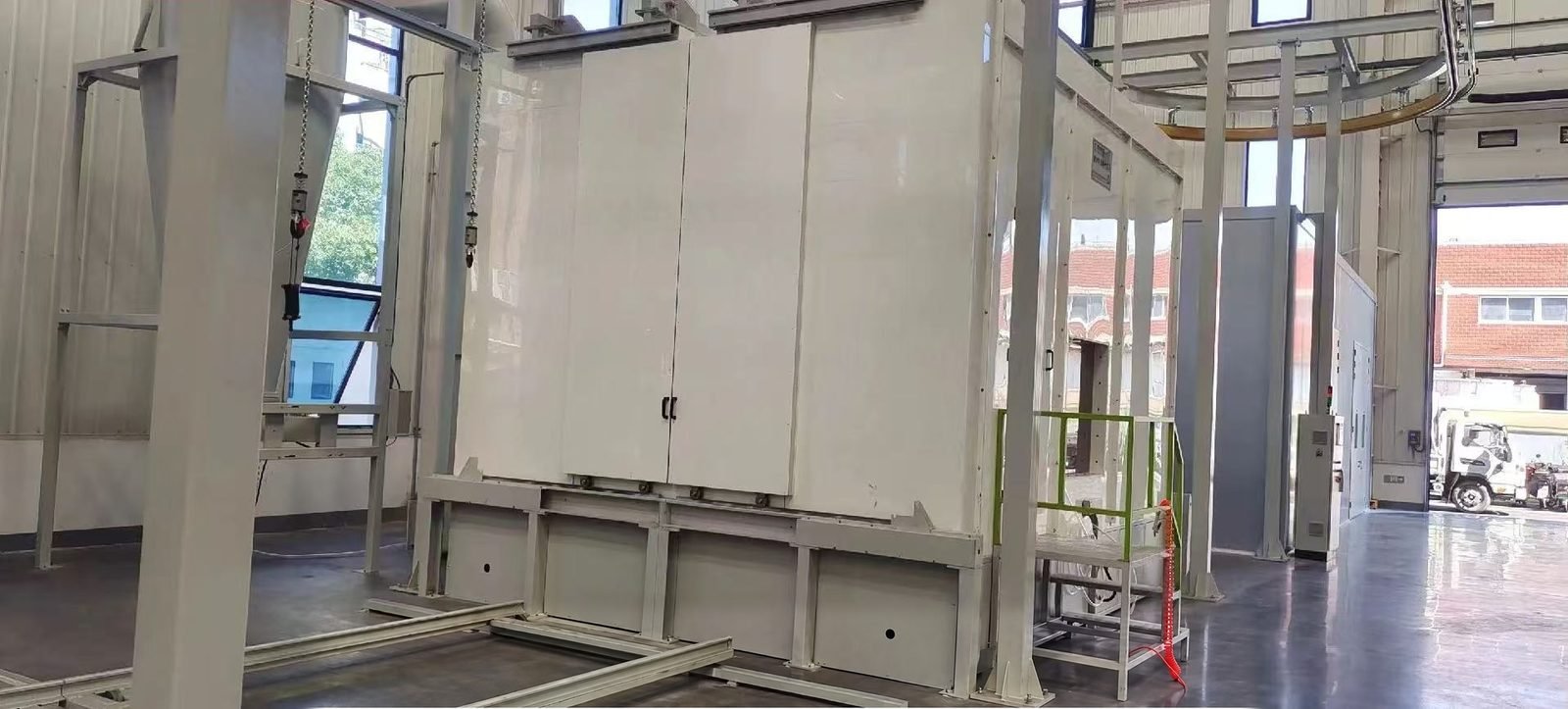
Industrial Paint Spray Booth
An industrial paint spray booth is a ventilated enclosure that captures liquid paint overspray and solvent vapour. It suits manufacturers coating metal, plastic or wood parts, in crossdraft, semi-downdraft, downdraft or open-face layouts designed around roughly 100 fpm (0.5 m/s) air velocity.
Built for manufacturers who spray liquid paint on anything from small batch parts to large equipment and need controlled airflow, overspray capture and a booth sized to the workpiece.
Technical Specifications
Values below are typical ranges for this equipment type. The figures for your line are fixed in the written specification after we review your parts, output and site.
| Airflow layouts | Crossdraft, semi-downdraft, side-downdraft, downdraft and open-face |
|---|---|
| Crossdraft design velocity | Almost always a minimum of 100 fpm (0.51 m/s) across the booth section; open-face booths often 125 fpm (0.64 m/s) |
| Downdraft design velocity | From 30 fpm to over 100 fpm (0.15-0.51 m/s) averaged with the booth empty; 50-100 fpm is typical |
| US reference: OSHA 29 CFR 1910.107(b)(5)(i) | Average of at least 100 linear fpm over the open face or booth cross section; at least 60 fpm for electrostatic spraying |
| US reference: OSHA 29 CFR 1910.94(c)(6), Table G-10 | Velocities into booth openings from 50 to 250 fpm depending on operation, crossdraft and booth size |
| Vapour concentration limit | Exhaust volume sufficient to keep solvent vapour to 25 % of the lower explosive limit or below (US OSHA 1910.94(c)(6)(ii); also NFPA 33 and the International Fire Code) |
| Downdraft air volume | 20-40 % more air than a crossdraft booth of the same size |
| Exhaust filter capture | At least 98 % of paint overspray, tested to ANSI/ASHRAE 52.2 (US EPA 40 CFR 63.11173); water wash booths are exempt from this filter test |
| Ceiling supply filter | Diffusion media of class M5 to EN 779 / ISO ePM10 50 % to ISO 16890, used at 0.25-0.5 m/s face velocity (one filter maker's published data) |
| Lighting level | 100-150 foot-candles (about 1,080-1,610 lux), the IES recommendation for paint spray booths as reported in the trade press |
| Cure (bake) mode | Air make-up unit discharges at about 140 °F or 160 °F (60 °C or 71 °C) with reduced airflow and up to 80 % recirculation |
Booth Configuration
- Insulated or single-skin steel panel cabin with product doors, personnel door and observation windows
- Supply plenum with pre-filters and ceiling or door diffusion filters
- Exhaust chamber with dry paint-arrestor filter stages or a water wash (water curtain) section with tank, pump and sludge removal
- Exhaust fan and stack with motor and fan rated for the hazardous-area classification of the installation
- Air make-up unit with burner or other heater for spray mode and cure (bake) mode
- Sealed light fixtures behind glass panels, control panel with fan and spray interlocks, pressure gauge across the filters and fire suppression connection
Which airflow type should an industrial spray booth use?
Crossdraft is the usual choice for general industrial work because it needs the least air and no pit; downdraft gives the cleanest finish but needs more air and a floor pit. The table compares the five common layouts.
| Airflow type | Air path | Pit needed | Strengths | Limits | Typical use |
|---|---|---|---|---|---|
| Cross draft paint booth | In through filtered doors or front plenum, horizontally along the part, out through a rear exhaust chamber | No | Lowest airflow, smaller fans and air make-up unit, lower running cost | Overspray can travel across other parts; floor dust can be drawn into the airstream | General industrial finishing, multiple small parts |
| Semi downdraft paint booth | In through a filtered ceiling zone at the front (first 25-30 % of the booth), then diagonally to a rear exhaust | No | Cleaner than crossdraft at lower installed and running cost than full downdraft | Possible dead-air zone near the floor at the front | Budget-limited shops wanting better finish than crossdraft |
| Side downdraft spray booth | In through a full-length filtered ceiling, down over the part, out through exhaust chambers along both side walls | No | More uniform airflow and better contamination control without civil work | Wider footprint, full-ceiling filtration to maintain | Sites that cannot excavate a pit |
| Downdraft paint booth | In through a full filtered ceiling, vertically down around the part, out through a filtered floor pit or raised floor | Yes (pit or raised basement) | Strongest overspray and contamination control; air moves away from the painter | Needs 20-40 % more air; awkward when painting undersides of large items | Vehicles and high-appearance finishes |
| Open face spray booth | Room air drawn in through the open front, across the part, out through filters in the rear wall | No | Simple access for loading; no doors or supply plenum | Uses unfiltered shop air; often designed at 125 fpm | Batch parts, wood and general metal products |
Dry filter spray booth or water wash paint booth?
A dry filter spray booth is the simpler and lower-capital option for most industrial work; a water wash booth suits high paint volumes where filters would load too quickly. Both capture overspray before the air reaches the exhaust fan.
| Point | Dry filter spray booth | Water wash paint booth |
|---|---|---|
| Capture method | Exhaust air passes through paint-arrestor filter stages | Recirculating water curtain or scrubber section collects paint particles continuously |
| Capital cost | Lower | Higher |
| Routine work | Regular exhaust filter changes, which stop production while they are done | Sludge removal by skimmer, centrifuge or manual clean-out, from every few days to monthly depending on paint volume |
| Fits | Low to medium paint volumes and frequent product changes | Large coating quantities, robots and conveyorised high-volume lines |
| Fire aspect | Loaded filters are combustible waste and are protected by sprinklers under US rules | Overspray is wetted, which reduces the fire risk with coatings such as nitrocellulose |
| US EPA 6H filter rule | Filters must show at least 98 % capture | Exempt when operated to the manufacturer's specification |
How is an industrial paint booth sized and its exhaust airflow calculated?
Exhaust airflow equals the booth cross-section the air passes through multiplied by the design velocity. The booth is sized from the largest part plus working clearance: trade guidance for industrial work is at least 2 ft (0.6 m) on height and 5 ft (1.5 m) on width and depth. Generic worked example only, not a quotation: part 2.4 m wide x 1.8 m high x 5.0 m long gives a booth of 3.9 m x 2.4 m x 6.5 m.
| Booth layout (example) | Area the air crosses | Design velocity | Exhaust airflow, m³/h | Exhaust airflow, cfm |
|---|---|---|---|---|
| Crossdraft, enclosed | Face 3.9 x 2.4 m = 9.36 m² (101 ft²) | 100 fpm (0.51 m/s) | 17,100 | 10,080 |
| Open face | Face 3.9 x 2.4 m = 9.36 m² (101 ft²) | 125 fpm (0.64 m/s) | 21,400 | 12,590 |
| Downdraft | Floor 3.9 x 6.5 m = 25.35 m² (273 ft²) | 50 fpm (0.25 m/s) | 23,200 | 13,640 |
Components
Component selection follows the hazardous-area classification and the coating being sprayed. Key components are available from international brands such as ebm-papst and Ziehl-Abegg for fans, including explosion-protected versions, Camfil and Freudenberg Viledon for supply and exhaust filters, Riello, Weishaupt and Maxon for burners, Siemens, Allen-Bradley and Mitsubishi Electric for PLC and HMI, and Wagner and Nordson for spray guns and pumps (configurable per customer specification).
Application References
Used for machinery and large equipment, steel fabrications, vehicle bodies and trailers, agricultural and construction components, furniture and wood products, plastic parts and general sheet-metal products.
Engineering Commitment
Every line is engineered against a written performance specification. Line speed, cure profile, film build and emission level are stated in the contract and demonstrated on your own part at the factory trial run before shipment. One engineering team owns the whole chain — pretreatment, application, curing, conveying and emission control — so the trade-offs between them are settled on the drawing board, not on your factory floor.
Service & Delivery
Standard configurations ship in 30-60 days with a 12-month full-machine and 36-month critical-component warranty. On-site installation, commissioning and operator training are available worldwide, and process tuning and spare parts support continue for the working life of the line.
Frequently Asked Questions
What air velocity does an industrial spray booth need?
US rules are the usual reference. OSHA 29 CFR 1910.107 calls for an average of at least 100 fpm over the open face or cross section of a dry-filter booth, or 60 fpm for electrostatic spraying, and 1910.94 Table G-10 gives 50-250 fpm by operation. Other countries apply their own standards, so the local code should be checked.
Is a downdraft spray booth always better than a cross draft paint booth?
No. Downdraft gives stronger overspray control, but trade data puts its air volume 20-40 % higher, with correspondingly higher capital and operating cost, and it needs a pit or raised floor. Crossdraft is the most common industrial layout and is adequate for many general finishing jobs.
How big should a large equipment spray booth be?
Start from the largest workpiece. Trade guidance for industrial booths adds at least 2 ft to the height and 5 ft to the width and depth, with about 3 ft between parts when several are painted together. Aircraft work uses far larger clearances, with room for lifts or scaffolding.
What lighting and electrical equipment can be used inside a paint spray booth?
Under US OSHA 1910.107 only fixed lighting is allowed, separated from the spray area by sealed glass panels. Fire code summaries require fixtures listed for the hazardous classification, and wiring inside the spray space rated Class I Division 1. Fans, motors and controls are selected to the same classification.
Can the booth also cure the paint?
Yes, with an air make-up unit that has a cure mode. Published unit data shows discharge air of about 140 °F or 160 °F in cure mode with reduced airflow and up to 80 % recirculation. US fire code summaries require a purge period before drying and interlocks that prevent spraying during the cure cycle.