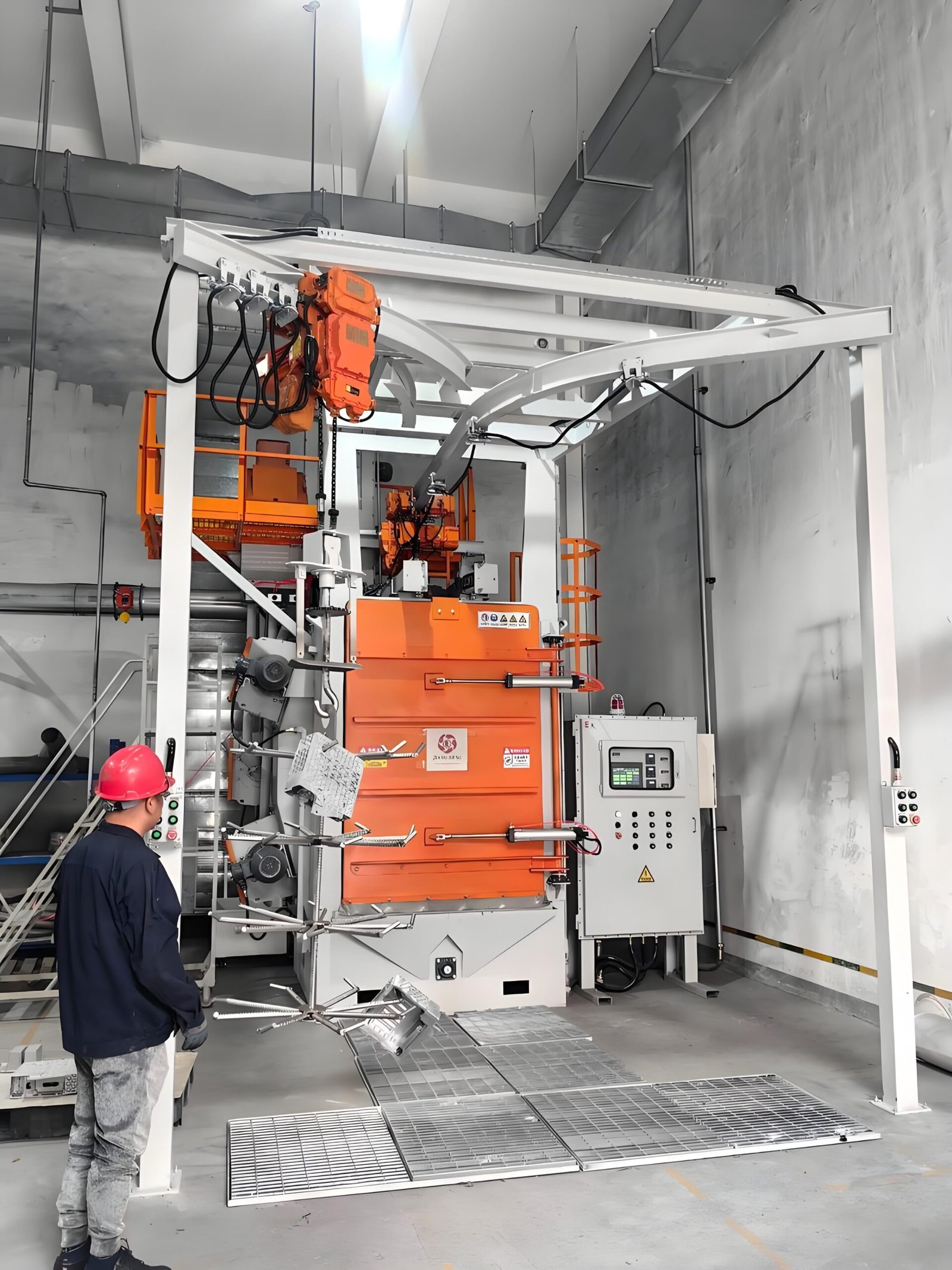
Shot Peening Machine
Wheel and air-nozzle shot peening machines that put a controlled compressive stress layer into springs, gears, shafts and welded or machined parts, with intensity verified on Almen strips and coverage set per drawing.
Built for parts that fail by fatigue rather than by corrosion: the machine is specified by peening intensity, coverage and media, not by cleaning rate.
Technical Specifications
A shot peening machine is specified by the result on the part, so the table lists how intensity, coverage and media are controlled. Cabinet size, number of wheels or nozzles and handling are fixed in the written specification after we review your parts, drawings and output.
| Process | Controlled shot peening: round media strikes the surface and leaves overlapping dimples, which puts the surface layer into compressive residual stress and delays fatigue crack initiation |
|---|---|
| Propulsion | Centrifugal blast wheels for high-volume, repeat parts; compressed-air nozzles on manipulators or robots for complex shapes, bores and local areas |
| Intensity measurement | Almen strips (N, A or C) in holders on a part-shaped fixture; arc height read on an Almen gauge; test strips, holders and gauge to SAE J442 |
| Intensity verification | Saturation curve per SAE J443: intensity is the arc height at the exposure time where doubling the time raises arc height by no more than 10% |
| Coverage | Set per drawing; 100% means the original surface is fully covered by overlapping dimples, 200% is twice the exposure time needed for 100% |
| Media | Cast steel shot, conditioned (rounded) cut wire, glass bead or ceramic bead, chosen by part material and the intensity required |
| Media classification | Size screening plus shape separation, so broken or undersize shot is removed before it reaches the part |
| Media flow and velocity control | Metered media flow per wheel or nozzle; wheel speed by frequency inverter or air pressure by regulator, with recorded setpoints |
| Part handling | Rotating hook, rotary table, satellite table, roller conveyor or robot, selected by part geometry and takt time |
| Process specifications supported | SAE J442 and J443; SAE AMS 2430 (automated peening) and AMS 2432 (computer-monitored peening); legacy MIL-S-13165C / AMS-S-13165 on request |
| Dust collection | Cartridge dust collector sized to the cabinet airflow, with air-wash separation of dust and fines from the media stream |
Almen Strip Selection
Strip type follows the intensity called out on the drawing. Thickness and ranges below are the published figures for certified Almen strips.
| Strip | Thickness | Used for |
|---|---|---|
| N | About 0.76-0.81 mm (0.030-0.032 in) | Arc heights below 0.004 in on the A scale; common with glass and ceramic bead |
| A | About 1.27-1.32 mm (0.050-0.052 in) | Arc heights of 0.004-0.024 in; the standard strip for cast shot and cut wire |
| C | About 2.36-2.41 mm (0.093-0.095 in) | Arc heights above 0.024 in on the A scale; heavy peening |
Published Fatigue Gains from Shot Peening
These are published reference figures, not a guarantee for a specific part; the gain on your part depends on material, geometry and loading and is confirmed by your own fatigue testing.
| Material or part | Published gain | Source |
|---|---|---|
| Aluminium alloys | Fatigue strength up by about 35% | The Open University, OpenLearn |
| Low and medium carbon and low-alloy steels | Fatigue strength up by as much as 50% | The Open University, OpenLearn |
| Connecting rods | Fatigue life up by 75-100% | The Open University, OpenLearn |
Machine Configuration
- Peening cabinet lined with wear plate, with blast wheels or nozzle manipulators positioned for the part family
- Part fixture or handling system that rotates or indexes the part so every specified surface receives the same exposure
- Media recovery, air-wash separator, size classifier and shape separator feeding a storage hopper
- Media flow control valves and wheel-speed or air-pressure control, with setpoints stored per part recipe
- Almen strip holders on a test fixture that matches the part, plus an Almen gauge for arc-height readings
- PLC and HMI with recipe management and process records; cartridge dust collector
Components
PLC and HMI from Siemens, frequency inverters from ABB or Siemens and gear motors from SEW-Eurodrive are available when the customer specifies them. Almen strips and gauges and MagnaValve media flow valves from Electronics Inc. can be fitted on request.
Application References
Coil and leaf springs, torsion bars, transmission and industrial gears, crankshafts, connecting rods and axles, plus welded and machined parts for construction, mining and agricultural machinery where fatigue life decides service life.
Engineering Commitment
Every machine is engineered against a written performance specification. Peening intensity, coverage and media specification are stated in the contract and demonstrated with Almen strips on your own part at the factory trial run before shipment.
Service & Delivery
Standard configurations ship in 30-60 days with a 12-month full-machine and 36-month critical-component warranty. On-site installation, commissioning and operator training are available worldwide, and process tuning and spare parts support continue for the working life of the machine.
Frequently Asked Questions
What is the difference between shot peening and shot blasting?
Shot blasting cleans: it removes scale, rust and old coating and leaves a profile for paint. Shot peening strengthens: round media of controlled size is thrown at a controlled intensity so the surface layer is left in compression. The machines look alike, but a peening machine adds media classification, flow and velocity control and Almen strip verification.
How is peening intensity measured?
With Almen strips. A strip is clamped in a holder and peened on one side; it curves, and the arc height is read on an Almen gauge. Strips are peened for increasing times to draw a saturation curve, and the intensity is the arc height at the point where doubling the exposure time adds no more than 10%.
Wheel peening or air-nozzle peening?
Wheels throw far more media per minute and suit springs, gears and shafts made in volume. Nozzles are slower but can be aimed, so they suit complex parts, bores, fillets and areas that must be peened to a different intensity from the rest of the part.
Which media should I use?
Cast steel shot and conditioned cut wire are the usual choices for steel parts; glass and ceramic bead are used for light intensities, thin sections and where iron contamination must be avoided. Whatever the media, it has to stay round and within size, which is why the machine classifies it continuously.