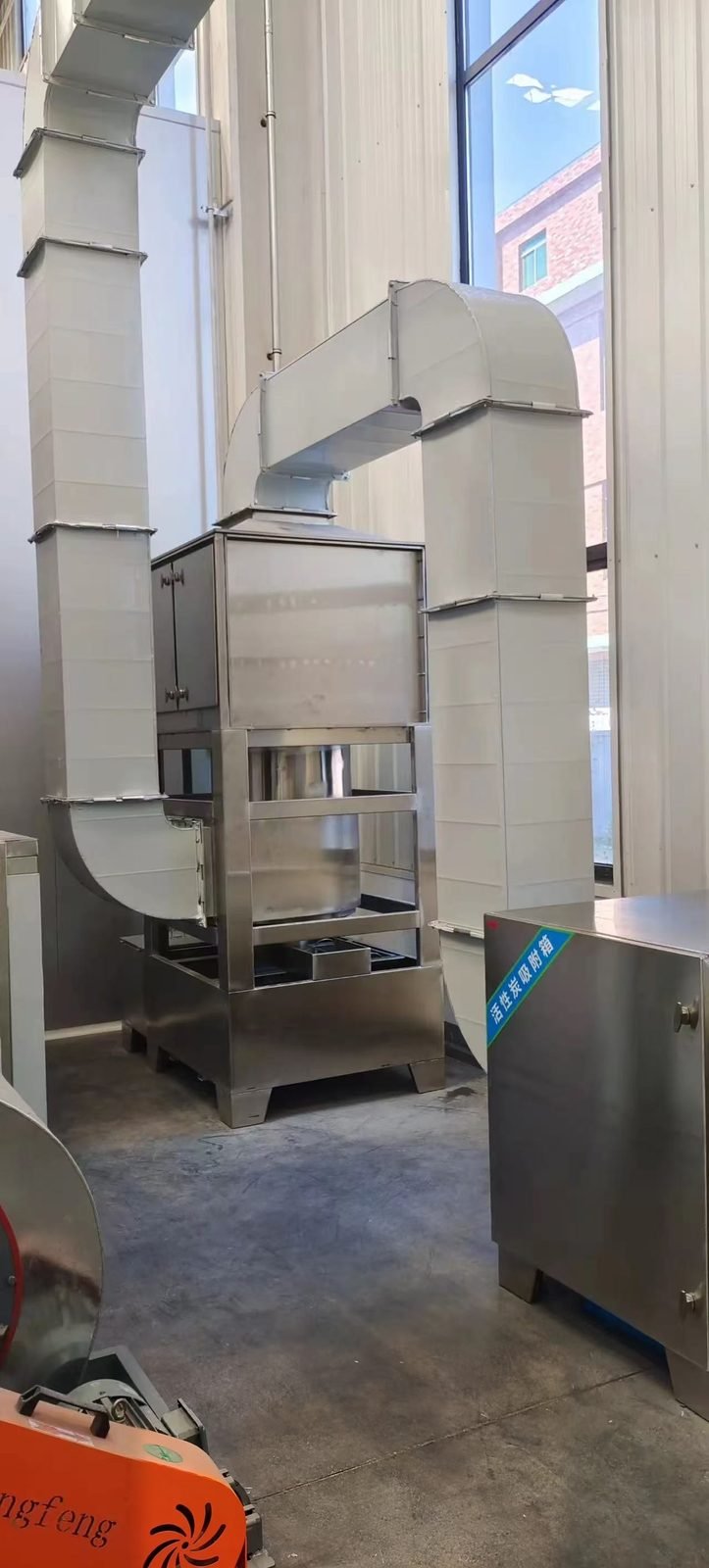
Oil-Film Paint Mist Purifier
Paint overspray capture unit that traps mist on oil-wetted surfaces instead of throw-away filters — 98% or more mist removal, oil drained and refilled on a schedule, and clean air delivered to the carbon or RCO stage behind it. MUSI Technology, based in Changzhou, China, designs and manufactures this equipment in-house and has delivered 800+ coating lines to 36 countries, with on-site installation and operator training included.
Built for booths that paint every day with high-build epoxies and polyurethanes, where dry filters would be changed too often and a water curtain is not wanted.
Technical Specifications
Values below are typical ranges for this equipment; the figures for your unit are fixed in the written specification after we review your booth, paint consumption and emission limit.
| Mist removal | 98% or more of paint overspray (design value) |
|---|---|
| Unit size | Typical 1,800 x 1,800 x 3,450 mm per unit; 2-3 units per 12-13 m booth |
| Airflow per unit | Typical 10,000-18,000 m3/h at 0.3 m/s or more booth cross-draft |
| Capture medium | Circulating oil film on stainless or galvanised plates, no water, no flocculant |
| Consumable | Paint-laden oil drained and replaced; interval set by paint volume |
| Downstream | Activated carbon boxes or adsorption-catalytic (RCO) unit |
| Construction | 1.5-2 mm galvanised or stainless housing, inspection doors, drain valve |
| Pressure drop | Low and stable; no rise with paint load as in dry media |
| Fan | Centrifugal exhaust fan sized for the booth, VFD optional |
| Noise | 85 dB(A) or less at the fan |
Configuration
- Oil-film capture modules in series at the booth exhaust wall
- Oil sump with level gauge, drain valve and refill connection
- Mist eliminator section before the outlet
- Galvanised ducting to the exhaust fan and treatment unit
- Differential pressure gauge and inspection doors
- Optional stainless construction for aggressive solvents
Oil-Film Paint Mist Purifier in Practice
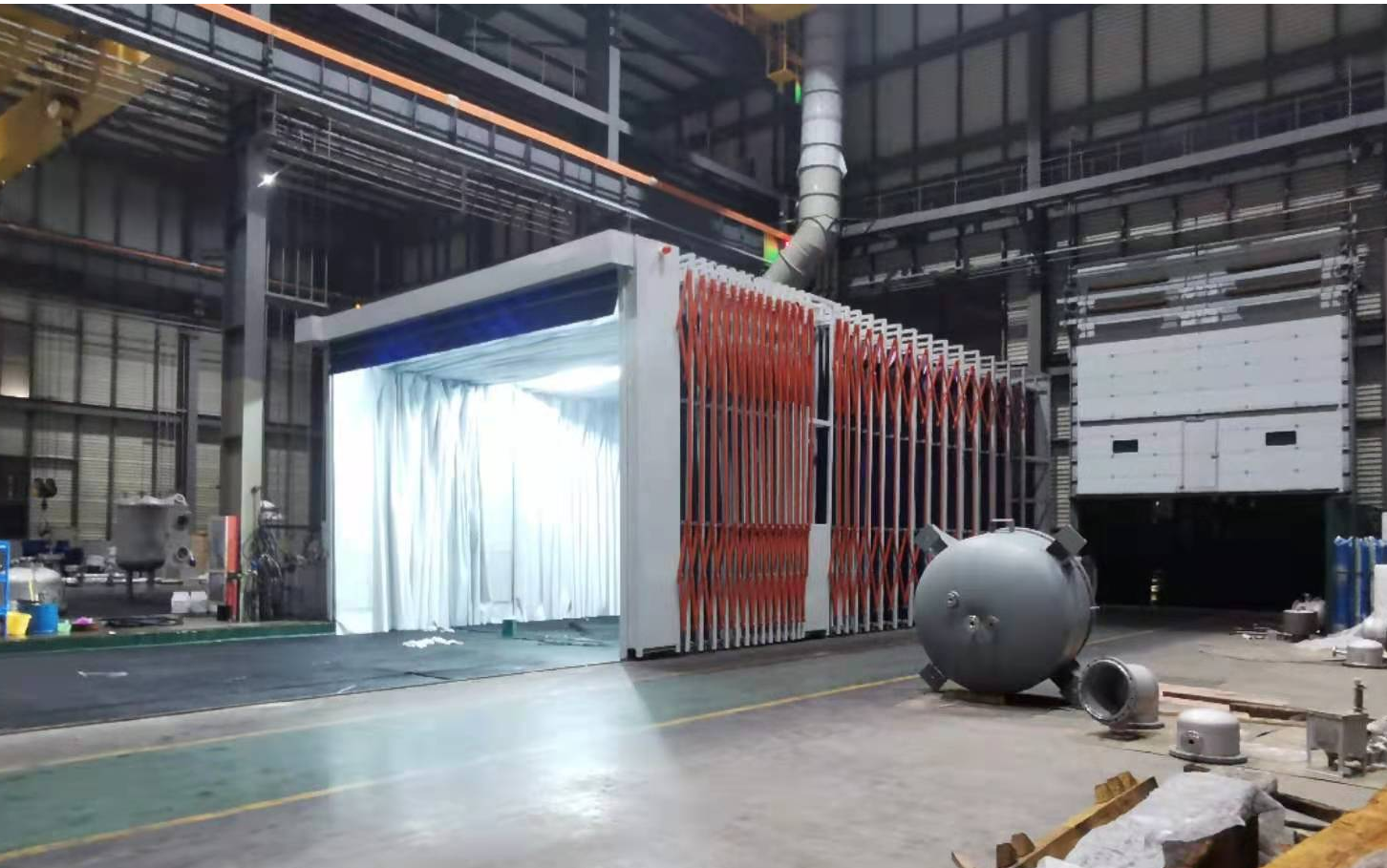
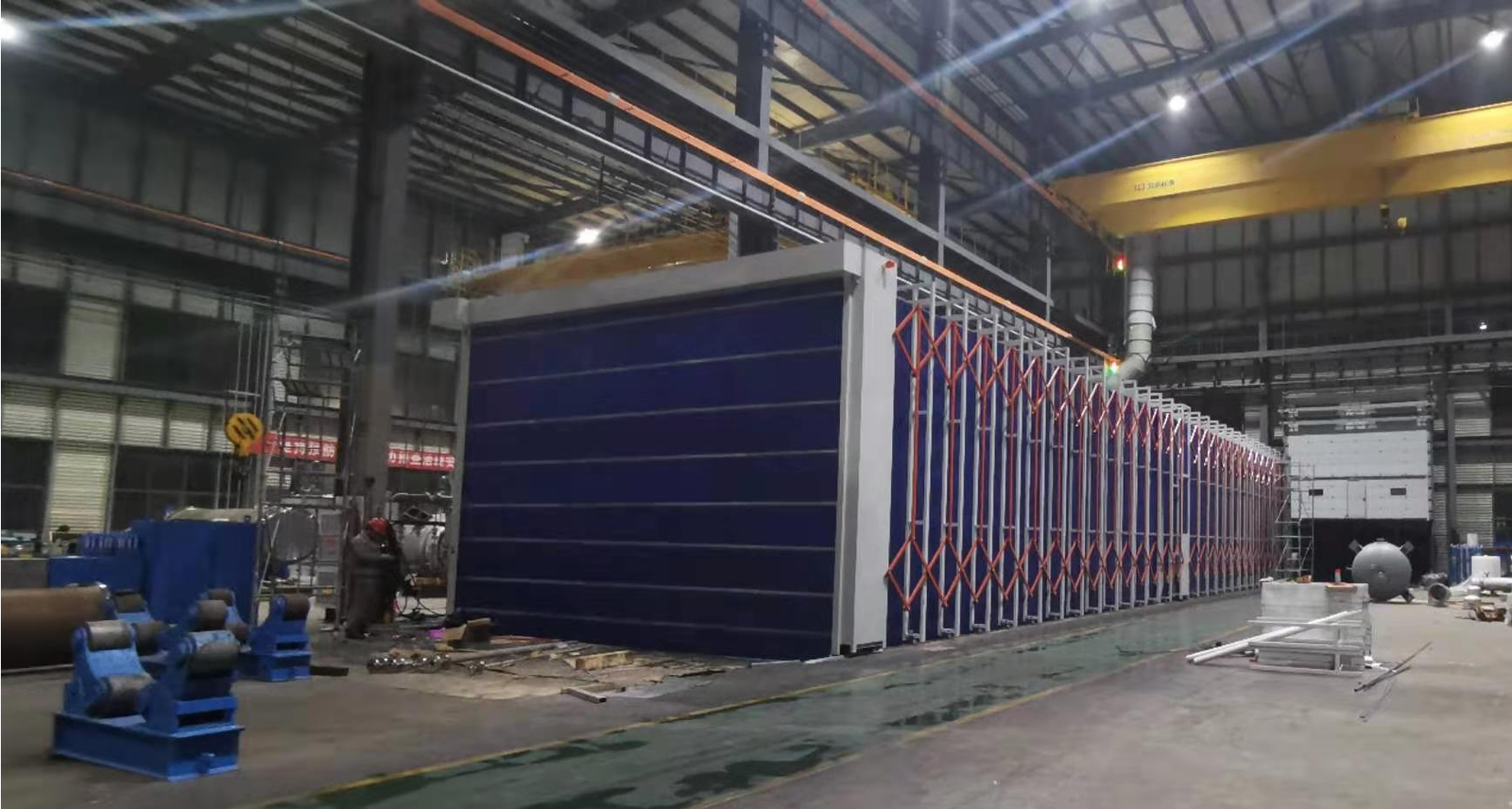
Application References
Pressure vessel and tank builders, machinery and crane manufacturers, shipyards and any liquid spray booth with daily painting where filter waste and catalyst protection matter.
Engineering Commitment
Every unit is engineered against a written performance specification. Mist capture, airflow, pressure drop and noise are stated in the contract and demonstrated at commissioning. One engineering team owns the booth, the capture stage and the exhaust treatment behind it, so the three are sized as one system.
Service & Delivery
Standard configurations ship in 30-60 days with a 12-month full-machine and 36-month critical-component warranty. On-site installation, commissioning and operator training are available worldwide, and filter media, oil and carbon supply continue for the working life of the unit. Structural parts are covered for up to 60 months.
Frequently Asked Questions
When is oil film better than dry filters?
When the booth paints every day: the oil is drained and replaced instead of filters being thrown away, the pressure drop stays stable, and the clean air protects a carbon or catalyst stage downstream.
Does it replace VOC treatment?
No. It removes the paint droplets; solvent vapour still goes to carbon, UV or RCO treatment behind it.
How many units does a booth need?
Follows the booth cross-section and airflow; a 12 x 7 m booth at 0.3 m/s uses three units, a 13 x 5 m booth two.
What happens to the used oil?
It is drained into drums and handled as paint-contaminated waste under local rules; the sump is refilled with fresh oil.
What do you need for a quotation?
Booth width and height, daily paint consumption and paint type, and the treatment unit the air will go to.
Further Reading
- Dry filter, oil film or water curtain: which to choose
- VOC treatment: carbon, UV or RCO
- Telescopic mobile spray booth
- Catalytic oxidizer (RCO)
QQuestions buyers ask before ordering
quotation · price · lead time · installation · warranty
What information do you need to prepare a quotation?
Send part drawings or photos, the largest part size and weight, the material, the required output per shift, the paint or powder type and number of colours, and the available floor space, ceiling height and power or gas supply. MUSI engineers reply within 24 hours; a recommended configuration and quotation follow once your part data is complete.
How much does this equipment cost?
Budget depends on part size, throughput and the level of automation. Indicative ex-works ranges are published in our complete coating line cost guide; a configured quotation is prepared from your part data. Published indicative ex-works ranges: a complete powder coating line is roughly USD 75,000–230,000 semi-automatic, USD 200,000–600,000 for a standard automatic line and USD 600,000–2,000,000 for a high-throughput automated plant.
What is the lead time?
Standard configurations ship in 30–60 days from contract signing and down payment; custom configurations take longer. The delivery date is fixed in the contract.
Do you install and train operators overseas?
Yes. MUSI engineers carry out on-site installation and commissioning and give 3–5 days of operator and maintenance training. MUSI has delivered 800+ coating lines to customers in 36 countries.
What warranty and after-sales support are included?
12 months full-machine warranty, 36 months on critical components and up to 60 months on structural parts. International customers get 24-hour phone response and 72-hour on-site arrival; spare parts ship from the Changzhou headquarters.
Can the environmental equipment be supplied with the line?
Yes. VOC treatment (RTO, RCO, activated carbon, zeolite rotor), dust collection and paint wastewater treatment are supplied with the coating line under one contract; MUSI has equipped 50+ coating facilities whose projects all passed local environmental compliance reviews.