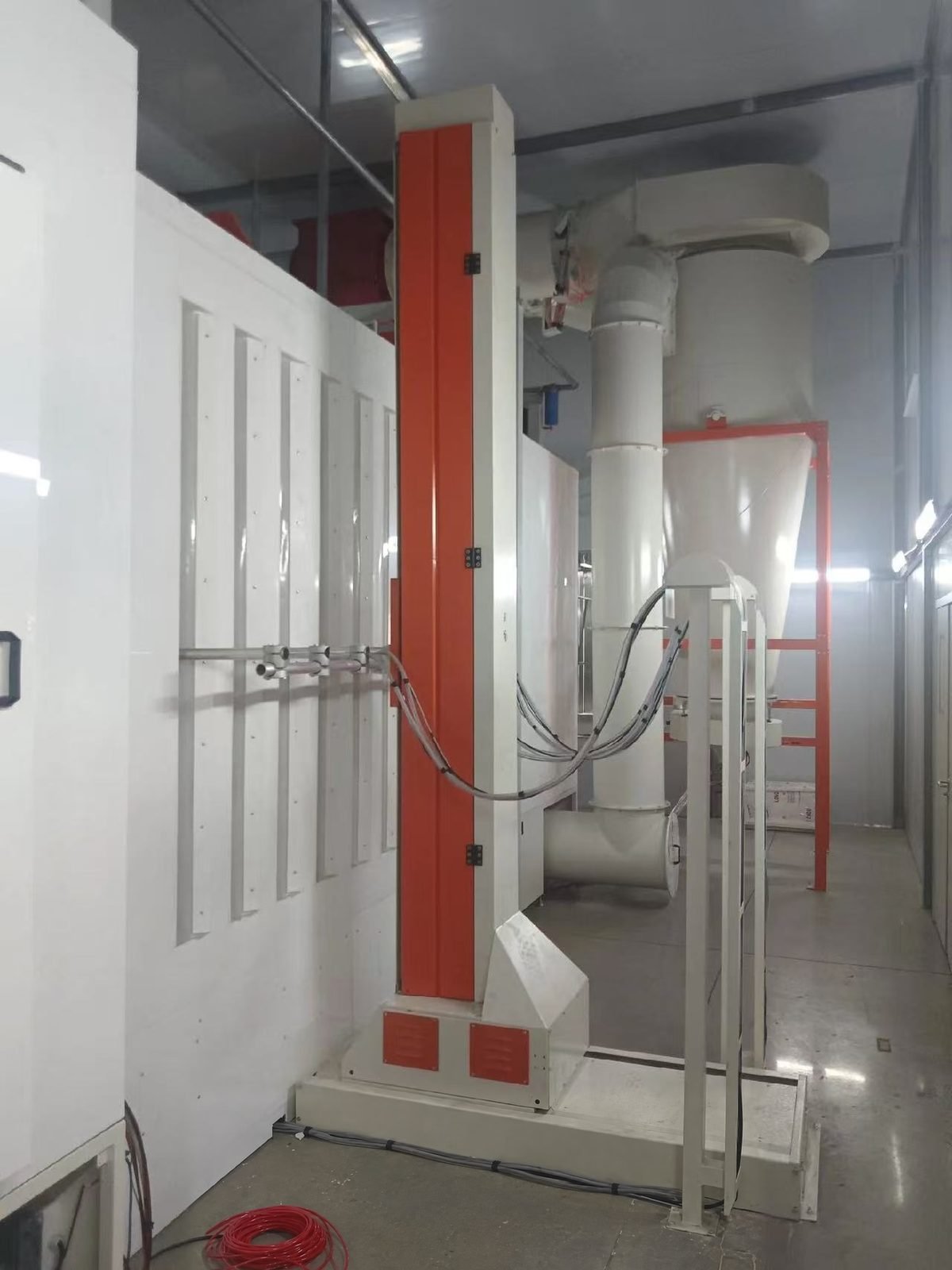
Automatic Powder Coating Line
An automatic powder coating line is a conveyorised turnkey powder coating system for manufacturers coating thousands of similar parts per shift: spray pretreatment, dry-off, automatic guns on reciprocators, powder reclaim and a curing oven holding parts at 180-200 °C object temperature.
Built for metal fabricators and OEM plants that need an automatic powder coating system: a continuous, recipe-controlled powder coating production line running at a fixed conveyor speed with reclaimed overspray and repeatable film build.
Technical Specifications
Values below are typical ranges for this equipment type. The figures for your line are fixed in the written specification after we review your parts, output and site.
| Line layout | Loading, 3- to 9-stage spray pretreatment, dry-off oven, powder booth, curing oven, cooling, unloading |
|---|---|
| Conveyor speed (published design examples) | About 0.6-3.0 m/min (2-10 ft/min); fixed by the longest dwell time and the required output |
| Spray pretreatment stage time | 1-2 min per cleaning or iron phosphate stage at 43-63 °C (110-145 °F), nozzle pressure from about 1 bar (15 psi) |
| Cure schedule (object temperature) | 12-24 min at 180 °C, 8-16 min at 200 °C or 4-10 min at 210 °C for a standard polyester; always per the powder data sheet |
| Curing oven air set point | 177-232 °C (350-450 °F), most ovens set near 204 °C (400 °F) |
| Film thickness | 60-90 µm recommended on powder data sheets; 50-75 µm (2-3 mil) common shop target |
| First-pass transfer efficiency | About 25-60 % depending on part shape; gun triggering and profiling add about 10 points |
| Powder utilisation with reclaim | 90 % or more overall; a cyclone passes about 3-5 % of overspray to the final filter as waste |
| Colour change, reclaim to reclaim | 30-45 min on older cartridge booths; 12-15 min on quick colour change booths; 5-15 min claimed for current fast-change systems |
| Booth opening face velocity | About 0.5-0.6 m/s (100-120 ft/min) average; powder concentration kept below 50 % of the minimum explosive concentration |
| Compressed air for powder | Oil 0.1 mg/m³ or less, pressure dew point about +3 °C or lower (ISO 8573-1 oil class 2, water class 4), 6-10 bar supply at the gun unit |
Line Configuration
- Multi-stage spray pretreatment tunnel with stainless tanks, risers, nozzles and drain zones
- Dry-off oven and convection curing oven with gas, electric or infrared heating
- Powder booth with automatic corona guns on vertical reciprocators plus manual touch-up stations
- Powder recovery: cyclone with after-filter for multi-colour work or cartridge module for single-colour reclaim, with powder feed centre
- Overhead conveyor (monorail chain or power-and-free) with drive, take-up, lubricator and earthed hangers
- PLC and HMI control cabinet with coating recipes, gap, height and width part detection and safety interlocks
What does each station of an automatic powder coating line do?
Parts stay on one conveyor from loading to unloading and pass each station at the same speed, so every station length equals conveyor speed multiplied by the dwell time it needs.
| Station | Function | Typical parameter |
|---|---|---|
| 1. Loading | Parts hung on earthed hooks or racks at a fixed pitch | Resistance from part to earth below 1 megohm |
| 2. Spray pretreatment | Clean, convert and rinse: combined clean/phosphate in 3 stages, separate cleaner and conversion coat in 5 or more | 1-2 min per chemical stage at 43-63 °C; 3 to 9 stages |
| 3. Dry-off oven | Remove rinse water before powder is applied | About 120-135 °C (250-275 °F) air temperature |
| 4. Cool before booth | Bring the part down so powder does not fuse on contact | Part below about 52 °C (125 °F) entering the booth |
| 5. Powder booth | Automatic guns on reciprocators coat the main faces, manual guns touch up recesses | Gun-to-part distance 200-300 mm; reciprocator travel 10-50 m/min |
| 6. Recovery | Extract overspray, separate powder from air, sieve and return it to the feed hopper | Reclaim blended at under 25 % of virgin powder by volume, about 15 % preferred |
| 7. Curing oven | Bring the metal to cure temperature and hold it | Bring-up time plus 8-16 min at 200 °C object temperature |
| 8. Cooling | Ambient run or forced-air tunnel so parts can be handled | Thin sheet 5-10 min; heavy sections need forced air |
| 9. Unloading | Inspect, measure film thickness, unhook and pack | Film 60-90 µm checked with a gauge |
How is powder coating line capacity calculated from conveyor speed and hanger pitch?
Hangers per hour equal conveyor speed times 60 divided by hanger pitch, and parts per hour equal hangers per hour times parts per hanger. The figures below are a generic worked example for illustration, not data from a MUSI project.
| Step | Formula | Generic worked example |
|---|---|---|
| Conveyor speed | Chosen so the slowest station still gets its dwell time | 2.0 m/min |
| Hanger pitch | Part width plus clearance so parts cannot touch on bends | 0.6 m |
| Hangers per hour | Speed x 60 / pitch | 2.0 x 60 / 0.6 = 200 hangers/h |
| Parts per hour | Hangers per hour x parts per hanger | 200 x 4 = 800 parts/h |
| Parts per shift | Parts per hour x working hours | 800 x 8 = 6,400 parts |
| Gap allowance | Add about 20 % to the speed for empty hooks and gaps between batches | 2.0 x 1.2 = 2.4 m/min design speed |
| Curing oven conveyor length | Design speed x (bring-up time + cure time) | 2.4 x (5 + 12) = 40.8 m of chain inside the oven |
Monorail, power-and-free or floor conveyor: which suits an automated powder coating line?
A monorail chain suits one part family on one fixed route; power-and-free is chosen when carriers must stop, buffer or take different routes; a floor conveyor is used for heavy parts.
| Criterion | Monorail overhead chain | Power-and-free | Floor conveyor |
|---|---|---|---|
| How it moves | One endless chain in an I-beam or enclosed track, all parts at one speed | Carriers on a free rail engaged or released by dogs on a powered chain | Chain, skid or inverted track at floor level carrying parts from below |
| Stop and accumulate | No, the whole line stops together | Yes, carriers buffer, switch tracks and stop for loading | Depends on design |
| Speed | Single speed through every station | Fast transfer and slow process speed on the same line | Usually single speed |
| Load guide | Enclosed track about 23 kg per pendant; I-beam about 91, 181 or 544 kg per trolley for 3, 4 and 6 inch track | Sized per carrier | High weight capacity |
| Oven and cooling footprint | Length equals speed x dwell | Diagonal banking of carriers shortens ovens and cooling zones | Length equals speed x dwell |
| Purchase and upkeep | Simplest and lowest | Higher price and more maintenance | Takes floor space and is harder to re-route; easy maintenance access |
| Typical use | One product family, steady volume | Mixed parts, several booths or recipes, long or heavy parts loaded at a standstill | Heavy parts such as items of several hundred kilograms |
Components
Key components are available from international brands such as Gema, Nordson and Wagner for powder guns, reciprocators and feed centres (configurable per customer specification). The same applies to PLC and HMI (Siemens, Allen-Bradley, Mitsubishi Electric), part-detection light grids (SICK, Pepperl+Fuchs), oven burners (Riello, Weishaupt, Maxon), circulation and exhaust fans (ebm-papst, Ziehl-Abegg), conveyor gearmotors (SEW-Eurodrive, Nord), pretreatment pumps and nozzles (Grundfos, Spraying Systems Co., Lechler), pretreatment chemistry (Henkel Bonderite, Chemetall) and oven temperature profiling (Datapaq from Fluke Process Instruments).
Application References
Built for steel and aluminium components made in volume: sheet-metal cabinets and enclosures, shelving and racking, appliance panels, lighting housings, furniture frames, agricultural and automotive components, wire goods and aluminium profiles.
Engineering Commitment
Every line is engineered against a written performance specification. Line speed, cure profile, film build and emission level are stated in the contract and demonstrated on your own part at the factory trial run before shipment. One engineering team owns the whole chain — pretreatment, application, curing, conveying and emission control — so the trade-offs between them are settled on the drawing board, not on your factory floor.
Service & Delivery
Standard configurations ship in 30-60 days with a 12-month full-machine and 36-month critical-component warranty. On-site installation, commissioning and operator training are available worldwide, and process tuning and spare parts support continue for the working life of the line.
Frequently Asked Questions
How fast does an automatic powder coating line run?
Published design examples for conveyorised powder lines sit between about 0.6 and 3.0 m/min (2-10 ft/min). The speed is not chosen freely: it follows from the parts per hour needed and the hanger pitch, and each oven and washer stage must then be long enough to give its dwell time at that speed.
How much powder does an automated powder coating system actually use?
First-pass transfer efficiency ranges from roughly 25 % on wire goods to 60 % on flat panels. With a reclaim system returning overspray to the feed hopper, overall utilisation of 90 % or more is achievable, and a cyclone loses about 3-5 % of the overspray to the final filter. Reclaim is normally blended at under 25 % of virgin powder by volume.
How long does a colour change take on an automatic powder coating line?
Older cartridge booths take 30-45 minutes reclaim to reclaim. Quick colour change booths with non-conductive walls, a cyclone and automatic gun purging reach 12-15 minutes, and gun makers quote 5-15 minutes for current fast-change systems. Plants with only one or two colours can use dedicated cartridge modules and avoid cleaning altogether.
What utilities does an automated powder coating line need?
Compressed air, electricity and usually gas. Gun makers specify oil of no more than 0.1 mg/m³ and dry air: a pressure dew point of about 3 °C or lower with 0.3 µm filtration, which is ISO 8573-1 oil class 2 and water class 4. Gas or electricity heats the washer tanks and ovens; electricity drives fans, pumps, conveyor and controls.
What does a turnkey automatic powder coating line cost?
Figures published on this site are USD 200,000-600,000 for a standard automatic line and USD 600,000-2,000,000 for a high-throughput line; compact semi-automatic lines start from about USD 45,000. Part size, conveyor speed, number of pretreatment stages and colour change equipment move a quotation within these bands.