Powder Coating Racks and Hangers: Design Guide
Quick answer: A powder coating rack must hold the part, earth it, present it to the guns, fill the line and survive washer, oven and stripping. Published guidance puts optimum line density at about 50 % of the projected envelope area, part gaps at 1 to 1.5 times part width (up to 2.5 times depth for boxes on automatic lines) and hook contact cleaning at every four to eight cycles. Square or diamond wire hooks contact on an edge for steadier earthing. Rack weight must fit the conveyor rating per trolley and is part of the oven heat load.
MUSI Technology, a powder and liquid spray coating line manufacturer in Changzhou, China, fixes the part window, hanging pitch, load per trolley and earth path at layout stage, so that the conveyor, washer, booth openings and oven heat load are all sized around the racks and carts the customer will run.
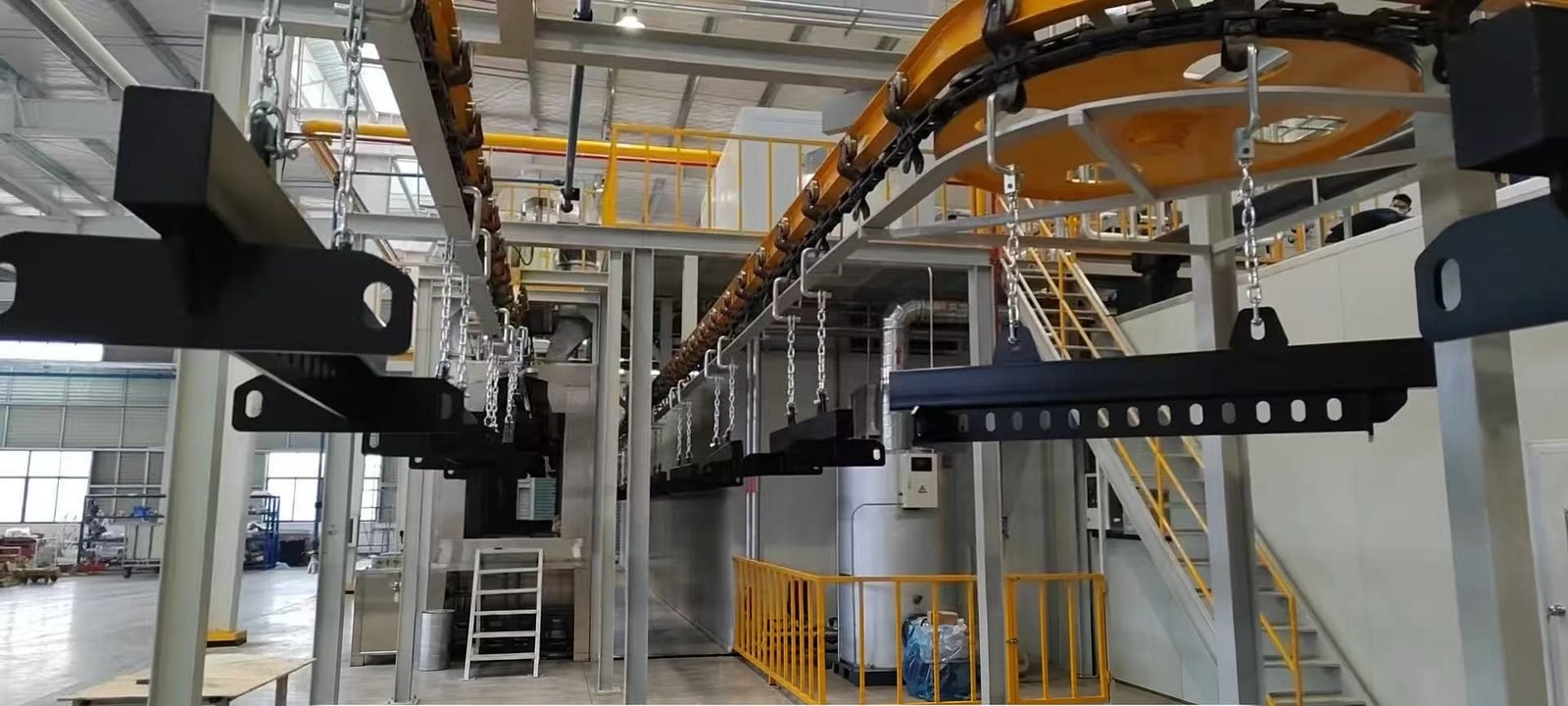
What does a powder coating rack have to do?
A powder coating rack has to hold each part securely, connect it to earth, present its surfaces to the guns, fill the conveyor, drain the washer and survive the ovens and the stripping process. Trade sources name rack density as the factor with the largest effect on cost per part, because every hourly line cost is divided by the number of parts hanging.
| Design rule | Reason |
|---|---|
| Hold the part at the same point and in the same position every cycle | Repeatable film build for automatic guns; parts must not swing into each other or the frame |
| Use sharp, minimal contact points in non-visible areas | Reliable earth through a small clean area and a small hook mark |
| Keep the number of links between conveyor and part low | Every joint is a place where cured powder can break the earth path |
| Angle the part so cavities drain | Less carry-over between washer stages and no water spots after dry-off |
| Group parts closely without touching | A high ratio of metal to air raises transfer efficiency and output |
| Make hooks removable | Hooks can be swapped several times before the whole rack is stripped |
| Keep rack mass low for the load carried | The rack is reheated on every pass through the oven |
Which hook and rack types suit which parts?
Single wire hooks suit parts with a hole and low volumes; multi-point racks on a load bar suit repeat production where density matters. Hook wire is spring steel. Square wire formed on edge, sold as diamond or square hooks, touches the part along a corner, which suppliers describe as giving steadier earthing over more cycles and a smaller hook mark. Racks cleaned in a burn-off oven need spring-grade stainless steel springs, because ordinary springs anneal at burn-off temperatures of about 800 °F (427 °C).
| Type | Typical use | Strength | Limitation |
|---|---|---|---|
| Round-wire C, S or V hook | Parts with a hanging hole, mixed work | Low cost, quick to load | Larger contact area, earth lost sooner as powder builds |
| Square or diamond wire hook | Parts needing a small mark and steady earth | Edge contact; one supplier’s load tests show almost double the capacity of its standard V or C hooks | Still needs periodic stripping |
| Two- or three-point spring-tension hook | Light parts that would swing or lift in the washer | Holds position; three-point hooks keep density | Made for a part family |
| V-shaped bottom hook | Heavy parts | Centres the part more positively than a U shape | Needs a suitable hanging feature |
| Welded dedicated rack | One part in high volume | Highest density and repeatability | No flexibility; repairs need welding |
| Adjustable crossbar rack with replaceable hooks | Changing part mix | Quick change of hook pitch and style | More joints to keep clean |
| Rotating or spin hook, powered rotator | Round parts such as wheels and discs | All-round coverage without stopping the line | Bearing must be shielded; added cost |
| Batch cart or trolley | Batch booth and box oven | Parts are loaded once and rolled from booth to oven | Needs a smooth floor so powder is not shaken off |
In one published case, replacing daisy-chained hooks (12 parts per load bar) with adjustable racks (40 per load bar) raised output from 600 to 2,000 parts per cycle. Ball-bearing spin hooks are catalogued with load ratings up to 250 lb (about 113 kg), and a published powered rotator installation turns parts at around 50 rpm in front of the guns.
How far apart should parts hang on a powder coating rack?
Parts should hang as close together as possible without touching, and deep parts need a gap related to their depth so that powder can reach the side faces. Published rules of thumb differ, so spacing is confirmed by trial on sample racks.
| Guidance | Published figure | Source type |
|---|---|---|
| Line density for powder | About 50 % of the projected area of the part envelope | Products Finishing |
| Gap between deep parts such as electrical boxes, fully automatic line | 2.5 times the depth; 1.5 times may be enough in some cases | Products Finishing |
| Gap between parts, general | 1 to 1.5 times the part width | Powder Coating Institute expert column |
| Gap between centre-hung racks on the steepest incline or decline | About 1 inch (25 mm) | Products Finishing |
| Clearance to washer, booth and oven openings | 3 inches (76 mm) top and bottom | PCI Magazine |
Parts hung too closely shield one another electrostatically, like a Faraday cage area, and film build becomes uneven. When only one face is coated, hanging parts back to back raises density without that penalty.
How often do hooks and racks need stripping?
Hook contact points generally need cleaning every four to eight cycles to keep the earth path between hook and part. Cured powder is an insulator, so the limit of 1 megohm from part to earth is lost at the contact first. Burn-off, chemical stripping and blasting are the usual methods, covered in the article on earthing parts and racks. Parts that shift or wobble, rising rejects and growing cleaning time signal that a rack should be replaced.
Masking belongs in the rack design. Permanent steel masks can be built into the rack and stripped with it, while plugs, caps and tape are chosen by temperature rating: one supplier’s guide lists silicone to 250 °C, high-temperature vinyl to 170 °C, EPDM and polyester to 150 °C, glass cloth tape to 180 °C and polyimide tape to 260 °C.
Which conveyor and oven limits should the rack be checked against?
A loaded rack must stay inside the conveyor load rating per trolley, the part window of every opening and the oven heat load. Rack weight counts twice: it uses conveyor capacity, and it is heated to cure temperature on every circuit along with the parts and chain, so the oven burner is sized on product plus rack and conveyor mass per hour. As an example of published ratings, one I-beam monorail range is listed at 200 lb per trolley on 3 inch track, 400 lb on 4 inch and 1,200 lb on 6 inch, doubled when a load bar spans two trolleys, and an enclosed-track range at 50 lb per pendant.
| Check before ordering a line | What to define |
|---|---|
| Part window | Largest part plus rack, width x height x length in travel direction |
| Load per hanging point | Heaviest part plus rack against the trolley or load bar rating |
| Line density | Parts per rack and rack pitch at the design line speed |
| Earth path | Number of joints from part to rail; where a megohmmeter test point sits |
| Washer | Drain angle, hold against spray pressure, parts that could float or trap solution |
| Oven | Mass of racks and chain per hour included in the heat load |
| Stripping | Method, interval and number of spare hook sets |
| Masking | Plugs, caps or built-in masks and their temperature rating |
Key components are available from international brands such as PACLINE for overhead conveyor track, chain and trolleys, SEW-Eurodrive and Nord for conveyor drive gearmotors, and Caplugs and Essentra Components for hooks and masking plugs (configurable per customer specification). The hanging design is settled together with the overhead chain conveyor, the pretreatment washer and the curing oven, which share one part window.
FAQ
What are powder coating hooks made of? Most powder coating hooks are spring steel wire, round or square. Where racks are cleaned in a burn-off oven, spring elements should be spring-grade stainless steel, since ordinary spring steel anneals and loses tension at burn-off temperatures of about 800 °F (427 °C).
Are square or diamond wire hooks better than round hooks? Square wire formed on edge touches the part along a corner, so the contact area is small and sharp. Suppliers describe steadier earthing over more cycles, a smaller hook mark and, in one supplier’s tests, almost double the load capacity of its standard V or C hooks.
Can the same racks be used for batch and conveyor lines? The hooks and crossbars can be shared, but a batch line hangs them on a cart or trolley that rolls from booth to box oven. The cart route should be short and smooth, because shaking can dislodge uncured powder or drop parts.
How do you hang round parts for powder coating? Round parts such as wheels and discs are hung on spin hooks with a ball bearing, turned by hand in a manual booth or by a powered rotator on an automatic line. Small cylindrical parts can also run on a chain-on-edge conveyor with rotating spindles.
Where MUSI Technology fits
MUSI Technology designs the conveyor, openings and oven around the customer’s part window and hanging method, and can supply load bars, racks and batch carts with the line. See the manual powder coating line for cart-based batch work or the powder coating line guide for conveyorised layouts.
Provided by Lin Cong, Technical Director, MUSI Technology
Send us your part size, throughput and coating type — our engineers reply with a layout and budget within one working day. Contact MUSI Technology or browse our equipment range.
Related technical guides
- Automotive Parts Coating Line: Spec & Throughput
Automotive coating lines must hold film build within plus or minus 10 microns, pass 500-1,000 h salt spray and meet OEM appearance standards. - Powder Coating Line: Types, Specs & Cost (2026)
A powder coating line pretreats, coats and cures metal parts on a conveyor. Full guide to line types, key specifications and 2026 price ranges. - Powder Coating Pretreatment Line: Stages & Cost
A pretreatment line degreases, rinses and chemically converts the metal surface before coating. Three, five and seven-stage layouts, phosphate versus. - BESS Container Coating Line: Spec & Corrosion
Battery energy storage containers need C4 to C5-M corrosion protection: shot blasting to Sa2.5, zinc-rich primer and weather-resistant polyester topcoat. - EV Battery Pack Housing Coating Line: Specs & Cost
Battery pack housings need dielectric strength, thermal stability and corrosion life in one coating. Powder versus liquid compared, film build targets,.